S. Korean companies express hope to explore new business opportunities through in-depth cooperation with China
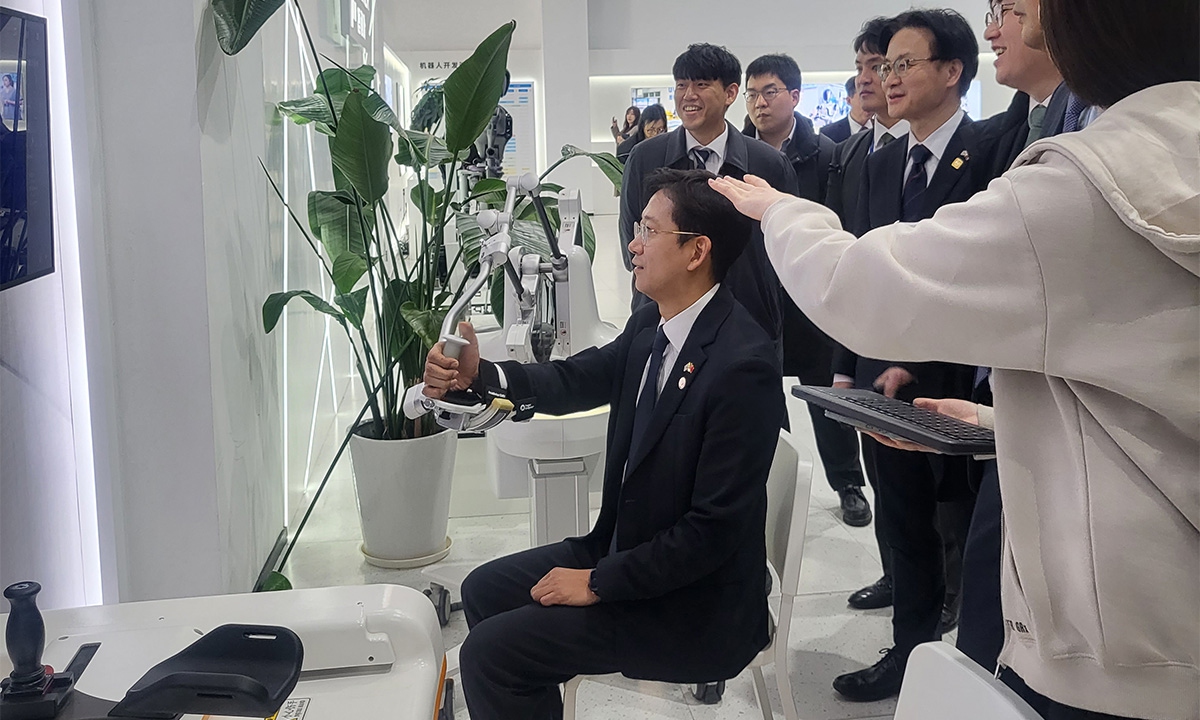
A delegation of South Korean government visits Shanghai Fourier Intelligence Co on January 6, 2026. Photo: Courtesy of KIC China
A high-profile economic delegation comprising over 200 South Korean entrepreneurs wrapped up a journey to China on Wednesday. During their visit, South Korean business leaders participated in various high-level forums, engaging in in-depth dialogues and brainstorming sessions with Chinese counterparts on topics such as industrial collaboration and technological innovation.
Multiple South Korean business leaders told the Global Times that the visit sends a clear signal that "South Korean companies view China as a core strategic market and hope to discover new growth opportunities through in-depth cooperation with China."
Lee Whan-chul, founder of South Korea's L&C Bio, a member of the delegation, told the Global Times on Thursday that the visit allowed him to truly sense the emphasis both sides place on deepening economic and trade cooperation. He said the meeting between the two heads of state in Beijing "sent a positive signal and significantly bolstered the confidence of the South Korean business community in investing in China. I believe this will mark a new beginning for long-term cooperation between China and South Korea."
As early as 2020, L&C Bio reflects its firm commitment to the Chinese market by establishing its Chinese legal entity in Kunshan, East China's Jiangsu Province.
"Traveling from South Korea to Kunshan is as convenient as going to Jeju Island," Lee said, highlighting the geographical advantage of China and South Korea being "close neighbors" as well as the local pool of high-quality talent and the exceptionally meticulous and proactive support from the Chinese government. Looking ahead, Lee said that the company has already formulated plans to expand investment and factory facilities in Kunshan, aiming to achieve large-scale sales in the Chinese market starting from 2027.
In an interview with the Global Times, Ahn Jung-hyun, founder of South Korean tech firm C&S, emphasized his close bond with China as he once studied in Shanghai for six years and once worked in a Chinese company. "I have a most intuitive perception of China's industrial ecosystem and market vitality. This place has long been the indispensable soil for my entrepreneurial journey," he said.
For this trip, Ahn's primary objective is to upgrade cooperative relationships, transitioning from a short-term contract model to medium-to-long-term business partnerships.
Against the backdrop of intensifying uncertainties in the current global trade environment, the Chinese market is demonstrating unique value, Ahn said. "For tech enterprises, China's advantages in market scale, the speed of commercialization, and the supporting manufacturing infrastructure make it an irreplaceable strategic market," he said, noting that the presence of over 200 South Korean entrepreneurs in China proves that this is not "a consideration focused on the short term, but rather a manifestation of the firm determination of those South Korean companies to discover new growth opportunities through in-depth cooperation with China."
Since the establishment of diplomatic ties in 1992, China and South Korea have built deeply integrated industrial chains and supply networks, forming a mutually beneficial economic partnership that has weathered multiple global shocks. This foundation is still one of the most resilient pillars of regional economic cooperation.
The year 2025 marked the 10th anniversary of the China-South Korea Free Trade Agreement. According to China's General Administration of Customs, bilateral trade volume reached $298.9 billion during the January-November period last year.
Park Sun-kyung, chief representative of the Korea International Trade Association Shanghai Office, told the Global Times that she has observed a "clear trend of warming and positive momentum" in South Korea-China economic and trade cooperation across multiple levels.
Park noted that in 2025, various South Korean local governments and economic organizations intensively organized business delegations to visit China, holding economic and trade matchmaking conferences with Chinese provinces and municipalities such as Shanghai, East China's Shandong Province, Jiangsu, and South China's Guangdong Province.
She further noted that South Korean corporate investment in China is transitioning toward "high technology and green development." Several leading South Korean battery companies continue to expand their production and R&D investment in new energy vehicle battery materials and hydrogen energy equipment in China, with an increasing number of cooperation projects alongside local Chinese automakers and energy firms.
On Tuesday, Bae Kyung-hoon, deputy prime minister and minister of science and ICT of South Korea, led a delegation comprised of South Korean research institutes to visit tech centers and companies in Shanghai, including the Zhangjiang Science City, the Huawei Lianqiu Lake R&D Center, the Zhangjiang Robot Valley, Shanghai Fourier Intelligence Co, and Shanghai Agibot New Creation Technology Co.
"Through the visit, we gained a more intuitive and profound understanding of China's development, particularly its technological strength and business environment," Kim Jong-moon, chief representative of the Korea Innovation Center (KIC China), who is a member of the delegation, told the Global Times.
China and South Korea share deep-rooted foundations in geographical proximity, industrial chains, and people-to-people exchanges. Looking ahead, by deepening collaborative innovation in high-tech fields and leveraging respective comparative advantages in their global footprint, we are fully capable of elevating China-South Korea cooperation to a new height and achieving genuine mutual benefit and win-win outcomes, Kim said.
RELATED ARTICLES