Thought lights path toward the new: Dialogue with Yang Peng, Party secretary and chairman of Chuyuan Group
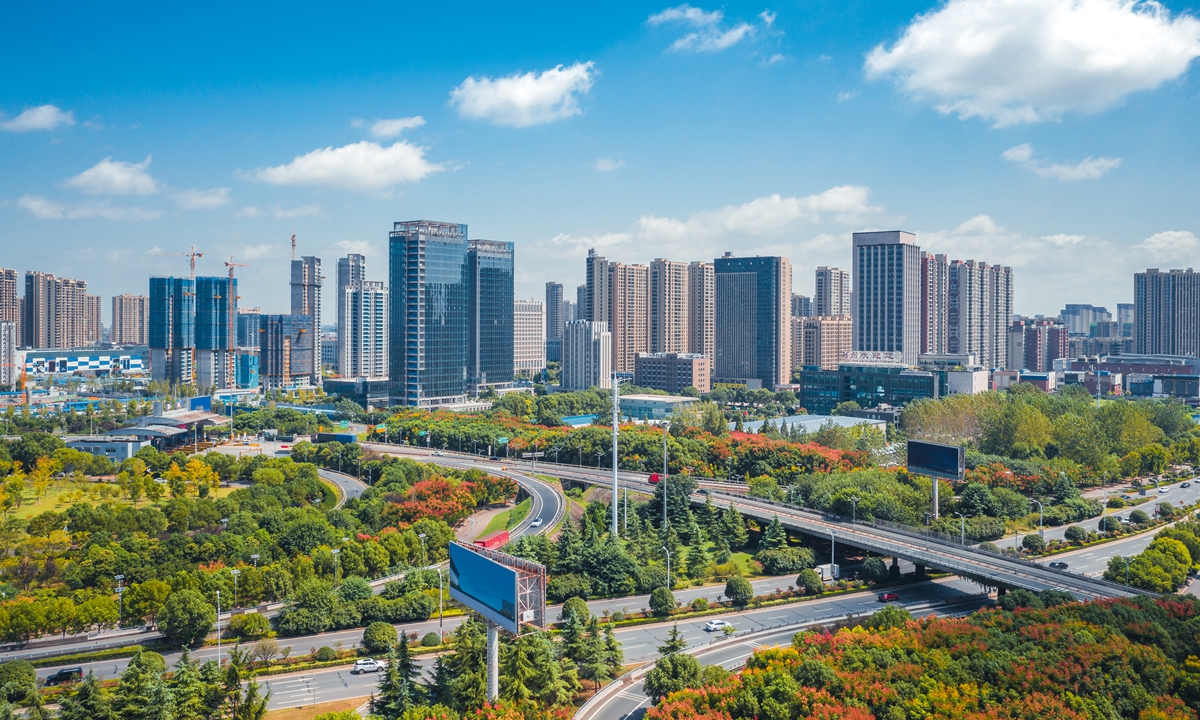
An aerial view of Shabei New District in Jingzhou, Central China's Hubei Province. File photo: VCG
Editor's Note:
The People's Daily front page on Monday published an article titled "The tale of Old Yang, Young Yang's 'shift' in mindset." Recently, focusing on the topic of studying, thinking, practicing and reflecting on Xi Jinping Thought on Socialism with Chinese Characteristics for a New Era, People's Daily reporters (PD) conducted an interview with Yang Peng (Yang), Party secretary and chairman of Chuyuan Group, the "Young Yang" featured in the article on Monday.
'With clear thought, obstacles yield'
PD: In 2016, Chuyuan received an "astronomical fine" for environmental protection violations and was ordered to halt production for rectification. Looking back on it a decade later, how do you view this major setback?
Yang: If we look at the short-term costs, a fine of over 27 million yuan ($3.86 million) and nearly 10 months of suspended production represent significant losses. But in the long run, ignoring ecological security and blindly pursuing rapid expansion would have eventually led to the company's collapse.
Looking back today, I am grateful to the Party and the government. We made mistakes, and the provincial and municipal Party committees and governments helped us correct them, treating us as "one of their own." The relevant departments were meticulous in their supervision where required, and equally dedicated in providing services where needed.
This has also prompted me to rethink: What exactly does the era demand from the private economy? My father's generation mainly focused on solving the issue of "whether we have it or not," emphasizing the number and scale of enterprises. Today, the pursuit of high-quality development means "whether it is good or not," meaning high quality and sustainability are not mere slogans but factors that determine the life or death of enterprises.
PD: Your open-mindedness toward that penalty reminds us of our first meeting in 2022, when you were not as composed as you are today.
Yang: At that time, my mind was not entirely clear. In 2022, Chuyuan's sales revenue hit rock bottom, and I even considered switching to a new track.
In 2023, the National Conference on Ecological and Environmental Protection was held in Beijing. Xi Jinping, general secretary of the Communist Party of China (CPC) Central Committee, Chinese president and chairman of the Central Military Commission, attended the conference and delivered an important speech. He said that "we must accelerate the green transformation and upgrading of industries."
The General Secretary's words immediately steadied my mind. With clear thought, obstacles yield. Without technical reserves, blindly chasing the trend into new energy would just be herd behavior and reckless rushing; steadfastly focusing on our core business without distractions is the right path for us.
Developing new quality productive forces
PD: Clearly, Chuyuan is on the right path now. Now that you have a steady mind, how should development proceed?
Yang: The Party's innovative theories contain invaluable treasures, and private enterprises cannot afford to be "thought slackers." General Secretary Xi has emphasized "developing new quality productive forces in light of local conditions." We have repeatedly studied and reflected on this statement, gaining immense benefits from it.
We must not pit new quality productive forces against traditional industries. The upgrading and transformation of traditional industries can also foster new quality productive forces.
Take our peer Xingfa Group as an example. In the past, for us who are in fine chemicals industries, we actually looked down on fertilizer and pesticide producers. But they studied and applied the new development philosophy early and effectively, successfully transforming itself to produce food-grade products, opening up new application fields.
Another example is our close neighbor, Xianhe Corp, which turned reeds along the Yangtze River into specialty paper products used in high-end fields like electronics, medical, and aerospace, truly translating lucid waters and lush mountains into invaluable assets.
Transformation does not mean completely switching industries. Seizing green opportunities, you could turn gourd into a treasured tower. In recent years, we have continuously increased investments, in order to firmly pursue green development and strengthen the circular economy.
Full confidence in real economy
PD: Some claim that now is not an opportune time to invest in the real economy, and that "holding cash is the best choice." Chuyuan has cumulatively invested 230 million yuan in 2024 and 2025, and plans to invest 400 million yuan in 2026. In pressing ahead despite pressure, where does the confidence come from?
Yang: All the private enterprises I interact with are full of confidence in the real economy and manufacturing. China's population of over 1.4 billion people means 1.4 billion customers. As long as there are people, they need to wear clothes, and when life gets better, they want to change clothes. Real demand will not disappear, and the vast market is real - this is our greatest source of confidence.
In recent years, China's "large-scale equipment upgrades and trade-in of consumer goods" policies have supported equipment upgrades, providing rewards in lieu of subsidies to promote technological transformation, digital empowerment, and low-carbon transformation. These are policy dividends that the country has given us, and we cannot afford to miss them.
Manufacturing is facing difficulties at present, but this is cyclical. Being in a trough does not mean the future is bleak. Having stumbled before, we now know better to look up and see the road ahead.
Many traditional manufacturing sectors, including chemicals, are also technology-intensive industries. If we persist in pursuing high-end, green, and intelligent development, and act as patient capital, time will not let us down. Take Chuyuan as an example. After weathering the setback of 2022, our sales revenue in both 2024 and 2025 grew at around 15 percent, showing our company is moving toward new and better directions.
PD: Seeing Chuyuan currently full of confidence in its transformation and upgrading, who would have thought that back in 2016, you were worried that the "sky-high fine" was selective enforcement. Do those concerns still exist today?
Yang: From the implementation of the new Environmental Protection Law to the steady advancement of the Private Economy Promotion Law, we clearly feel that the political ecosystem and business environment are vastly different from before. The starting line for everyone is getting closer and closer. When encountering issues, we don't look for personal connections first - we read the law first as the boundaries are clearer. When spotting market opportunities, if the law doesn't prohibit it, we boldly try and bravely innovate as expectations are more stable.
PD: What you just mentioned is precisely the significance of accelerating the construction of a unified national market. As China addresses involution-style competition, some enterprises may lose their previous special policy treatment. Is that regretful for businesses?
Yang: Special policy treatment is often not a free lunch, but a trap. Rule of law is the best business environment. Recommendations for the 15th Five-Year Plan (2026-30) called for efforts to "address rat race competition through holistic measures," and we are particularly looking forward to it. Relying on expanding capacity and price wars drags others down to "half-death," while making oneself live in exhaustion. Only high-quality development can truly secure the initiative in development and create a win-win situation.
Right view of 'second-generation entrepreneur'
PD: The issue of succession in private enterprises has drawn broad attention. As "a second-generation entrepreneur," have you ever thought about lying flat or switching career to investing?
Yang: Running a business naturally comes with pressure, and the key is to build the ability to withstand pressure. Someone once advised me to shut down the factory and move into venture capital - after A, B, and C three rounds of financing, one could earn much more in a short time than in the manufacturing industry. I refused, because I thought of three scenarios:
My child asks me: "Dad, why did you abandon manufacturing back then? Did you give up simply because it was too difficult?"
My employees ask me: "Mr. Yang, what about our jobs? What should we do about our lives?"
My fellow townspeople ask me: "Young Yang, where has the Shishou brand that your father's generation worked so hard to build gone?"
The entrepreneurial spirit cannot end with the "second generation" - this is our fortune. At the same time, we must let go of burdens and move forward. "Second-generation entrepreneurs" should also be entrepreneurs driving high-quality development. The key is to establish a correct view of righteousness and profit. The ultimate goal of innovative, coordinated, green, and open development is sharing.
Why is it hard to recruit workers in manufacturing? Without a friendly environment, intelligent operations, or sufficient benefits, why would young people be willing to come to work? Enterprises must not just focus on winning in market competition but on achieving win-win outcomes in their relationships with nature and the community, allowing employees, customers, and nearby residents to share in the benefits of corporate development. That's exactly what I think it means to "combine investment in physical assets with investment in human capital."
PD: Looking back over the past decade, if you were to summarize the journey in one word, what would it be?
Yang: Rebirth. The rebirth of thought, and the rebirth of the enterprise. When thought is clear, all things become clear. As a micro-level entity, an enterprise must integrate itself into the broader landscape of national development - advancing with the times, pushing forward under pressure, moving toward innovation, and staying on track. In conversations with other entrepreneurs, what we talk about most is not our individual businesses, but how to keep pace with the broader development trend, that is, how to achieve high-quality and sustainable growth.
Actually, I'm quite curious myself. I'm not a major entrepreneur, why have you come to Chuyuan year after year for on-site reporting and conducted these in-depth interviews with me?
PD: You embody a strong sense of the times. In advancing Chinese modernization, the private economy is a vital force. Observing Chuyuan is like observing the thousands upon thousands of Chinese enterprises that have decisively broken with outdated development concepts, armed themselves with new ideas, undergone difficult transformations and upgrades, and resolutely pursued green development.
Yang: In the past 10 years since General Secretary Xi held a symposium on improving the development of the Yangtze River Economic Belt, Chuyuan Group has achieved a shift in mindset and a transformation in development. We are convinced that high-quality development is a defining principle of the new era, and we will unswervingly continue along this path.
This was compiled from an article originally published on the fourth page of the People’s Daily on January 8, 2026.
RELATED ARTICLES