Faced with hegemonic coercion, Europe can no longer pretend to be asleep: Global Times editorial
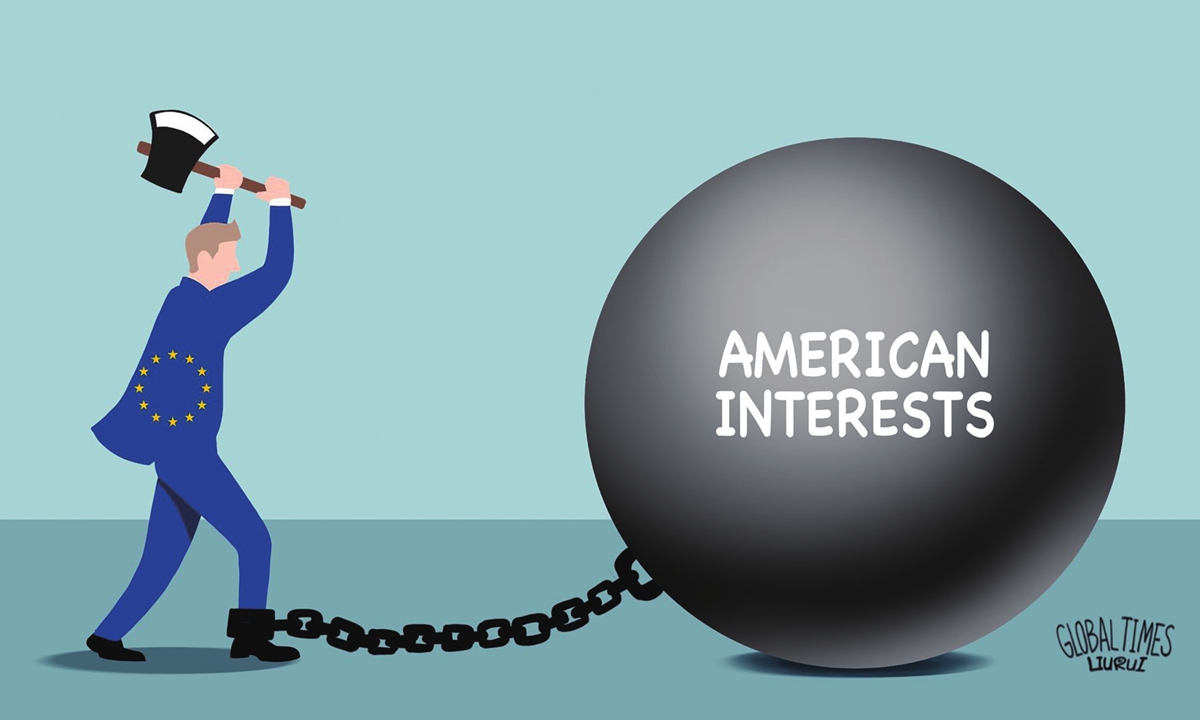
Illustration: Liu Rui/GT
Europe is facing a "soul-searching question" regarding the future of Greenland: Should it compromise with hegemonic requests or firmly defend its own sovereignty, interests and international rules? After the US' attack on Venezuela, it has put Greenland on its chopping board. Just as the European version of Politico said, "If European governments didn't realize before that Donald Trump's threats to seize Greenland were serious, they do now."
Now within Europe, many voices are discussing "what choices we have," and no matter how conflicted these voices may sound, the very notion of "facing choices" implies a degree of weakness and appeasement toward hegemony. This only reinforces Washington's determination to acquire Greenland. Europe's scattered and disjointed "opposition" regarding the Venezuelan crisis is perhaps one of the catalysts for Washington's recent escalation of threats against Greenland and its arrogant declaration that "Nobody's going to fight the United States militarily over the future of Greenland." The think tank, European Council on Foreign Relations, pointed out in an article, "Accommodating may preserve short-term transatlantic harmony, but it would reward coercion."
Faced with the rise of hegemonism and unilateralism, Europe has exhibited considerable hesitation and indecisiveness. This stems primarily from two illusions. First, it hinges on the hope that "the US will be better if a different party takes power"; second, it holds a wishful thinking that "Europe will not become the next target of bullying." This mentality reveals a harsh reality: Europe feels powerless to cope with various changes alone, and therefore regards its relationship with the US as a higher-priority "strategic asset" that must be carefully maintained. Consequently, some attempt to exchange compromises of principles for the preservation of their so-called core interests in the face of hegemonic behavior. This is a typical appeasement mentality, fantasizing about pacifying powerful forces through concessions.
However, Europe should no longer pretend to be asleep.
"Preserving Greenland" and "preserving the NATO alliance to ensure security" are not a one-or-the-other choice for Europe. Greenland's status as a key node in the transatlantic shipping route and a core area for Arctic resource development means that if it falls into US control, Europe may completely lose its voice in Arctic affairs. And this is by no means the end of the US taking advantage of Europe.
From coercing countries to increase NATO military spending and abandon energy cooperation with Russia, to forcing Europe to comply with US trade sanctions against China, the more Europe appeases hegemony, the more the hegemon will take advantage of it, thus accelerating the binding of Europe itself firmly to the hegemonic chariot and turning it into a pawn in the geopolitical game.
What Europe truly needs to ask itself is this: As a key pole in a multipolar world, how should Europe define itself?
Some in Europe resemble "geopolitical actuaries" who appear shrewd but end up calculating a profoundly muddled account. On matters of fundamental right and wrong, if Europe consistently responds to hegemonic behavior with appeasement and compromise, treats basic morality and conscience as tradable commodities, and places Washington's preferences above all else, it amounts to tacit acquiescence in, and complicity with, hegemonism and power politics. The consequences of unprincipled compromise came so quickly that Europe will swallow the bitter pill as Greenland faces occupation.
More profoundly, the core ideas and principles on which the EU has been built would be fundamentally shaken, putting at risk its image as a "defender of the international order and multilateralism." Respect for and protection of the sovereignty, security, and territorial integrity of all states is a widely accepted norm of international relations forged through the blood and fire of World War II. It is also the foundation and soul of the UN-centered international system and of an international order based on international law. Historical lessons have long written a painful verdict on appeasement.
In pursuing strategic autonomy, Europe is by no means without cards to play. As one of the world's largest economic entities, the EU possesses a vast internal market, an advanced industrial system, and deep-rooted multilateralist traditions, which together constitute its key sources of strength in countering hegemonism. Economically, Europe can further deepen internal market integration, reduce excessive dependence on the US financial system, and advance the internationalization of the euro. In the energy sector, it can adhere to a strategy of diversified cooperation and accelerate the deployment of renewable energy. Diplomatically, it should stop drawing ideological dividing lines and strengthen cooperation with emerging market countries such as China, and help build a multipolar diplomatic landscape. With a longer-term perspective, Europe has by no means reached a dead end.
If Europe truly regards "abiding by international law" and "upholding the purposes and principles of the UN Charter" as core values, it should take internationally recognized principles and norms as its guide, stand on the side of international justice and the historical trend toward multilateralism, rather than acquiesce in the erosion of fundamental principles and a return to a law-of-the-jungle world. In fact, at a time when European countries themselves are increasingly anxious and concerned about "hard power," what kind of outcome would there be in opening their arms to a Hobbesian world?
RELATED ARTICLES