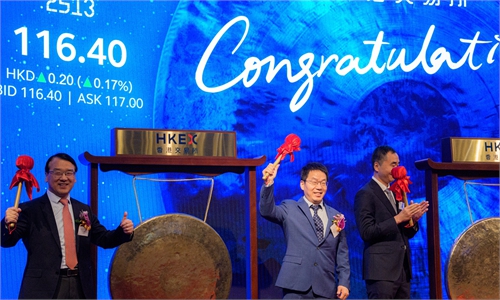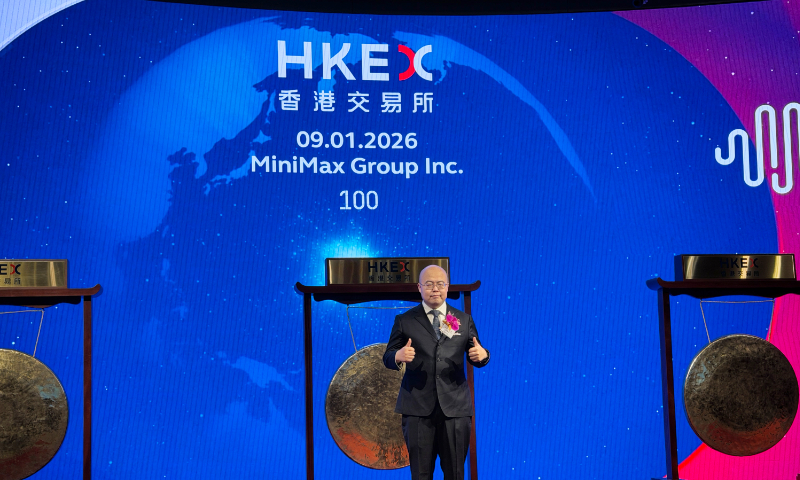
Yan Junjie, founder, chairman, and CEO of MiniMax Group Inc., attends the company's listing ceremony at the Hong Kong Stock Exchange in Hong Kong, on January 9, 2026. Photo: VCG
Chinese artificial intelligence (AI) start-up MiniMax saw its shares soar on their Hong Kong Stock Exchange (HKEX) debut on Friday, closing 109.1 percent higher, pushing the company's valuation to surpass HK$103 billion ($13.2 billion), underscoring strong investor enthusiasm bolstered by robust backing from major global institutions.
The initial public offerings (IPOs) of MiniMax, and AI start-up Zhipu, which debuted on HKEX on Thursday, showcased that China's domestically developed AI models are transitioning from experimental technology development to widespread commercial deployment, analysts said.
MiniMax's stock opened at HK$235.40 on Friday, a 42.7 percent premium over the IPO price of HK$165.
The listing raised HK$5.54 billion, achieved by pricing shares at the upper end of the range and expanding the offering to accommodate strong demand from institutional investors, MiniMax told the Global Times in a statement on Friday.
According to the allotment results released by the company on Thursday, the public offer portion oversubscribed MiniMax's IPO shares by 1,837 times, and the international tranche attracted 37 times subscription, showcasing that the market response to the offering was overwhelmingly enthusiastic.
The Shanghai-based 4-year-old AI startup positioned itself as possibly the fastest company to list after its founding.
The company said in the statement that it "completed its Hong Kong IPO only four years after its establishment, setting a new global record for the shortest time from founding to listing in the AI industry."
"The true value of an AI company lies in delivering a continuous stream of advanced intelligence that serves humanity, MiniMax will continue to strive for the advancement of intelligence and make greater contributions to social and economic development," said Yan Junjie, founder, chairman, and CEO of MiniMax, at the listing ceremony in Hong Kong on Friday, according to the company's statement.
MiniMax is a global leader in general artificial intelligence (AGI), having independently developed a series of full-modality large models, including MiniMax M2.1, Hailuo 2.3, Speech 2.6, and Music 2.0. It is one of only four companies worldwide to reach the top tier in full-modality capabilities, the company said.
As one of the world's four leading full-modal large model companies, MiniMax had over 212 million individual users across more than 200 countries and regions as of September 2025.
In the first nine months of 2025, the company's revenue grew by more than 170 percent year-on-year, with overseas markets contributing over 70 percent of total revenue, demonstrating outstanding global market expansion capabilities and a healthy, diversified revenue structure, the company said.
Knowledge Atlas Technology JSC Ltd, better known as Zhipu, which OpenAI publicly identifies as a rival, became the first Chinese AI large-language model firm to go public, as China's homegrown AI models move from technological exploration to large-scale commercial application, analysts said.
MiniMax, Zhipu and DeepSeek are known as China's "AI tigers."
Such stock market debuts will accelerate technological advancements and strengthen supporting ecosystems, further solidifying Chinese firms' competitiveness in global AI competition. The capital raised also enables international investors to share in the rapid growth of China's AI sector, Wang Peng, an associate researcher at the Beijing Academy of Social Sciences, told the Global Times on Friday.
This wave of listings highlights capital shifting toward high-value sectors - a clear snapshot of China's evolution from the "world's factory" to a global "innovation powerhouse," Wang noted.
"This round of technological revolution, led by AI, has indeed delivered tangible real-world applications. The deep integration of AI with multiple traditional industries is reshaping sector landscapes, enhancing profitability, and boosting production efficiency. This has led to elevated valuations for related tech companies at the application level," Yang Delong, chief economist at Shenzhen-based First Seafront Fund, told the Global Times on Friday.
Yang also pointed out that in contrast to the lofty valuations in US stocks, A shares and Hong Kong stocks remain below their historical average valuations overall.
Analysts voiced optimism about global capitals flowing into A-shares and Hong Kong stocks, driven by China's advancements in technological innovation.
"The enormous productive forces unleashed by the AI revolution have fueled sustained capital enthusiasm for leading tech stocks," said Yang.
RELATED ARTICLES