IN-DEPTH / IN-DEPTH
The US faces global condemnation, mixed reactions from ‘allies’ over raid on Venezuela
US strikes on Venezuela and its forcible seizure of Venezuelan President Nicolas Maduro and his wife have sent shockwaves across the international community. Condemnations over the wanton act - including from some US allies - have poured in, blaming the US for flouting international law and basic norms governing international relations.
On Monday, diplomats and foreign representatives convened a UN Security Council meeting to discuss the situation in Venezuela. It was the second time that the Security Council had convened a session recently to discuss actions that the US has taken regarding Venezuela that other nations said threatened the stability and security of the international order, The New York Times reported on Wednesday.
"It is unusual for there to be two meetings focused on US action," said Maya Ungar, a UN expert at the International Crisis Group. This, she said, "shows a pattern of increased American disregard for the tenets of the UN Charter," according to The New York Times.
"The international community has generally voiced strong opposition to and condemnation of the raid in disregard of international law, norms and basic principles governing international relations. Many countries have voiced opposition to the US' unilateral bullying foreign policy and self-serving economic and trade practices," Sun Yanfeng, director of Latin American research at the China Institutes of Contemporary International Relations, told the Global Times.
How is the international community reacting to the US' raid on Venezuela? What considerations are shaping different countries' responses? This article analyzes the varied international reactions and examines the incident's global implications.
Outcry from international community
Beyond Venezuela itself, particularly fierce opposition came from the country's Latin American neighbors as they, according to Sun, are especially concerned that the US may replicate this model of invading sovereign states and arresting their leaders elsewhere.
"Today it's Venezuela, tomorrow it could be anyone else," Chilean President Gabriel Boric said on January 3, raising alarm across Latin American countries over what they see as US hegemonic interference, the Xinhua News Agency reported.
Latin American experts and media outlets believe that US action against Venezuela aims to create a "chilling effect" to deter countries in the region, according to Xinhua.
On January 4, the governments of Spain, Brazil, Chile, Colombia, Mexico, and Uruguay issued a joint statement, expressing "deep concern and rejection of the military actions carried out unilaterally on Venezuelan territory," saying that "these actions constitute an extremely dangerous precedent for peace and regional security and endanger the civilian population," according to an English version of the statement released on the Colombian Foreign Ministry website.
Cuban President Miguel Diaz-Canel accused the US of a "criminal attack," according to the BBC.
Countries that emphasize international rules and uphold multilateralism in the world have expressed strong opposition to the US' move.
"The US move, a typical act of bullying, seriously violates international law, infringes upon Venezuela's sovereignty, and undermines the rights of the Venezuelan people," Chinese Foreign Ministry spokesperson Mao Ning said at a regular news briefing on Wednesday.
Venezuela's acting president Delcy Rodriguez on Thursday expressed gratitude to China for condemning US aggression against Venezuela and the seizure of Venezuelan President Nicolas Maduro and his wife, according to a post she published on Instagram.
Some regional organizations also stressed the importance of peace and stability citing the potential risks and challenges to Latin America and even global stability.
"The African Union (AU) underscores the importance of dialogue, peaceful settlement of disputes, and respect for constitutional and institutional frameworks, in a spirit of good neighborliness, cooperation, and peaceful coexistence among nations," read a statement by the AU released on its website on January 3.
In a statement published on the website of Liberia's Permanent Mission to the UN, Lewis G Brown, Liberia's permanent representative, said that the A3 members - the Democratic Republic of Congo, Somalia and Liberia - continues to monitor developments with deep concern. "Such developments present serious challenges not only to Venezuela's internal stability and underscore the imperative to safeguard the broader peace and security of the region," Brown said.
Complex reaction among 'allies'
In the US, hundreds of people took to the streets of Manhattan as early as January 3 to protest against the military operation in Venezuela, according to Xinhua.
The march was part of nationwide "No war on Venezuela" demonstrations held in more than 100 US cities, including Washington, Boston, Los Angeles, Atlanta, Chicago and Miami.
"This war is not about drugs, it is about Venezuela's oil," Karen, a middle-aged New Yorker in the march, told Xinhua. "How do you have the right to step in Venezuela, to attack Venezuela?" she said. "It feels like we act as criminals."
Divisions are also seen in the US political circle. The Republican-controlled Senate on Thursday voted 52-47 to advance a war powers resolution, which would stop the Trump administration from carrying out further military strikes in Venezuela without congressional authorization, according to the Financial Times.
Thursday's vote was the clearest signal that Republican lawmakers are growing wary of the White House's increasingly interventionist foreign policy and are eager to place limits on the White House's use of military force, per the Financial Times report.
German Chancellor Friedrich Merz said the legality of the US operation was "complex" and international law in general must apply. Canada's Foreign Minister Anita Anand said "Canada calls on all parties to respect international law and we stand by the people of Venezuela and their desire to live in a peaceful and democratic society." Norway's Foreign Minister Espen Barth Eide said "international law is universal and binding for all states" and "the American intervention in Venezuela is not in accordance with international law," according to the BBC.
French President Emmanuel Macron criticized the Trump administration on Thursday for defying the rules-based global order after the administration renewed threats to annex Greenland, Politico reported.
European countries maintained selective silence over the US military violation of Venezuela's sovereignty out of fear of offending Washington, yet they were soon bullied by the US over the Greenland issue. This exposes the long-standing double standards of Western countries in international affairs and reveals Europe's predicament in transatlantic relations, according to a Xinhua article released on Thursday.
The Japanese government is also seeking to avoid taking a clear stance on Washington's military operation in Venezuela, finding itself caught between its commitment to the Japan-US alliance and its emphasis on the international rule of law, Nikkei Asia reported on Wednesday.
The Japanese government has refrained from offering a direct evaluation of the US military operation in Venezuela. But it plans to keep a close watch on developments, including responses of relevant countries, Japanese Prime Minister Takaichi Sanae addressed this during a New Year's news conference on Monday, per the NHK report.
On the evening of Friday, a large number of Japanese citizens gathered in front of the Prime Minister's official residence to protest. Their grievances were directed at Takaichi's evasive stance regarding the US strikes on Venezuela and the government's recent series of concerning military policy shifts, according to Xinhua.
A similar situation has also emerged within the Philippine government. In a statement issued on Monday, the Philippines' Department of Foreign Affairs expressed "concern over evolving events in Venezuela," according to the Manila Times.
Analysts warn that a further slide towards "might-makes-right" behavior could leave smaller states more exposed in a world increasingly shaped by power rather than rules, said Malaysian news outlet The Star.
The Venezuela incident has had profoundly negative implications for international relations. First, it elevates domestic law above international law; second, it disregards the principle of sovereign equality by allowing a powerful country to invade another at will under fabricated pretexts; and third, the US may replicate such behavior against future rivals, using unilateral domestic legal standards to judge other countries' foreign policies and heads of state - an extremely dangerous precedent, Sun told the Global Times.
A wake-up call
The US' dramatic display of power in Venezuela has not only shocked the world, but also deepened global concerns over its expanding interventionism and the destabilizing effects of a new iteration of the Monroe Doctrine, which historically declared the Western Hemisphere as a US sphere of special interest. At the same time, it has fueled growing calls for greater international solidarity and a more multipolar world order.
"Expressions of unbridled power don't come blunter than abducting a sitting president from his capital in the dead of night," read a CNN editorial.
"Deep in the heart of this staggering operation lies Washington's wider ambitions for greater control of its near-abroad, for what they have termed an updated Monroe Doctrine," it read.
The implementation of the new Monroe Doctrine in the Americas will lead to more crises, turmoil and conflict; if it spreads to other regions, it could trigger greater global instability - a scenario the vast majority of countries are unwilling to see, Li Haidong, a professor at China Foreign Affairs University, warned during the interview with the Global Times.
The US' double standards exposed by the Venezuela incident may make its friends in Asia-Pacific realize the need to rely more on themselves, which means these countries may become more proactive in expanding their influence in the region, Liao Fan, director of the Institute of World Economics and Politics at the Chinese Academy of Social Sciences, said at a seminar held by the China Institutes of Contemporary International Relations on Tuesday, according to The Paper.
"For other Global South countries, the top priority is to rapidly strengthen themselves and enhance their comprehensive national capacity, which is essential to enable them to withstand external interference on all fronts," Li stressed.
On Monday, diplomats and foreign representatives convened a UN Security Council meeting to discuss the situation in Venezuela. It was the second time that the Security Council had convened a session recently to discuss actions that the US has taken regarding Venezuela that other nations said threatened the stability and security of the international order, The New York Times reported on Wednesday.
"It is unusual for there to be two meetings focused on US action," said Maya Ungar, a UN expert at the International Crisis Group. This, she said, "shows a pattern of increased American disregard for the tenets of the UN Charter," according to The New York Times.
"The international community has generally voiced strong opposition to and condemnation of the raid in disregard of international law, norms and basic principles governing international relations. Many countries have voiced opposition to the US' unilateral bullying foreign policy and self-serving economic and trade practices," Sun Yanfeng, director of Latin American research at the China Institutes of Contemporary International Relations, told the Global Times.
How is the international community reacting to the US' raid on Venezuela? What considerations are shaping different countries' responses? This article analyzes the varied international reactions and examines the incident's global implications.
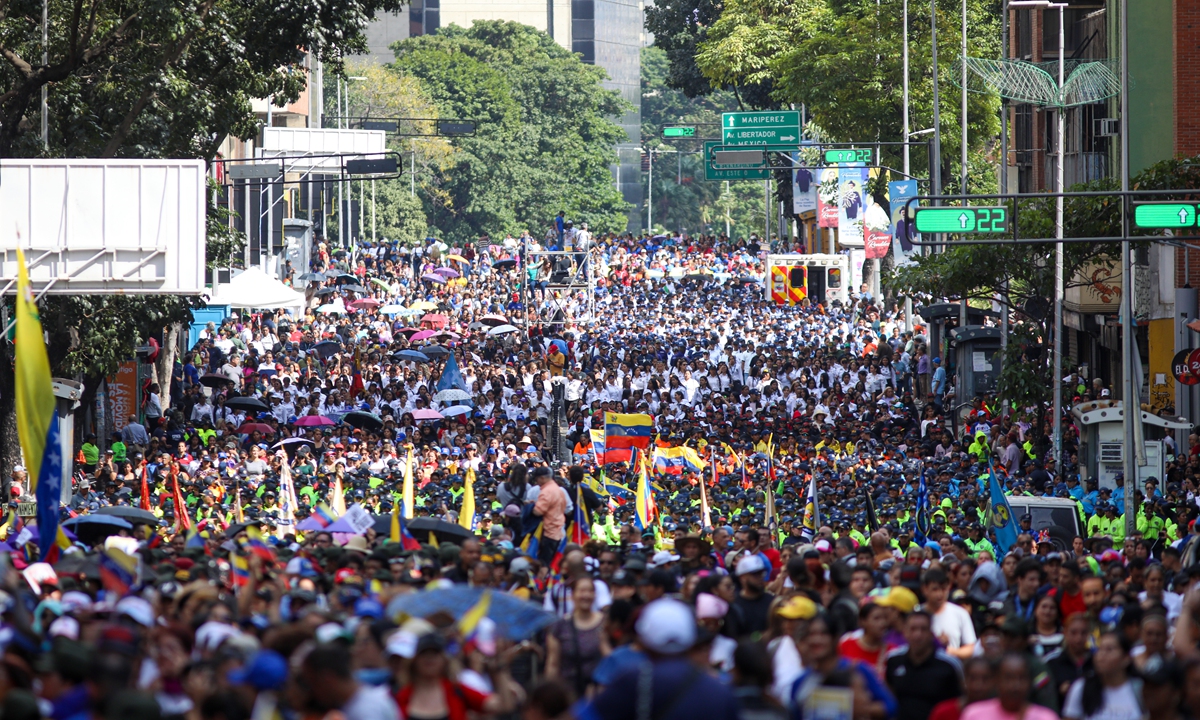
Supporters of Venezuelan President Nicolas Maduro and his wife, Cilia Flores, gather during a demonstration, expressing solidarity with the government, in Caracas, Venezuela, on January 6, 2026. Photo: VCG
Outcry from international community
Beyond Venezuela itself, particularly fierce opposition came from the country's Latin American neighbors as they, according to Sun, are especially concerned that the US may replicate this model of invading sovereign states and arresting their leaders elsewhere.
"Today it's Venezuela, tomorrow it could be anyone else," Chilean President Gabriel Boric said on January 3, raising alarm across Latin American countries over what they see as US hegemonic interference, the Xinhua News Agency reported.
Latin American experts and media outlets believe that US action against Venezuela aims to create a "chilling effect" to deter countries in the region, according to Xinhua.
On January 4, the governments of Spain, Brazil, Chile, Colombia, Mexico, and Uruguay issued a joint statement, expressing "deep concern and rejection of the military actions carried out unilaterally on Venezuelan territory," saying that "these actions constitute an extremely dangerous precedent for peace and regional security and endanger the civilian population," according to an English version of the statement released on the Colombian Foreign Ministry website.
Cuban President Miguel Diaz-Canel accused the US of a "criminal attack," according to the BBC.
Countries that emphasize international rules and uphold multilateralism in the world have expressed strong opposition to the US' move.
"The US move, a typical act of bullying, seriously violates international law, infringes upon Venezuela's sovereignty, and undermines the rights of the Venezuelan people," Chinese Foreign Ministry spokesperson Mao Ning said at a regular news briefing on Wednesday.
Venezuela's acting president Delcy Rodriguez on Thursday expressed gratitude to China for condemning US aggression against Venezuela and the seizure of Venezuelan President Nicolas Maduro and his wife, according to a post she published on Instagram.
Some regional organizations also stressed the importance of peace and stability citing the potential risks and challenges to Latin America and even global stability.
"The African Union (AU) underscores the importance of dialogue, peaceful settlement of disputes, and respect for constitutional and institutional frameworks, in a spirit of good neighborliness, cooperation, and peaceful coexistence among nations," read a statement by the AU released on its website on January 3.
In a statement published on the website of Liberia's Permanent Mission to the UN, Lewis G Brown, Liberia's permanent representative, said that the A3 members - the Democratic Republic of Congo, Somalia and Liberia - continues to monitor developments with deep concern. "Such developments present serious challenges not only to Venezuela's internal stability and underscore the imperative to safeguard the broader peace and security of the region," Brown said.
Complex reaction among 'allies'
In the US, hundreds of people took to the streets of Manhattan as early as January 3 to protest against the military operation in Venezuela, according to Xinhua.
The march was part of nationwide "No war on Venezuela" demonstrations held in more than 100 US cities, including Washington, Boston, Los Angeles, Atlanta, Chicago and Miami.
"This war is not about drugs, it is about Venezuela's oil," Karen, a middle-aged New Yorker in the march, told Xinhua. "How do you have the right to step in Venezuela, to attack Venezuela?" she said. "It feels like we act as criminals."
Divisions are also seen in the US political circle. The Republican-controlled Senate on Thursday voted 52-47 to advance a war powers resolution, which would stop the Trump administration from carrying out further military strikes in Venezuela without congressional authorization, according to the Financial Times.
Thursday's vote was the clearest signal that Republican lawmakers are growing wary of the White House's increasingly interventionist foreign policy and are eager to place limits on the White House's use of military force, per the Financial Times report.
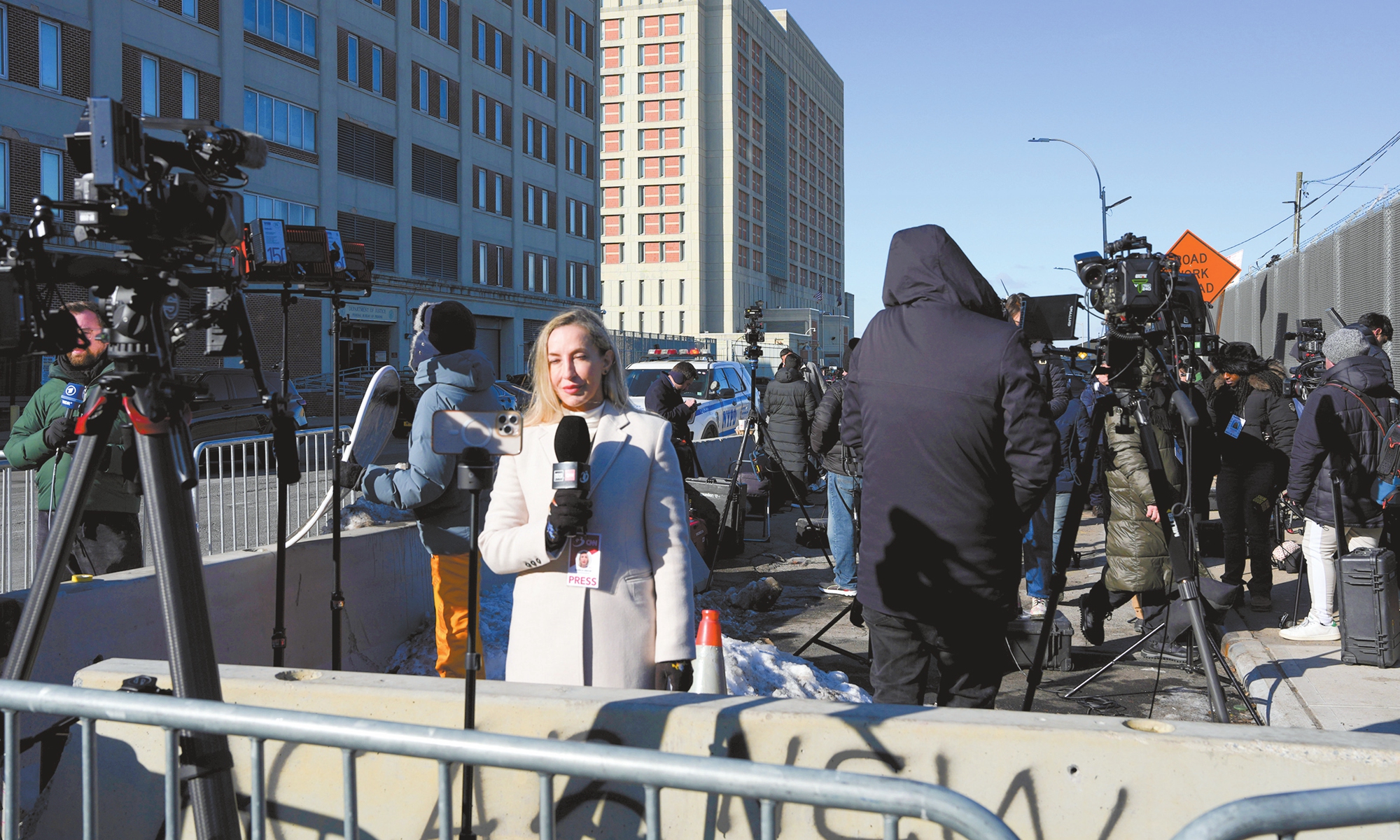
Members of the media gather at where Maduro is being held, in the Brooklyn borough of New York, the US, on January 4, 2026. Photo: VCG
Following the US raid on Venezuela, officials and leaders of many European countries have issued statements. However, official reactions have been notably uneven, with major capitals stressing "principles" while often avoiding direct criticism of Washington, according to Xinhua.German Chancellor Friedrich Merz said the legality of the US operation was "complex" and international law in general must apply. Canada's Foreign Minister Anita Anand said "Canada calls on all parties to respect international law and we stand by the people of Venezuela and their desire to live in a peaceful and democratic society." Norway's Foreign Minister Espen Barth Eide said "international law is universal and binding for all states" and "the American intervention in Venezuela is not in accordance with international law," according to the BBC.
French President Emmanuel Macron criticized the Trump administration on Thursday for defying the rules-based global order after the administration renewed threats to annex Greenland, Politico reported.
European countries maintained selective silence over the US military violation of Venezuela's sovereignty out of fear of offending Washington, yet they were soon bullied by the US over the Greenland issue. This exposes the long-standing double standards of Western countries in international affairs and reveals Europe's predicament in transatlantic relations, according to a Xinhua article released on Thursday.
The Japanese government is also seeking to avoid taking a clear stance on Washington's military operation in Venezuela, finding itself caught between its commitment to the Japan-US alliance and its emphasis on the international rule of law, Nikkei Asia reported on Wednesday.
The Japanese government has refrained from offering a direct evaluation of the US military operation in Venezuela. But it plans to keep a close watch on developments, including responses of relevant countries, Japanese Prime Minister Takaichi Sanae addressed this during a New Year's news conference on Monday, per the NHK report.
On the evening of Friday, a large number of Japanese citizens gathered in front of the Prime Minister's official residence to protest. Their grievances were directed at Takaichi's evasive stance regarding the US strikes on Venezuela and the government's recent series of concerning military policy shifts, according to Xinhua.
A similar situation has also emerged within the Philippine government. In a statement issued on Monday, the Philippines' Department of Foreign Affairs expressed "concern over evolving events in Venezuela," according to the Manila Times.
Analysts warn that a further slide towards "might-makes-right" behavior could leave smaller states more exposed in a world increasingly shaped by power rather than rules, said Malaysian news outlet The Star.
The Venezuela incident has had profoundly negative implications for international relations. First, it elevates domestic law above international law; second, it disregards the principle of sovereign equality by allowing a powerful country to invade another at will under fabricated pretexts; and third, the US may replicate such behavior against future rivals, using unilateral domestic legal standards to judge other countries' foreign policies and heads of state - an extremely dangerous precedent, Sun told the Global Times.
A wake-up call
The US' dramatic display of power in Venezuela has not only shocked the world, but also deepened global concerns over its expanding interventionism and the destabilizing effects of a new iteration of the Monroe Doctrine, which historically declared the Western Hemisphere as a US sphere of special interest. At the same time, it has fueled growing calls for greater international solidarity and a more multipolar world order.
"Expressions of unbridled power don't come blunter than abducting a sitting president from his capital in the dead of night," read a CNN editorial.
"Deep in the heart of this staggering operation lies Washington's wider ambitions for greater control of its near-abroad, for what they have termed an updated Monroe Doctrine," it read.
The implementation of the new Monroe Doctrine in the Americas will lead to more crises, turmoil and conflict; if it spreads to other regions, it could trigger greater global instability - a scenario the vast majority of countries are unwilling to see, Li Haidong, a professor at China Foreign Affairs University, warned during the interview with the Global Times.
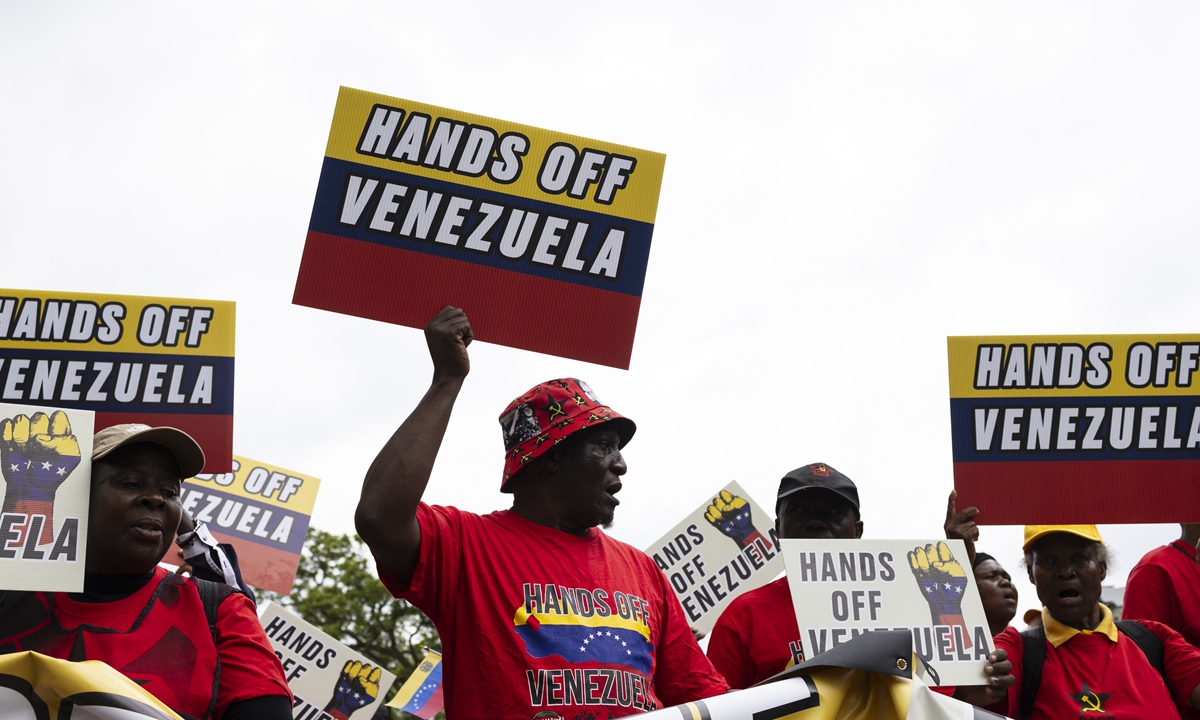
Protesters gather outside the US Embassy during a "hands off Venezuela" protest in Pretoria, South Africa, on January 8, 2026. Photo: VCG
At the same time, it may prompt countries to better recognize the importance of strengthening cooperation and safeguarding a sound international order, while also accelerating the process of multipolarization, Li said.The US' double standards exposed by the Venezuela incident may make its friends in Asia-Pacific realize the need to rely more on themselves, which means these countries may become more proactive in expanding their influence in the region, Liao Fan, director of the Institute of World Economics and Politics at the Chinese Academy of Social Sciences, said at a seminar held by the China Institutes of Contemporary International Relations on Tuesday, according to The Paper.
"For other Global South countries, the top priority is to rapidly strengthen themselves and enhance their comprehensive national capacity, which is essential to enable them to withstand external interference on all fronts," Li stressed.
RELATED ARTICLES