China-Europe freight train services start the new year with intensive departures, strengthening the Eurasian trade corridor
Cross-border railways further strengthen the Eurasian trade corridor
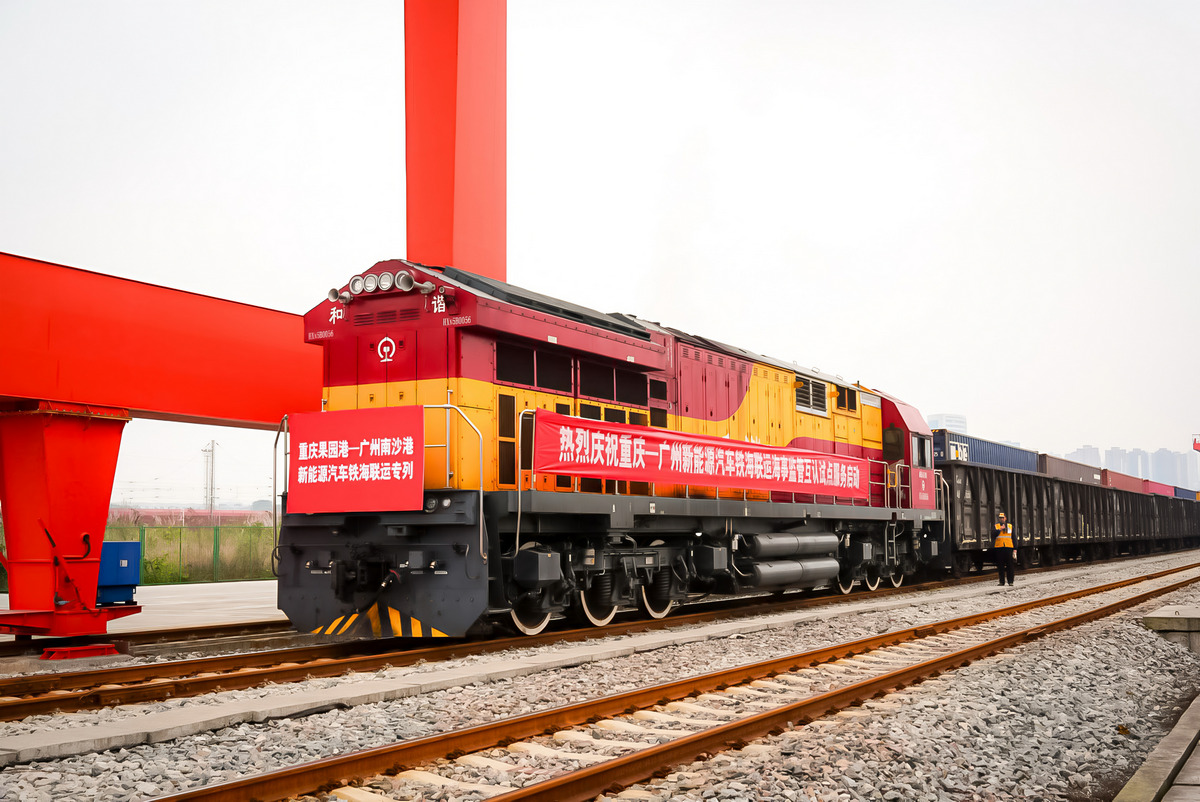
A freight train carrying new-energy vehicles made in Southwest China's Chongqing departs Yuzui Station at Guoyuan Port in Chongqing on January 7, 2026. The freight train is scheduled to reach Nansha Port in South China's Guangzhou in 48 hours before shipping onward to the Middle Eastern market. Photo: Courtesy of Chongqing International Logistics Hub Park
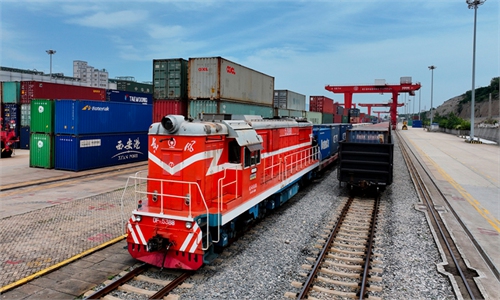
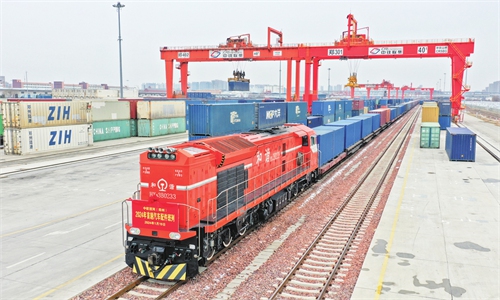
On January 1, the Guangdong-Hong Kong-Macao Greater Bay Area (GBA)'s first China-Europe freight train in 2026 departed from Zengcheng West Station at the Guangzhou Eastern Road-rail Intermodal Transport Hub under customs supervision. The train is scheduled to exit China via the Horgos border port and reach Malaszewicze, Poland, in around 14 days, marking the official launch of the China-Europe overland trade corridor for the new year, according to the General Administration of Customs (GAC).
The train carried 110 twenty-foot equivalent units (TEUs) with a total cargo value of about 20 million yuan ($2.8 million), mainly electronics, daily consumer goods and textile products manufactured in the GBA.
As a key hub linking the GBA with countries participating in the China-proposed Belt and Road Initiative (BRI), Zengcheng West Station has opened 14 outbound routes and eight return routes, reaching 34 cities in 17 countries across Europe, Central Asia and ASEAN, with its operating volume ranking the highest in Guangdong Province.
Beyond the GBA, freight trains also departed from multiple regions on New Year's Day in 2026, reflecting broad-based and coordinated launches across the network.
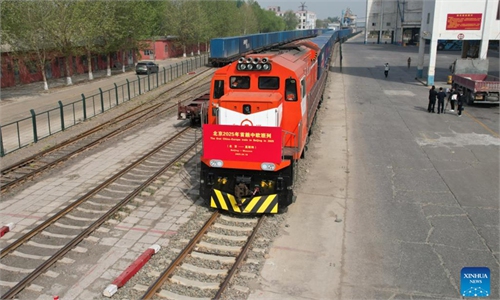
On January 1, a China-Europe freight train carrying goods such as ventilation systems departed from Wuhan Wujiashan Station, capital of Central China's Hubei Province, for Copenhagen, Denmark, marking both the city's first China-Europe service of the year and Hubei's first direct rail link to a Nordic capital, according to China Railway Wuhan Group Co.
In Northwest China, Xi'an International Port Station also dispatched its first China-Europe freight train of the year, carrying 50 standard containers bound for Azerbaijan, highlighting the continued extension of the rail network toward Central Asia, according to China State Railway Group.
The strong start in early 2026 builds on solid momentum from the previous year. In 2025, China-Europe (Asia) freight trains made about 34,000 trips and carried 3.17 million TEUs, up 9.8 percent and 7.6 percent year on year respectively, with China-Europe services alone accounting for more than 20,000 trips. Meanwhile, freight volume on the New Western Land-Sea Corridor surged 47.5 percent to 1.42 million TEUs in 2025, China State Railway Group said in a statement it sent to the Global Times.
Trade flows by rail
Judging from the cargo mix, the first China-Europe freight trains of the new year were not limited to a single category but carried a broad range of goods, including home furnishings, electromechanical equipment, HVAC products (heating, ventilation, and air conditioning products) and daily consumer items. These higher value-added shipments, more closely aligned with end-market demand across Central Asia and Europe, suggest the rail service is moving beyond its early role as a supplementary route toward a more stable, regular trade channel.
Several exporters in Yiwu and Shenzhen said that amid volatile global shipping rates and growing uncertainty on some maritime routes, rail transport, valued for its stable transit times and predictability, is increasingly becoming a preferred option, particularly for orders with tight delivery deadlines.
Arkadiusz Filipowski, CEO of Polish logistics firm Fulfilio Sp. z o.o., said in a previous interview with the Global Times that a significant share of the company's cargo is transported via China-Europe freight trains, citing their reliability and faster transit times compared with sea shipping.
He said Fulfilio sees strong potential in deepening cooperation with Chinese partners. "It's important for us to understand how Chinese companies do business and what they value in international cooperation," he said, adding that the company is committed to building long-term relationships in the Chinese market.
Wang Peng, an associate research fellow at the Beijing Academy of Social Sciences, told the Global Times on Sunday that the New Year's "strong start" of China-Europe freight trains reflects the continued release of the corridor's long-term competitiveness.
A key shift, he noted, is the transformation in cargo structure - from mainly basic goods in the early years to higher value-added products such as auto parts, machinery and electronic equipment - signaling that the service has evolved from a simple logistics route into an integral link in the global industrial chain.
Meanwhile, the growth of return trips has become a key indicator of the corridor's value. In recent years, the balance between outbound and inbound services has steadily improved, with some hubs achieving near two-way equilibrium. Many return trains now bring European goods such as cosmetics, agricultural products and machinery into China, helping to form a more balanced, two-way trade flow and optimize the trade structure across the Eurasian continent, China State Railway Group told the Global Times.
Sun Zhang, a mass transit expert and professor at Shanghai Tongji University, told the Global Times that the rising share of return services shows the China-Europe freight trains are shifting from one-way exports to a healthier, two-way trade corridor, helping make Eurasian trade more balanced and sustainable.
Amid the rapidly evolving international dynamics between China and the US, the expanding network of China-Europe freight trains is expected to further facilitate the circulation of high-tech products among China, Central Asia, Europe and Southeast Asia, Sun said.
The corridor as a stabilizer
Amid an increasingly complex global trade environment, the China-Europe freight trains have evolved beyond a logistics service to become a stabilizer of Eurasian trade, offering exporters more reliable options while underpinning cross-regional industrial cooperation and supply chain resilience, analysts said.
Wang noted that a multi-corridor, mutually reinforcing network is a key strength of the China-Europe freight trains in managing external uncertainties. As southern, western and northern routes continue to expand, the system no longer relies on a single pathway, effectively dispersing geopolitical and operational risks.
In day-to-day operations, the China-Europe freight trains are increasingly serving as a stabilizer. Their relatively fixed schedules and predictable transit times offer exporters with clearer expectations for production planning, inventory management, and cash flow, according to China State Railway Group.
Amid the disruptions to some international shipping routes and rising cost volatility, the rail service has become an important safeguard for cross-border supply chain continuity, Sun said.
The China-Europe freight trains are also reshaping inland regions' openness. New routes such as Wuhan-Copenhagen and Xi'an-Azerbaijan allow the inland provinces to connect more directly with the European and neighboring markets, shortening the logistics chains, lowering the overall costs, and encouraging the clustering of high-end manufacturing and export-oriented industries in key hubs, analysts said.
Sun said this positive cycle of smoother logistics, expanding trade and industrial clustering means China-Europe freight trains are no longer just the transport corridors, but the "super connectors" that energize regional economies and facilitate industrial coordination across Eurasia.
China's National Development and Reform Commission said in November 2025 that it would promote the high-quality development of China-Europe freight trains in four key areas: expanding diversified and efficient corridors, boosting innovation-driven growth, strengthening the foundations for safe operations, and enhancing their spillover and driving effects, according to the Xinhua News Agency.
Analysts noted that the China-Europe freight train services are forming a positive interaction with the BRI. By continuously expanding the cross-border logistics network, trade ties between China and countries along the BRI route have strengthened, injecting sustained momentum into the Eurasian trade. The intensive departures on the first day of 2026 vividly reflect this trend.
RELATED ARTICLES