Chinese firms apply for over 200,000 satellite constellation frequencies ahead of 2026, taking longer-term view

Satellite communication File photo: VCG
According to the website of the International Telecommunication Union (ITU), multiple Chinese satellite operators submitted applications for more than 200,000 satellite frequencies during the final week of 2025, the Securities Times reported, further reflecting Chinese companies' determination and strategic planning in developing the commercial aerospace industry.
This is the largest centralized application for international frequency tracks in China to date, according to the Science and Technology Daily on Sunday.
An expert said that the Chinese commercial aerospace sector is shifting from isolated breakthroughs to systematic advancement, integrating rockets, satellites, and ground systems. By applying for frequency allocations on a large scale, China is planning its space deployment over the next decade and beyond, rather than focusing on short-term launches.
This batch of applications covers a dozen satellite constellations by Chinese companies. Chinese commercial aerospace company Galaxy Space confirmed to the Global Times on Sunday their applications for its satellite constellation plans.
Notably, two constellations - CTC-1 and CTC-2 - each applied for 96,714 satellites, totaling more than 190,000 satellites, making them the main contributors in this round.
In addition, other Chinese companies, and telecom carriers, including China Satellite Network Group Co, Shanghai Yuanxin Satellite Technology Co, China Mobile, China Telecom, and Guodian Gaoke, are also seen on the ITU's website.
The ITU is the UN'S specialized agency for digital technologies. It allocates global radio spectrum and satellite orbits, develops technical standards that ensure networks and technologies connect seamlessly, and works to improve access to digital technologies in underserved communities worldwide, according to its website.
To prevent "radio-frequency spectrum warehousing", the ITU has introduced a mechanism requiring satellite constellations to achieve 10 percent deployment within two years after the end of the current regulatory period for bringing them into use, 50 percent within five years, and complete deployment within seven years, or else their frequency allocations will expire.
A Xinhua News Agency report on Sunday noted that the recent filings of satellite network information by Chinese satellite operators with the ITU are considered routine procedures required under related rules, citing China's national radio regulation center.
An expert from the center said China has strictly complied with ITU radio regulations, noting that its latest filings include two networks each involving more than 90,000 satellites, while multiple countries have also submitted applications involving constellations exceeding 100,000 satellites.
Complete industrial ecosystem
The batch of large-scaled satellite constellation applications came as China's commercial launch capacity, satellite manufacturing throughput and constellation deployment capabilities have advanced in parallel, forming an increasingly complete industrial ecosystem.
An anonymous satellite manufacturer told the Global Times on Sunday that the application for more than 200,000 satellite frequencies signals huge opportunities in the space economy. "We will respond quickly to industry changes and stay aligned with its development."
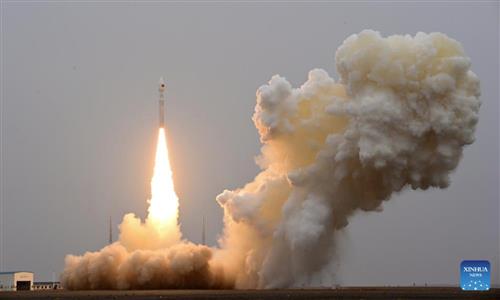
On May 19, 2025, Beijing-based Guodian Gaoke launched the last four satellites of its Tianqi satellites constellation aboard a CERES-1 sea-launch variant rocket by Chinese private launcher Galactic Energy from waters near Rizhao, East China's Shandong Province. The success of the mission marked the completion of the global networking of Phase I of the Tianqi constellation, China's first low-Earth-orbit satellite Internet of Things constellation, according to its official WeChat account.
A representative from Guodian Gaoke told the Global Times on Monday that the company will launch Phase II of the Tianqi constellation project in the second half of 2026, deploying 48 satellites, but did not confirm whether the constellation was included in the latest round of frequency applications.
China currently has three planned mega-constellations each involving more than 10,000 satellites, including China Satellite Network Group's GW constellation, Shanghai Yuanxin's Spacesail Constellation, and Hongqing Technology's Honghu-3 constellation. As of October 2025, the GW constellation had launched a total of 116 satellites, including experimental and operational satellites, while the Qianfan constellation had deployed 108 networking satellites, excluding four experimental satellites launched before 2024, according to media report.
Wang Peng, an associate researcher at the Beijing Academy of Social Sciences, said that this process also reflects how Chinese companies, through proactive early allocation of space resources, aim to support a certain level of competitiveness in the international race of the satellite internet era.
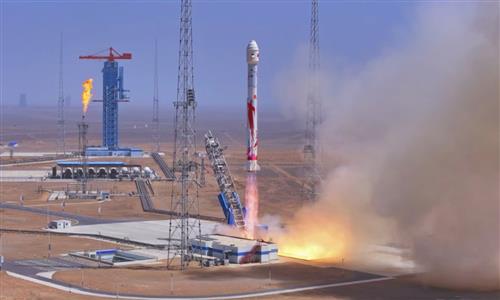
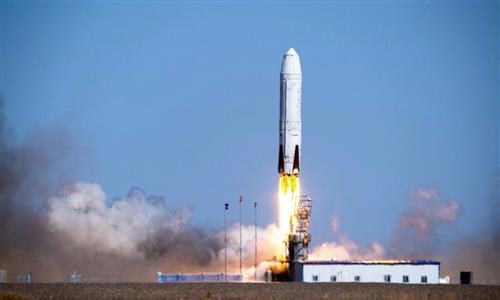
In 2025, China's commercial aerospace sector achieved multiple milestones in launch vehicle development, with several reusable rockets undergoing test flights. Although some recovery targets were not fully met, both the industry and domestic social media have given positive recognition to these trials.
Within in the satellite manufacturing sector, at the Wenchang International Aerospace City, South China's Hainan Province, a "super satellite factory" with an annual production capacity of 1,000 satellites is set to begin operations, enabling seamless integration of satellite manufacturing and launch, with satellites ready for launch immediately upon rollout.
An industry report showed that China's commercial aerospace sector has entered a new stage of scale and commercialization, with rapid growth and significant market expansion expected in the coming years. More frequent rocket launches and accelerated deployment of large constellations, along with regular operations at the Hainan commercial aerospace launch site, have driven multiple breakthroughs across the commercial aerospace industry, the Xinhua News Agency reported.
RELATED ARTICLES