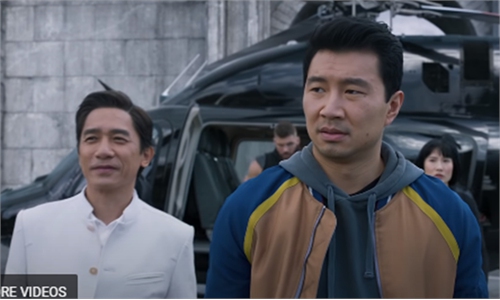
A poster of the film Escape From The Outland Photo: Courtesy of the film crew
As the sweltering heat of the Sahara Desert unfolds on the silver screen of the film Escape From The Outland, vibrant red tomatoes tenaciously sprout from mine casings. Audiences are struck by this powerful imagery - a stark reminder that war's wreckage can nurture the hope of life.
Released in the Chinese mainland on December 31, 2025, as part of the New Year's holiday film lineup, the film has garnered positive reception for its foundation in real overseas hostage survival events. What sets it apart is its focus on ordinary Chinese citizens living long-term in war-torn regions, highlighting their deep bonds with local communities - bonds forged through the sincerity, kindness, and daily efforts of engaging with locals.
The film leaves viewers with a question to ponder: in a world where turmoil and conflict are everyday realities, what can truly heal wounds? Its answer lies not in grand gestures, but in small, consistent acts of care. Beyond the screen, this idea finds echoes in real-world Chinese actions abroad: building infrastructure, providing medical aid, and sharing practical skills.
'Red represents peace in China'
Escape From The Outland tells the story of Ma Xiao, a Chinese reporter stationed in foreign countries, and his wife Pan Wenjia, a volunteer doctor, who accompany their engineer friend to a fictional country to repair a communication base station, only to be caught in a sudden turn for the worse in the local situation. Confronted with a terroristic massacre, they embark on a harrowing 105-day struggle for survival and escape.
Director Shen Ao explained that the professions of the three core characters are deeply symbolic: The journalist represents information, the doctor symbolizes the safeguarding of life, and the engineer signifies infrastructure. "These are the three pillars of a civilized society," he said. Shen deliberately placed these ordinary bearers of modern civilization into a savage environment where "buying a gun is as easy as buying groceries." Isolated and unarmed, they repeatedly rely on sheer willpower, integrity, and "folk wisdom" to navigate life-threatening dangers.
"The film opposes militarism and terrorism, focusing more on the civilians scarred by war. We hope to provoke the audience to reflect on terrorism and extremism, to sympathize with refugees, and to yearn for peace," Shen stated.
During preparation, Shen and his team immersed themselves in documentaries and survivor accounts, extracting a wealth of details to preserve a sense of authenticity within the dramatic narrative. Recounting his creative inspiration, Shen shared a poignant detail: An overseas Chinese staff member told him about teaching local people to grow tomatoes on arid land. "That's why we used mine casings as planters for tomatoes in the film, creating a powerful symbol," Shen explained. "A weapon once meant to kill is transformed into a vessel that nurtures life." In the film, this is more than just a practical survival skill for the characters; it evolves into a striking visual metaphor: Life can still take root and thrive tenaciously atop the wreckage of war, the ultimate symbol of destruction.
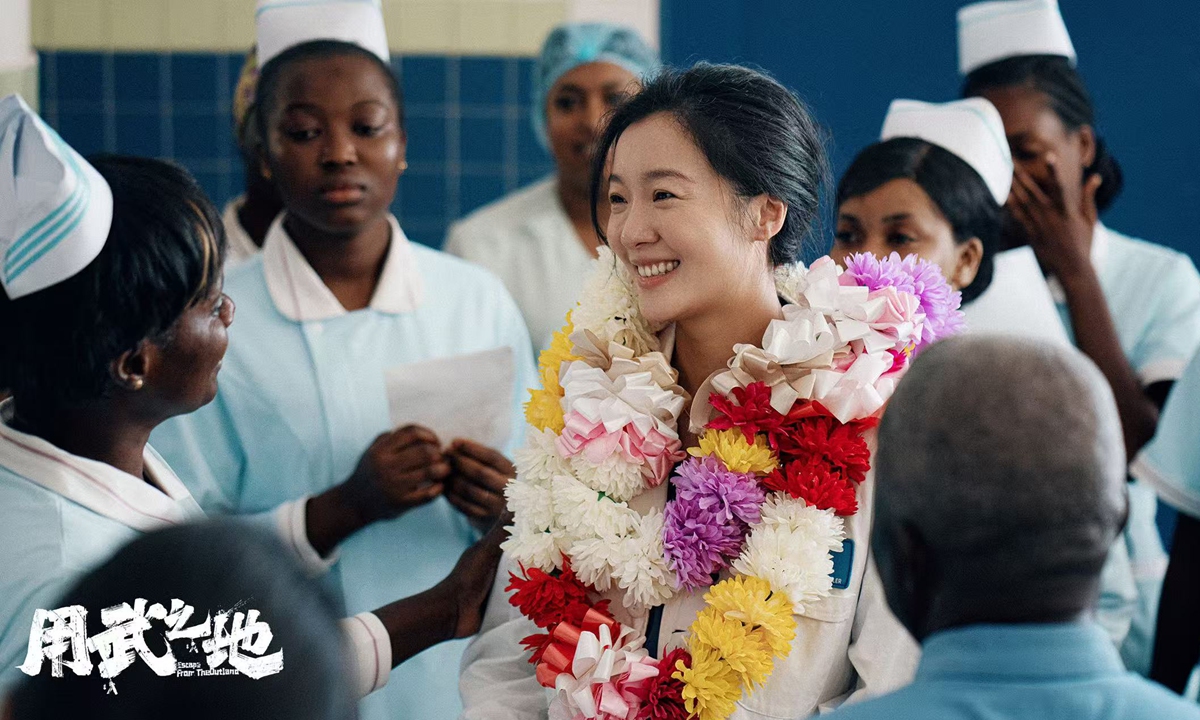
A movie still from the film Escape From The Outland shows the volunteer doctor, played by Chinese actress Qi Xi, receiving a garland at a local hospital in a foreign country. Photo: Courtesy of the film crew
Shen noted that the tomato is not native to China. It was introduced from abroad and eventually became a common food. "In our script, Chinese people using Chinese folk wisdom, teaches locals how to grow tomatoes in a dry environment. This is actually a symbol of the combination of east and west and mutual advancement," he explained. Thus, the tomato growing from the landmine casing connects past and present, becoming a small yet luminous testament to cultural exchange and the resilience of life.
"In China, when people see the color red, they instinctively think of beautiful ideals. Even seeing a red flag can make one think of the motherland," Shen said. Therefore, in the film, when a character sees the tomato, they sincerely state that red represents peace in China.
Among the many film reviews on Douban, a major Chinese film rating platform, one comment reads: "After watching the film, I suddenly realized for the first time that peace is still a luxury for some people in this day and age. In our eyes, red symbolizes peace, luck, and love, yet in the eyes of Latif [a local character in the film], red is the color of bloodshed across a landscape strewn with corpses. I really love one metaphor in the film: Ma Xiao teaching Latif to grow tomatoes is like sowing the 'red' that symbolizes peace and luck on that land. If only all the red in the world were the red of tomatoes."
'Simple sense of responsibility'
Portraying Ma, "Uncle Tomato" in the film, actor Xiao Yang reflected that the most compelling aspect of the character is a "simple sense of responsibility." "Resident foreign journalist isn't a born hero; he just wants to survive and protect his family, but learns to shoulder responsibility under desperate circumstances," Xiao shared in an interview with the Global Times.
This cinematic narrative mirrors tangible Chinese engagement in a turbulent world. Beyond the screen, particularly in volatile regions, many Chinese citizens embody the "Uncle Tomato" spirit. They are not detached, short-term visitors but ordinary individuals deeply rooted in their local communities, fostering connections through long-term presence.
Huang Chun, a veteran security manager with Chinese companies operating overseas, embodies this sentiment through his own experiences. For more than a decade, he has navigated the perils of global conflicts.
As a security officer, Huang's job goes beyond just planning from an office, but rather he needs to handle the real work: Running training sessions on site, sorting out team disagreements, and getting involved in every part of the operations.
His skills were shaped by tough experiences. During his decade of security operations overseas, his experience in Afghanistan in 2018 were etched deeply in his memory. The camp where he worked was only half-built when it faced repeated, surprise attacks from gangs. "I kept things steady on the ground, giving clear orders," Huang told the Global Times. "But inside, I was very tense; I had planned for the worst."
Seeing that the attackers wanted to scare, not kill, his team chose to calm things down: Skipping fights for talks and deals. "It wasn't giving up. It was choosing no injuries over pointless bravery," he noted.
Huang emphasized that it's vital to listen to local people and offer real help, showing "China's good intentions through actions, not big words, by connecting with them heart to heart in everyday life."
In Afghanistan, he built these connections with locals every day. As the main contact of the Chinese company, he dealt with villagers, workers, and sellers in all sorts of ways: Buying goods, hiring staff, keeping relationships strong, fixing sudden problems, and joining in local holidays.
According to Huang, Chinese companies often bring useful tools for locals: Big machines for building roads, digging ditches, and leveling ground; jobs for everyone from basic workers to experts; and training in useful skills.
"These aren't just gifts," Huang pointed out. "They build trust - helping people understand each other better, creating strong feelings, and making work safer for the long run."
"Chinese people's work around the world builds a reputation for its hardworking spirit, which comes with no hidden agendas," Huang said. Therefore, local views changed with more contact with Chinese people: From early doubt to careful trust during tough times, then to lasting partnerships, which he often experiences overseas.
From places like Lebanon and Afghanistan, Huang has observed a core Chinese "way of survival" - one that is also profoundly reflected in Escape From The Outland. It is neither blind optimism nor passive pessimism, but a spirit of resilience and pragmatism: A willingness to acknowledge the harshness of reality, yet never abandoning hope, to value one's own safety, and also care for the fates of others.
Trust nurtures vitality
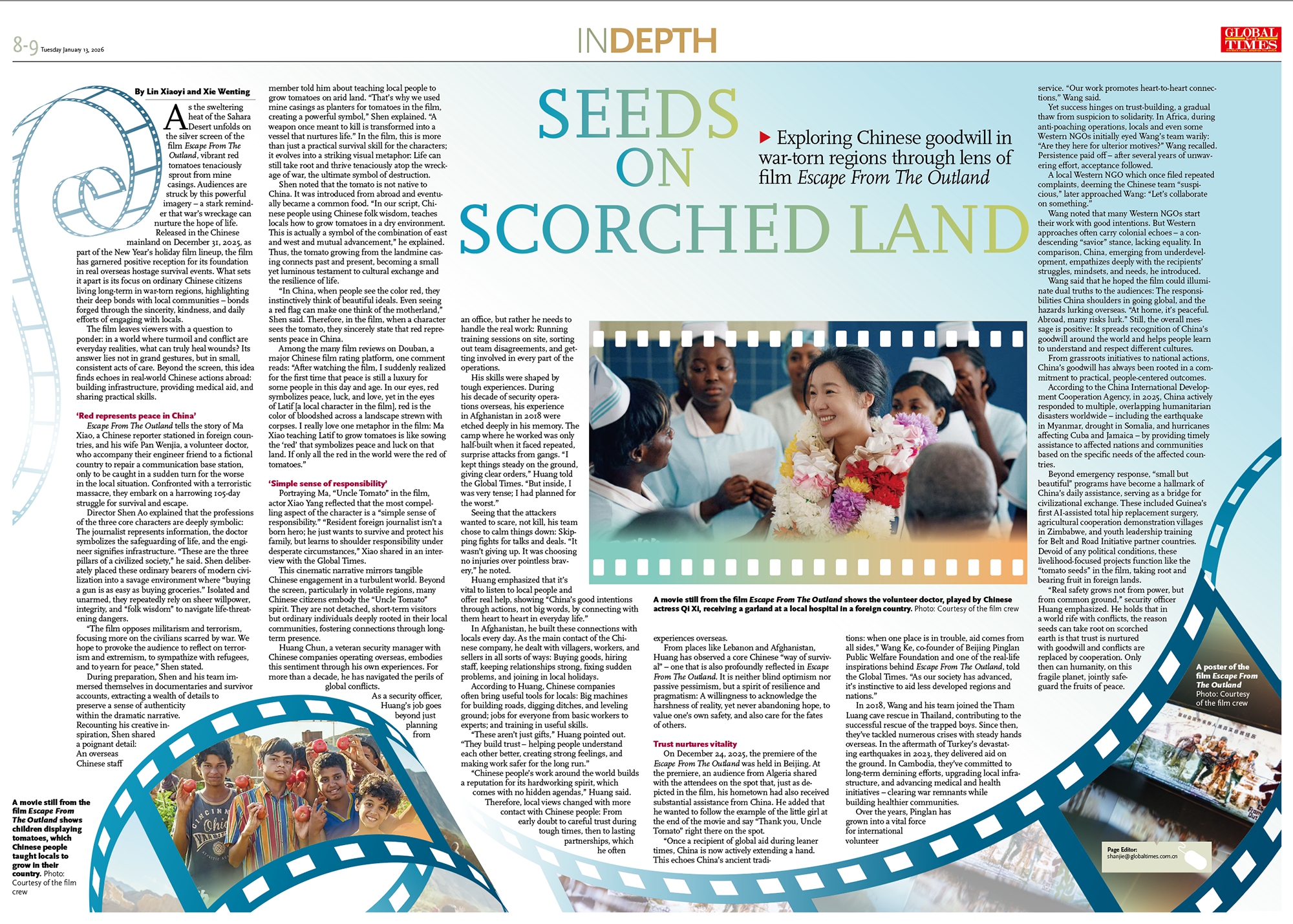
On December 24, 2025, the premiere of the Escape From The Outland was held in Beijing. At the premiere, an audience from Algeria shared with the attendees on the spot that, just as depicted in the film, his hometown had also received substantial assistance from China. He added that he wanted to follow the example of the little girl at the end of the movie and say "Thank you, Uncle Tomato" right there on the spot.
"Once a recipient of global aid during leaner times, China is now actively extending a hand. This echoes China's ancient traditions: when one place is in trouble, aid comes from all sides," Wang Ke, co-founder of Beijing Pinglan Public Welfare Foundation and one of the real-life inspirations behind Escape From The Outland, told the Global Times. "As our society has advanced, it's instinctive to aid less developed regions and nations."
In 2018, Wang and his team joined the Tham Luang cave rescue in Thailand, contributing to the successful rescue of the trapped boys. Since then, they've tackled numerous crises with steady hands overseas. In the aftermath of Turkey's devastating earthquakes in 2023, they delivered aid on the ground. In Cambodia, they've committed to long-term demining efforts, upgrading local infrastructure, and advancing medical and health initiatives - clearing war remnants while building healthier communities.

A movie still from the film Escape From The Outland shows children displaying tomatoes, which Chinese people taught locals to grow in their country. Photo: Courtesy of the film crew
Over the years, Pinglan has grown into a vital force for international volunteer service. "Our work promotes heart-to-heart connections," Wang said.
Yet success hinges on trust-building, a gradual thaw from suspicion to solidarity. In Africa, during anti-poaching operations, locals and even some Western NGOs initially eyed Wang's team warily: "Are they here for ulterior motives?" Wang recalled. Persistence paid off - after several years of unwavering effort, acceptance followed.
A local Western NGO which once filed repeated complaints, deeming the Chinese team "suspicious," later approached Wang: "Let's collaborate on something."
Wang noted that many Western NGOs start their work with good intentions. But Western approaches often carry colonial echoes - a condescending "savior" stance, lacking equality. In comparison, China, emerging from underdevelopment, empathizes deeply with the recipients' struggles, mindsets, and needs, he introduced.
Wang said that he hoped the film could illuminate dual truths to the audiences: The responsibilities China shoulders in going global, and the hazards lurking overseas. "At home, it's peaceful. Abroad, many risks lurk." Still, the overall message is positive: It spreads recognition of China's goodwill around the world and helps people learn to understand and respect different cultures.
From grassroots initiatives to national actions, China's goodwill has always been rooted in a commitment to practical, people-centered outcomes.
According to the China International Development Cooperation Agency, in 2025, China actively responded to multiple, overlapping humanitarian disasters worldwide - including the earthquake in Myanmar, drought in Somalia, and hurricanes affecting Cuba and Jamaica - by providing timely assistance to affected nations and communities based on the specific needs of the affected countries.
Beyond emergency response, "small but beautiful" programs have become a hallmark of China's daily assistance, serving as a bridge for civilizational exchange. These included Guinea's first AI-assisted total hip replacement surgery, agricultural cooperation demonstration villages in Zimbabwe, and youth leadership training for Belt and Road Initiative partner countries. Devoid of any political conditions, these livelihood-focused projects function like the "tomato seeds" in the film, taking root and bearing fruit in foreign lands.
"Real safety grows not from power, but from common ground," security officer Huang emphasized. He holds that in a world rife with conflicts, the reason seeds can take root on scorched earth is that trust is nurtured with goodwill and conflicts are replaced by cooperation. Only then can humanity, on this fragile planet, jointly safeguard the fruits of peace.