US slaps tariff on Iran’s trading partners amid escalating situation; move solidifies US' image of arbitrarily abusing power: Chinese expert
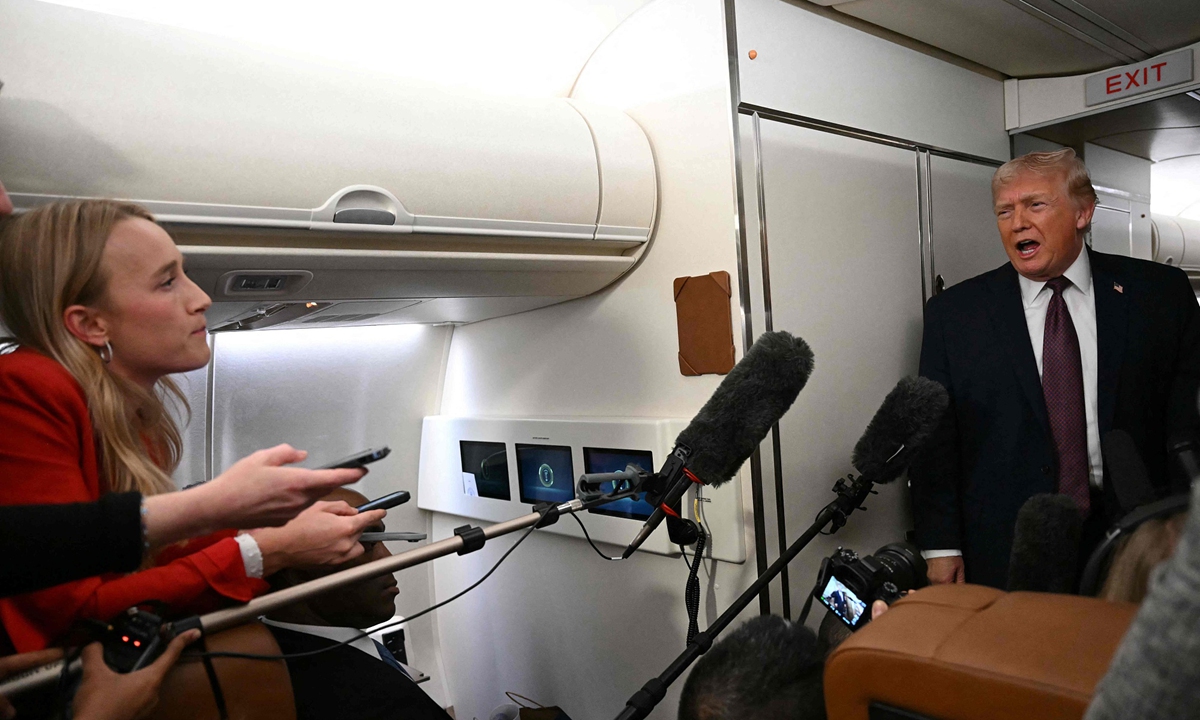
US President Donald Trump speaks to the press aboard Air Force One on January 11, 2026. Photo: VCG
Amid escalating US-Iran row, US President Donald Trump announced on Monday that countries do business with Iran will face a 25 percent tariff when doing business with the US, after claiming the previous day that he is looking at a number of "very strong" options to hit Iran for its handling of the protests.
It is not clear which countries might be affected, but major economies such as Russia, China, Brazil and Turkey all trade with Iran. Iraq and the United Arab Emirates are also important trading partners, according to the database Trading Economics, Al Jazeera reported.
Chinese Foreign Ministry spokesperson Mao Ning responded to US President's related claim at Tuesday's press briefing, noting that China's position on the tariffs issue is very clear. Tariff wars have no winners. China will firmly protect its legitimate and lawful rights and interests.
Liu Pengyu, the spokesperson of Chinese Embassy in the US, said earlier on Tuesday via X following the US president announcement that "China firmly opposes any illicit unilateral sanctions and long-arm jurisdiction, and will take all necessary measures to safeguard its legitimate rights and interests."
"China's position against the indiscriminate imposition of tariffs is consistent and clear. Tariff wars and trade wars have no winners, and coercion and pressure cannot solve problems. Protectionism harms the interests of all parties," Liu said in the X post.
Trump announced the decision in a social media post on Monday, claiming that it was "final and conclusive," but offering few additional details. "Effective immediately, any country doing business with the Islamic Republic of Iran will pay a Tariff of 25 percent on any and all business being done with the United States of America."
A Chinese expert said the US' tariff measures will not only exacerbate Iran's economic crisis but bring shockwaves to the already-sluggish global economy. What's more, the move will solidify the US' international image of arbitrarily abusing power, further dampen the enthusiasm for capital inflows.
Escalating situation
About 2,000 people including security personnel have been killed in protests in Iran, an Iranian official said on Tuesday, per Reuters.
German Chancellor Friedrich Merz on Tuesday said Iranian government is in its "final days and weeks." Iranian Foreign Minister Abbas Araghchi, in response, has accused Germany of double standards on human rights, citing Berlin's stance on Israel's war in Gaza, Al Jazeera reported Tuesday.
German Foreign Minister Johann Wadephul is on a US visit. During his meeting with US Secretary of State Marco Rubio on Monday local time, the two discussed a range of topics and reiterated the importance of denying Iran the ability to develop or obtain a nuclear weapon, per a State Department readout.
Amid the tense situation, multiple foreign commissions in Iran have ordered their citizens to leave the country or scaled down diplomatic staff as of Tuesday.
The US Embassy in Iran has issued an urgent directive for all American citizens to evacuate the country immediately, citing escalating protests that could potentially turn violent. France's Foreign Ministry says it has "reconfigured" its embassy in Tehran after reports the facility's nonessential staff left Iran earlier this week. Australian Foreign Minister Penny Wong is urging nationals in Iran to depart the country as tensions rise with deadly protests and military threats from the US, according to media reports including Bastille Post and Al Jazeera.
When asked whether China still advises its citizens to travel to Iran for tourism, spokesperson Mao Ning said "We are closely following the developments of the situation in Iran. We will take all measures necessary to protect the safety of Chinese nationals."
Euractiv reported Tuesday that several EU countries - including Spain, Finland, Belgium and Czechia - have summoned Iranian ambassadors to increase pressure on Iran over its handling of domestic protests amid a widening diplomatic backlash.
The previous day, Iran's foreign ministry has summoned the envoys of Britain, Germany, France, and Italy after their governments expressed support for the protests, the semi-official Tasnim reported Monday.
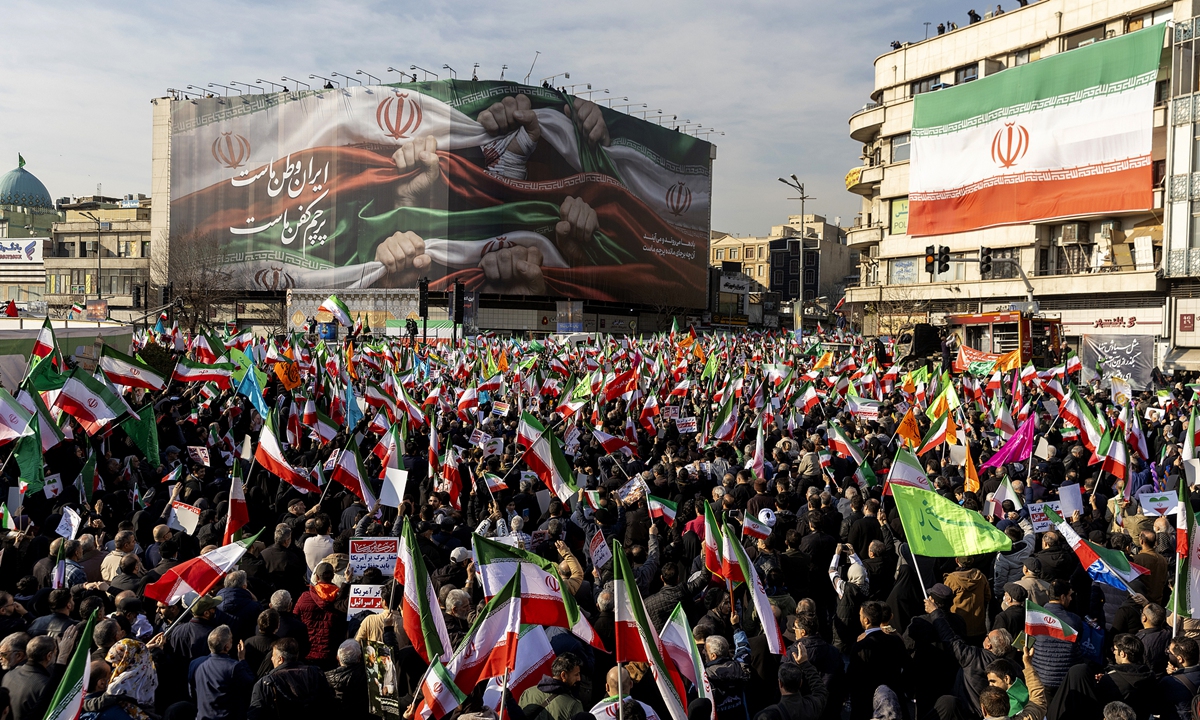
Pro-government Iranians gather on streets in Tehran on January 12, 2026, in opposition to recent anti-government riots, and US and Israeli interference in Iran. Photo: VCG
'Coercion to backfire'
Zhu Yongbiao, the executive director of the Research Center for the Belt and Road at Lanzhou University, said the US' latest tariff measures could further exacerbate Iran's economic crisis. Currently mired in a systemic crisis, Iran faces economic distress and sustained outbreaks of national governance contradictions amid suppressions by the US, Israel and other countries.
"Under such context, the tariffs may impact Iran in two ways: directly weakening its external economic ties, exacerbating the economic crisis; indirectly impacting and further undermining its governance structure and system," Zhu told the Global Times on Tuesday.
Zhu noted that the US intensive pressure on Iran is likely stimulated by the "success" of the Venezuela strike, attempting to replicate a similar model at lower cost and lower risk.
However, US' tariff measures will ultimately exert significant backlash on itself, the expert noted. "The global economic growth is already sluggish, coupled with the impact of various geopolitical conflicts and US policy uncertainty. By continuously implementing tariff measures, the US is eroding the foundation of global economic growth, which not only brings multiple negative impacts to the global economy but also causes shocks to its own."
According to the expert, this is specifically reflected in three aspects: first, exacerbating global geopolitical volatility, weakening confidence in global economic recovery, directly impacting the energy pattern and triggering price fluctuations. Sharp swings in energy prices will shake countries' expectations and confidence in economic growth, and the US cannot remain unscathed; second, directly threatening the energy security of US allies such as European countries and indirectly increasing their economic cost burdens.
Third, the move will solidify the US' international image of arbitrarily abusing power, and its consistent practice of provoking geopolitical conflicts and interfering in other countries' internal affairs around the world will dampen the enthusiasm for capital inflows, the expert said.
Tens of thousands of pro-government Iranians flooded the streets on Monday, answering an official call to show solidarity with the state. As state media broadcast images of sprawling crowds at Tehran's Enghelab Square, Foreign Minister Seyed Abbas Araghchi declared that the internal situation is now "under total control," the Xinhua News Agency reported.
The pro-government demonstrations, which also took place in cities such as Kerman, Zahedan, and Birjand, were characterized by state broadcasters as a "popular uprising against American-Zionist terrorism." In Shahrud, the rallies coincided with a funeral for security personnel killed during recent unrest.
Supreme Leader Ali Khamenei described the gatherings as a stern warning to US politicians to "halt their deceitful actions and stop relying on their traitorous hirelings," according to Xinhua.
Commenting on the recent development in Iran, Chinese Foreign Ministry spokesperson Mao said that China hopes Iran will maintain stability in the country and supports Iran in doing so. We always oppose interference in other countries' internal affairs and oppose the use or threat of force in international relations. We hope all parties will act in ways conducive to peace and stability in the Middle East.
RELATED ARTICLES