Experts refute Microsoft leader’s ‘subsidy’ claims against Chinese AI; China’s edge comes from open-source, structural advantages
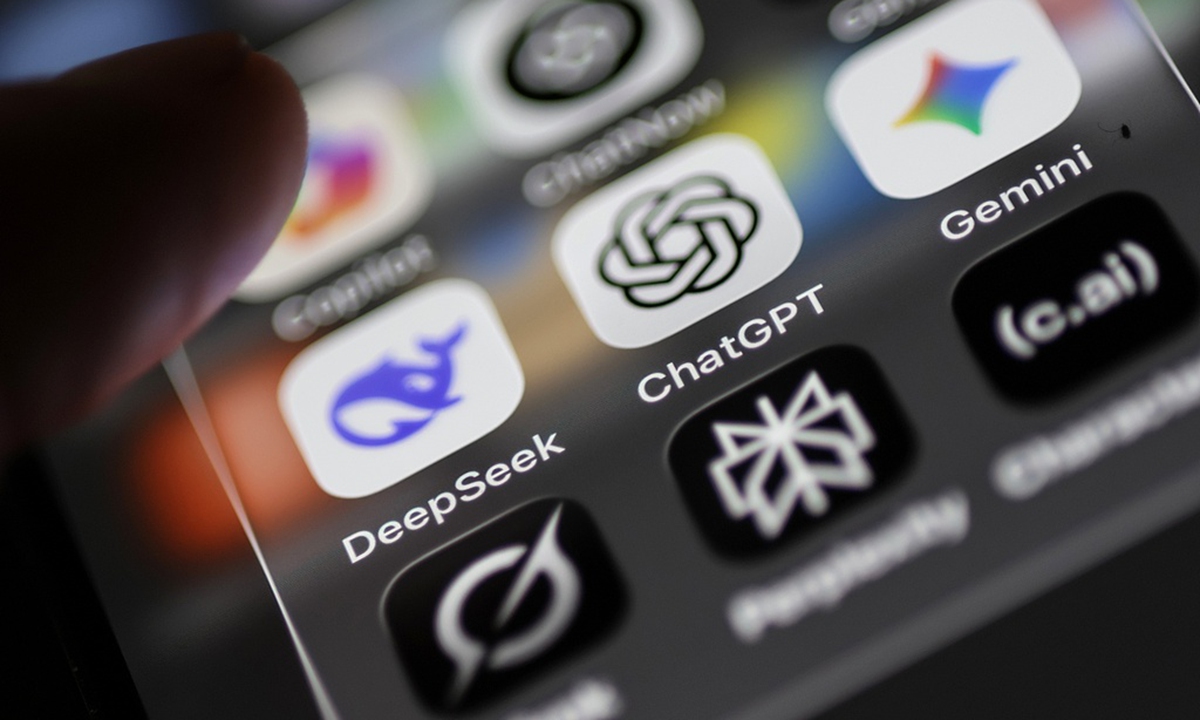
AI large models including Deepseek, ChatGPT and Gemini Photo: VCG
Microsoft leader has claimed that US artificial intelligence (AI) groups are being outpaced by Chinese rivals in the battle for users outside the West, the Financial Times (FT) reported on Tuesday. Chinese experts said the claims reflect growing anxiety among US tech firms and their attempt to smear Chinese AI with "subsidy" claims, stressing that China's AI edge comes from open-source approaches, efficiency gains and structural cost advantages that lower barriers in emerging markets.
Brad Smith, Microsoft's president, told the FT that the rapid adoption of Chinese AI start-up DeepSeek's technology in emerging markets such as Africa underscores the competition American firms face around the world.
"We have to recognise that right now, unlike a year ago, China has an open-source model, and increasingly more than one, that is competitive," Smith said, FT reported. "They benefit from subsidisation by the Chinese government. They benefit from subsidies that enable [them] to basically undercut American companies based on price."
Smith's comments come as new research from Microsoft found that the release of DeepSeek's R1 large language model a year ago helped accelerate the uptake of AI worldwide, particularly in the Global South, due to its "accessibility and low cost". That has also led to China overtaking the US in the global market for open AI models, which are often free to use, modify and integrate by developers, FT reported.
US tech companies have long held global dominance, but with AI emerging as a critical battleground for future technology and software leadership, China's rapid AI advances have heightened their anxiety, Chen Jing, vice-president of the Technology and Strategy Research Institute, told the Global Times on Tuesday.
Chen refuted the so-called "subsidy" claims against Chinese AI, stressing that government support is not the source of China's AI advantage, and subsidies cannot solve technical challenges or drive token prices down to extremely low levels at scale. He further pointed out that China strong infrastructure in energy and other areas helped reduce AI operating costs, and that this reflects a system-wide structural advantage rather than subsidy-driven support.
Microsoft's research, which is based on usage data from the tech group's products, estimated the Chinese group has an 18 percent share of the AI market in Ethiopia and 17 percent in Zimbabwe, FT reported.
Chen noted that startups in many African countries face severe funding constraints, while Western AI models charge prohibitively high token prices. By contrast, Chinese models often cost less than one-tenth as much—and in some cases are cheaper by orders of magnitude. Designed for efficiency, they can run on low-cost hardware with far lower upfront investment, making large-scale deployment in Africa more feasible.
China's open-source approach is another key advantage, Chen said, as it offers greater data sovereignty and flexibility for customization. Unlike closed Western models that limit users to paid APIs, Chinese open-source models allow local deployment and modification, easing data-security concerns and enabling startups to build local-language solutions while retaining control over core technologies.
"China's large AI models not only match their US counterparts in performance at much lower cost, but can also run on very affordable hardware, making them hard to turn down," Toyin, an entrepreneur from Abuja, Nigeria, told the Global Times in a previous interview. He said that with computing resources both costly and scarce across Africa, enabling AI to run on cheaper and more energy-efficient platforms is key to helping African tech startups better serve users.
Toyin runs an AI startup studio called Corefield. He said he first encountered DeepSeek in March 2025 and was "thrilled," noting that compared with models he had previously used from OpenAI and Google, the Chinese large language model was not only significantly cheaper but also more practical. He is now experimenting with DeepSeek to help develop a new education system in Nigeria.
Chen added that the rapid growth in the number of Chinese open-source models has already formed a self-reinforcing cycle of iteration and improvement, with some companies reporting sharp increases in large model service revenues, while global companies and developing countries are increasingly supporting a China led open-source AI ecosystem.
Bi Qi, chief scientist at the China Telecom Research Institute, told the Global Times that compared to Western models, China's mainstream models offer better value for money, with simpler architectures and lower power consumption, making them more suitable for engineering and commercial use. He noted that in the Global South, users prioritize affordability and practicality, focusing on viable business models and closer collaboration with local enterprises.
RELATED ARTICLES