China to extend anti-dumping duties on solar-grade polysilicon from US, South Korea; countervailing duties on US products also prolonged
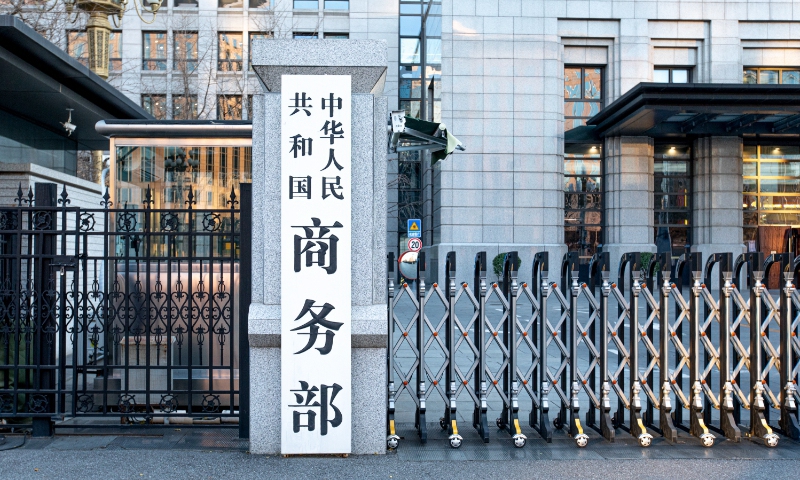
The Ministry of Commerce of China File photo: VCG
China will continue imposing anti-dumping duties on imports of solar-grade polysilicon from the US and South Korea, and extend countervailing duties on the same product originating from the US, after separate expiry reviews found that lifting the measures could lead to renewed dumping or subsidization and continued injury to the domestic industry, the Ministry of Commerce (MOFCOM) said on Tuesday.
Starting on January 14, 2026, China will extend anti-dumping duties on solar-grade polysilicon imports from the US and South Korea for another five years, in accordance with domestic laws, following an expiry review initiated at the request of China's domestic polysilicon industry, the ministry said in an announcement.
Under the ruling, existing anti-dumping duty rates will remain unchanged. US companies are subject to rates ranging from 53.3 percent to 57 percent, while South Korean producers face duties ranging from 4.4 percent to 113.8 percent, depending on the company.
The measures apply to solar-grade polysilicon used as a key raw material for crystalline silicon photovoltaic cells, while electronic-grade polysilicon used in semiconductor manufacturing is excluded, per the MOFCOM announcements.
The MOFCOM ruled that if the anti-dumping measures were terminated, dumping of solar-grade polysilicon from the two countries could continue or resume, and the resulting injury to China's domestic industry could persist or reoccur. Based on the findings, the ministry recommended continuing the measures, a decision subsequently approved by the Customs Tariff Commission of the State Council.
Separately, another MOFCOM announcement said that China will continue to impose countervailing duties on imports of solar-grade polysilicon originating from the US for a further five-year period, effective January 14, 2026.
The ministry found that if the countervailing measures were terminated, subsidization of US-origin solar-grade polysilicon could continue or reoccur, and the resulting injury to China's domestic industry could persist. Acting on the MOFCOM's recommendation, the Customs Tariff Commission of the State Council decided to maintain the countervailing duties in line with existing rates.
Under the ruling, countervailing duty rates on US producers range from 0 percent to 2.1 percent, with Hemlock Semiconductor Corp and AE Polysilicon Corp subject to a 2.1 percent rate, while several other US producers remain exempt, according to the ministry.
Both the anti-dumping and countervailing measures cover solar-grade polysilicon classified under tariff code 28046190, including polysilicon products used in photovoltaic manufacturing. Importers will be required to pay the applicable duties to Chinese customs authorities on an ad valorem basis.
The MOFCOM said that the decisions were made in accordance with China's anti-dumping and countervailing regulations, adding that parties dissatisfied with the rulings may apply for administrative reconsideration or initiate legal proceedings in accordance with the law.
"China's investigations are carried out strictly according to established procedures. They examine not only the prices of the products in the Chinese market, but also whether they cause material injury to the domestic industry and whether there is a clear causal link to the dumping or subsidies," Zhou Mi, a senior researcher at the Chinese Academy of International Trade and Economic Cooperation, told the Global Times on Tuesday.
The MOFCOM bases its decisions on the facts from the investigation and adheres strictly to evidence-based and rule-of-law principles, Zhou said, adding that if the countries involved follow normal market rules, and their exports no longer harm China's industry or create unfair competition — the measures may be adjusted accordingly.
The measures trace back to January 2014, when China first imposed anti-dumping duties on solar-grade polysilicon imports from the US and South Korea, along with countervailing duties on US-origin products. The measures were adjusted and subsequently extended in January 2020 for another five-year period.
In January 2025, at the request of China's domestic solar-grade polysilicon industry, the MOFCOM launched expiry reviews covering both the anti-dumping measures on imports from the US and South Korea and the countervailing measures on US products, to assess whether terminating the duties could lead to renewed dumping or subsidization and continued injury to the domestic industry.
The latest decisions were made after the expiry reviews, according to the MOFCOM's statements.
RELATED ARTICLES