ARTS / CULTURE & LEISURE
Root carving between natural form and human imagination
Harmony in wood
By Published: Jan 13, 2026 08:58 PM

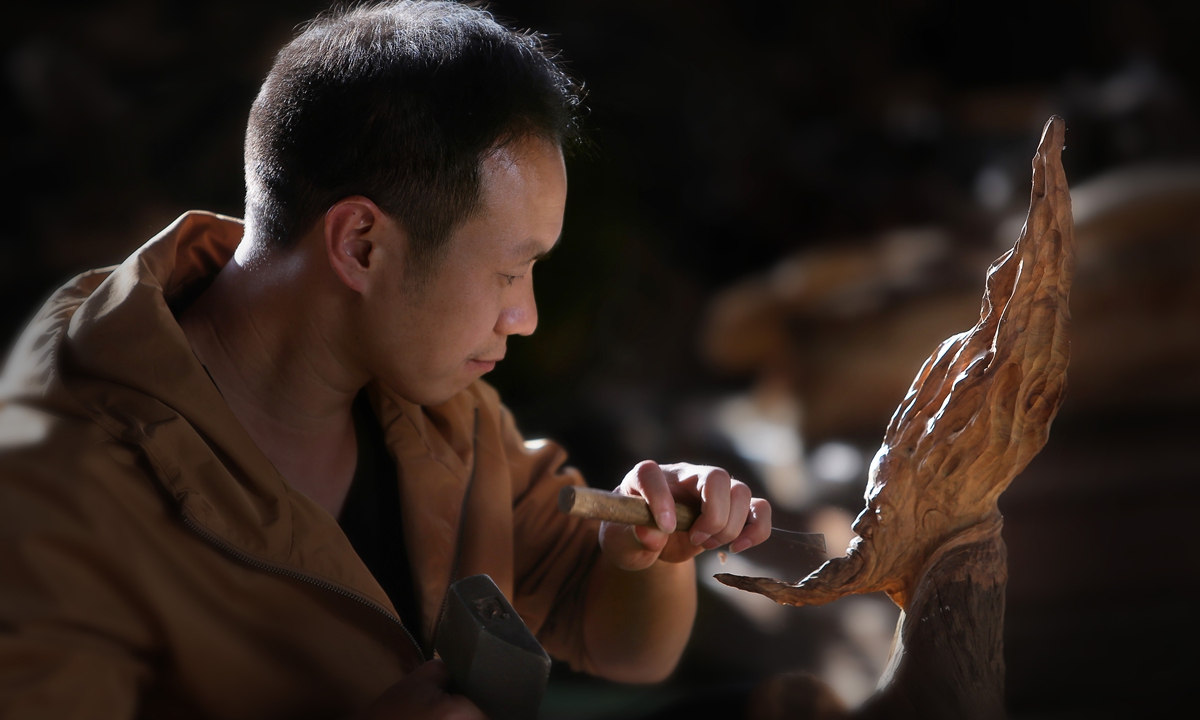
Root carving artist Chen Xing Photo: Courtesy of Chen Xing
In a sun-drenched studio in Tengchong, Southwest China's Yunnan Province, where spring seems eternal, root carving artist Chen Xing wielded his chisel along the natural grain of handpicked roots, revealing the images he envisioned in his heart. Boasting over three decades of devotion to his craft, Chen just set a Guinness World Record for the "largest-ever root carving exhibition" with 3,666 meticulously selected pieces. Through his artistry, he fuses the beauty of nature with the richness of Chinese culture, bringing greater recognition to the ancient art of Chinese root carving.Chen's creative journey is a dialogue with time and a profound resonance with nature. For 30 years, he has steadfastly embodied the philosophy of "harmony between man and nature," breathing contemporary life into this time-honored art form.
Retelling classics in wood
"Root carving has never been a solitary pursuit. It requires both long-term accumulation of experience and close teamwork," Chen told the Global Times when discussing his Guinness achievement. Over the past two decades, Chen has established a creative base in Yunnan, where he and his team have crafted nearly 20,000 pieces. The 3,666 works featured in his record-setting exhibition were all personally selected and shaped by his own hands.
Much of Chen's work is anchored in traditional Chinese culture, drawing on subjects such as Confucius and the 72 sages, the Four Great Classical Novels, and mythic figures like the Nine Sons of the Dragon. Each piece seeks to transmit the spirit of tradition. Among his most ambitious projects are the 108 Heroes of Liangshan Marsh and 800 arhats. The latter took over a decade to complete, as Chen painstakingly carved the 800 arhats, all with unique faces and expressions ranging from serene and compassionate to fierce and contemplative.
"It's all too easy to accidentally create 'twin faces,'" Chen said. To avoid repetition, he constantly adjusted his technique and meticulously shaped each figure, ultimately completing this monumental work.
For the 108 Heroes of Liangshan Marsh, Chen spent nearly 10 years going from conception to completion.
"To carve a character well, you must first truly understand them," he explained. He repeatedly read Water Margin, analyzing each hero's personality, background, and experiences to ensure the sculptures stayed true to their literary origins.
Take Li Kui, for example. To capture his fierce hatred of evil and volatile temperament, Chen sculpted his eyebrows in an upward sweep, gave him thick, bristling facial hair, and tense, defined muscles. Through these vivid features, he conveys the essence of the character, allowing viewers to grasp Li's spirit at a glance.
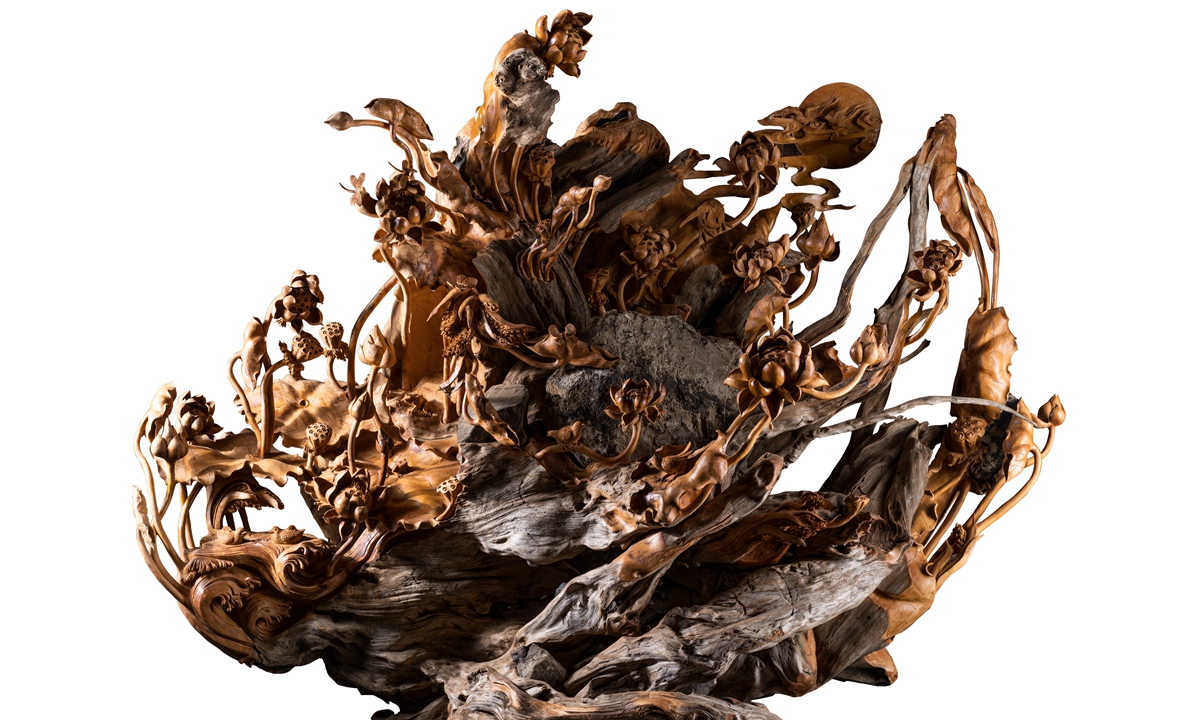
A sculpture created by Chen Xing Photo: Courtesy of Chen Xing
Letting the wood speak
Unlike other art forms that add material, root carving is about subtraction - following the root's natural form and removing excess to reveal its intrinsic beauty.
"Where nature has already shaped something perfectly, there's no need for further human intervention," Chen insists. Achieving artistic expression by yielding to nature is a principle he has always upheld, one that echoes the traditional Chinese philosophy of harmony between man and nature.
Creating a root carving involves several stages: washing, peeling, shaping, and carving. Among these, shaping is the most demanding, requiring the artist's keen judgment and experience.
When presented with a new root, Chen first studies its grain and growth patterns to determine the best orientation and theme, adapting his creative approach to the wood's natural form.
Selecting the right root remains a formidable challenge.
"Root growth is not controlled by humans; we must adapt ourselves to the wood," Chen noted. The true ingenuity of root carving lies not in transforming nature, but in complementing its imperfections - creating a harmonious blend of artistry and natural form, which is the essence of the "harmony between man and nature" ideal.
Chen's distinctive style has been shaped by the environments of both his native Yongtai in East China's Fujian Province and his long-time home in Tengchong.
The pristine ecology of Yongtai, instilled in him a deep respect for nature from an early age, while Tengchong's inclusive migrant culture, rich Chinese heritage, and pleasant climate provide a nurturing environment for his art.
"The natural and cultural landscapes of these two places give my work traditional roots and also inspire new ideas," Chen said. This dual influence lends his carvings both the enduring texture of tradition and a dynamic vitality.
As a practitioner of this intangible cultural heritage, Chen is also committed to passing on the craft.
He teaches through a "hands-on apprentice" model and by bringing root carving into local schools in Tengchong, where he offers theoretical instruction and opens his workshop to interested students.
"To do root carving, you need patience; it can't be rushed," Chen explained. He said it takes about three years to learn the basics, but more than a decade to truly excel. Mastery requires both solid skills and a calm mind.
He hopes young learners can embrace and uphold the philosophy of harmony between man and nature, while also integrating their own insights to ensure the art form's continued inheritance.
Today, Chen's works have gained wider recognition through his Guinness World Record, giving Chinese root carving a broader stage for display.
These carvings, steeped in tradition, preserve the authenticity of nature while embodying thoughtful cultural reflection, capturing the unique elegance of Eastern aesthetics.
Chinese artisans like Chen, through decades of unwavering dedication, continue to breathe new life into root carving, sustaining the ideal of "harmony between man and nature" in the modern era.
RELATED ARTICLES