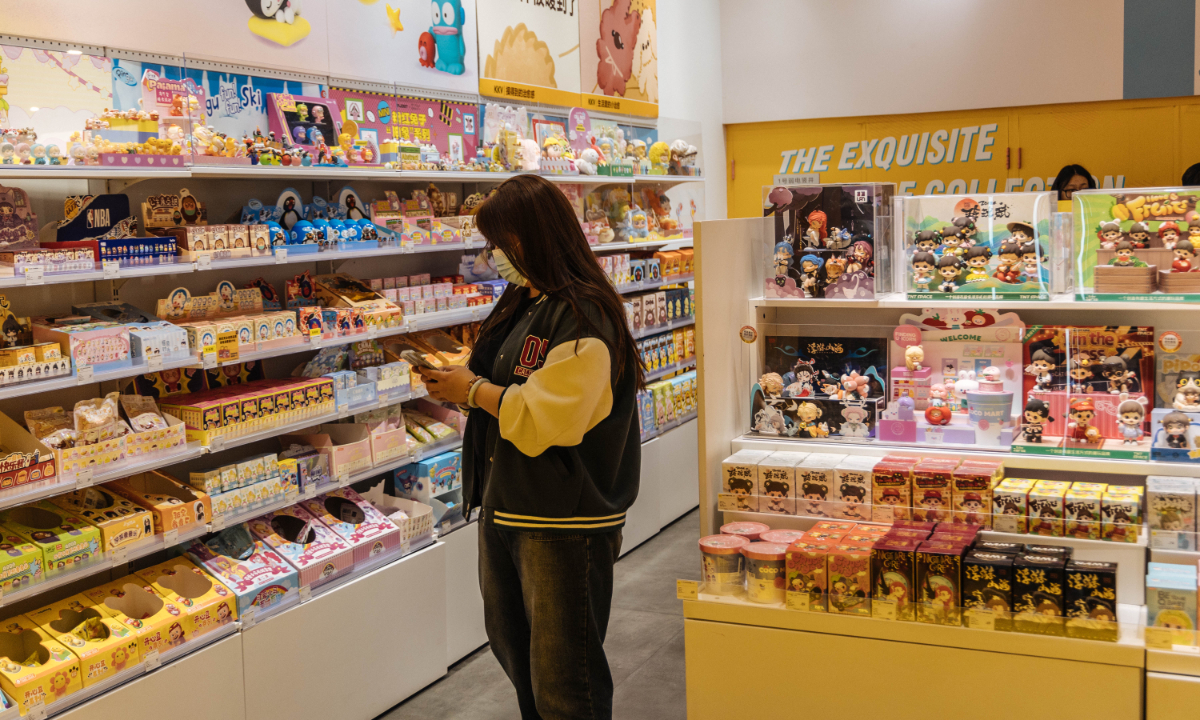
A consumer selects blind boxes in a store in Beijing. File photo: Li Hao/GT
In Kunming, Southwest China's Yunnan Province, where living costs remain relatively gentle compared to megacities, 21-year-old office worker Dong carves out a small but steady space for joy in her monthly budget. Every month, she allocates more than 1,000 yuan ($143) to merchandise tied to her favorite anime characters - figurines, badges, prints, and other collectibles that bring her instant comfort.
As the Spring Festival approached, she went further, setting aside over 3,000 yuan to commission a custom, hand-drawn illustration from an independent artist. The result? A personalized piece featuring her beloved characters, now hanging where she can see it daily.
"These things make me happy just by looking at them," Dong told the Global Times. "My salary isn't high, but this kind of spending doesn't affect my savings. Living costs in Kunming aren't that high, and I think I deserve to reward myself after a hard year."
Dong's story is far from isolated. Across China, a growing wave of young people are embracing what analysts call "emotional consumption" or "self-reward" spending. They prioritize "loving oneself first" - a mindset captured in a light-hearted catchphrase "Ai ni lao ji" that has gone viral online.
Literally meaning "love you, my dear self," the phrase has taken over Chinese social media recently. It reflects a kind of trend that Chinese young people, especially the Gen-Z, are paying more attention to their inner well-being, according to the Xinhua News Agency. As of Tuesday, the catchphrase had garnered more than 75 million views on China's social media platform Xiaohongshu, or RedNote.
In interviews with the Global Times, many young consumers are rewarding themselves through shopping, travel or small upgrades to everyday life. The question guiding spending decisions, many say, has shifted from "Is it necessary?" to "Does it make me happy?"
Self-reward spending is becoming normalized among younger interviewees, ranging from purchases of premium pet products to high-end dining. Even with modest incomes, some view emotionally driven consumption as compatible with financial discipline rather than a trade-off. Analysts say the trend has become increasingly visible as living standards improve and basic material needs are increasingly met.
'Happy' spending
Emotional value-driven experiences in pet consumption have become a widely recognized trend. A representative of GOGOGYM, the country's first pet gym, which opened in Shanghai last year, told the Global Times on Tuesday that the facility has already attracted more than 300 members.
The gym provides a comprehensive range of services, from treadmill workouts, swimming and hydrotherapy to land-based training, catering to needs from weight management to advanced fitness. It also offers rehabilitation and health assessments, enabling more targeted and long-term care for pets. Single-session services are typically priced between 300 and 500 yuan.
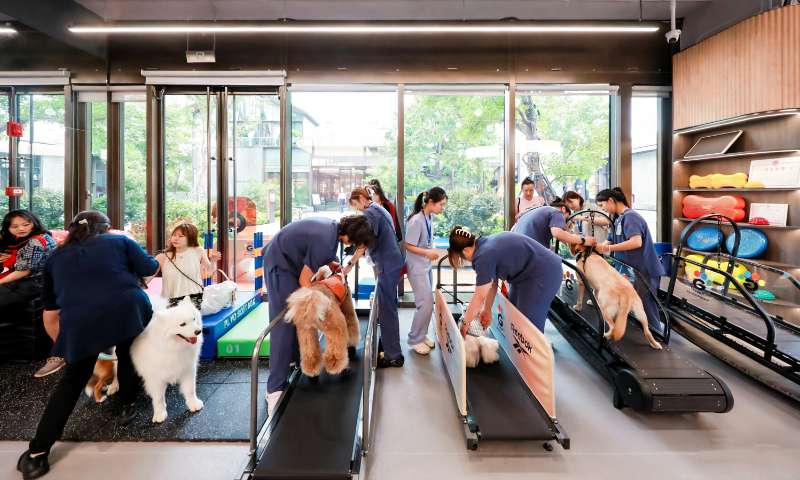
Staff members and customers take their dogs through fitness sessions at GOGOGYM, a pet gym in Shanghai. Photo: Courtesy of GOGOGYM
"In our view, our consumers are not simply purchasing a 'service,' but embracing the belief that health is a responsibility. They are willing to pay for professional assessments, tailored programs and long-term health management," the representative said, adding that customers also expect that by exercising with their pets and learning together, they can deepen their emotional bond and gain mutual emotional value from the experience.
This emotional calculus increasingly extends beyond Gen-Z, Zhang Jingrong, a 26-year-old white-collar worker in Beijing, said the approach resonates among her friends across different age groups. Each Spring Festival season, Zhang buys new clothes for herself and also for her pets.
Prices are far from trivial. Zhang said she has spent more than 400 yuan on a pet sweater and nearly 600 yuan on harness-and-leash sets, levels many pet owners would consider expensive. "My family fully supports it," she told the Global Times while shopping for pet supplies at WellTown, a mall in Tongzhou District, Beijing. "Buying things I've admired for months but hesitated to purchase feels easier ahead of the New Year," Zhang said.
"It's not just about rewarding myself," Zhang added. "It symbolizes a fresh start for the new year and a sense of rising happiness and even good fortune."
While the idea of "spending for luck" may sound abstract, analysts note that such symbolic value is increasingly priced into consumer decisions, especially in categories linked to identity, companionship and emotional reassurance.
That logic is even clearer among collectors of designer toys. Li Minghao, a 31-year-old consumer interviewed by the Global Times, said he recently bought a 999-yuan Wakuku panda toy - a purchase he would not normally make during the year. "These big dolls are expensive. I usually can't bring myself to buy them," he said. "But after receiving my year-end bonus, I bought it."
His display cabinet now holds four such figures. "I feel happy every time I see them. That feeling lasts much longer than the money I spent," he said.
Such self-rewarding behavior is not confined to holiday seasons. Dong said she also treats herself during particularly stressful times. "When overtime piles up and I feel down, I do it then, too. Mood affects health. Nothing is more important than being happy."
Emotional consumption is no longer impulsive or sporadic, but increasingly planned, rationalized and normalized within household budgets, analysts said.
Growing demand
Industry observers say a key consumption trend taking shape in the new year lies not in how much people spend, but in why they spend. Emotional returns are increasingly weighed alongside price and practicality, pushing self-reward consumption beyond basic indulgence toward higher-quality, higher-value choices.
The diversification of consumer demand is pushing companies to expand and refine product lines, rather than relying on one-size-fits-all offerings.
The trend has also prompted established brands to enter the pet market. Adidas last May announced a crossover move into pet apparel, which quickly gained strong traction among consumers. A staff member at the Adidas Originals flagship store in Sanlitun, Beijing, told the Global Times that newly launched pet sweaters for the New Year period continue to sell briskly. Priced at 369 yuan, some sizes already require restocking.
The "emotional economy" now spans cosmetics, designer toys, pet food, pet medical services, aesthetic medicine and other lifestyle-oriented sectors. More than 90 percent of young people recognize the importance of emotional value, while nearly 60 percent are willing to pay for it, according to a report on cctv.com.
China's emotional consumption market has expanded rapidly, rising from 1.63 trillion yuan in 2022 to 2.31 trillion yuan in 2024, and is projected to have reached 2.72 trillion yuan in 2025 before surpassing 4.5 trillion yuan by 2029, according to the report.
Li Changan, a professor at the Academy of China Open Economy Studies at the University of International Business and Economics, said the popularity of self-reward and emotion-driven consumption reflects both short-term emotional release and deeper, structural shifts in consumer behavior.
"Chinese consumers are gradually moving away from purely function- and price-oriented purchasing toward decisions shaped more by value, experience and emotional satisfaction," Li told the Global Times on Tuesday. He noted that among younger consumers in particular, the weight placed on practicality has declined, while emotional return, self-expression and experiential value have become increasingly important.
This shift, Li said, is reshaping the supply side, prompting businesses to move beyond one-size-fits-all offerings and develop more diversified, faster-evolving products tailored to emotional and personalized demand.
China's Ministry of Industry and Information Technology, together with five other government departments, jointly released an implementation plan in November last year to boost consumption, proposing that by 2027 the supply structure of consumer goods will be significantly optimized. Zhe plan sets out 19 priority tasks in five areas, including better aligning offerings with diverse consumer needs, cultivating new consumption scenarios and business formats, and fostering a supportive development environment.
In addition, the nation's 15th Five-Year Plan (2026-30) lists boosting consumption as a key priority, vowing to develop a batch of high-profile new consumption scenarios with broad appeal.
RELATED ARTICLES