ARTS / CULTURE & LEISURE
Convenience store blackboard turns ‘national reading’ into spiritual shelter
By Published: Jan 13, 2026 10:04 PM

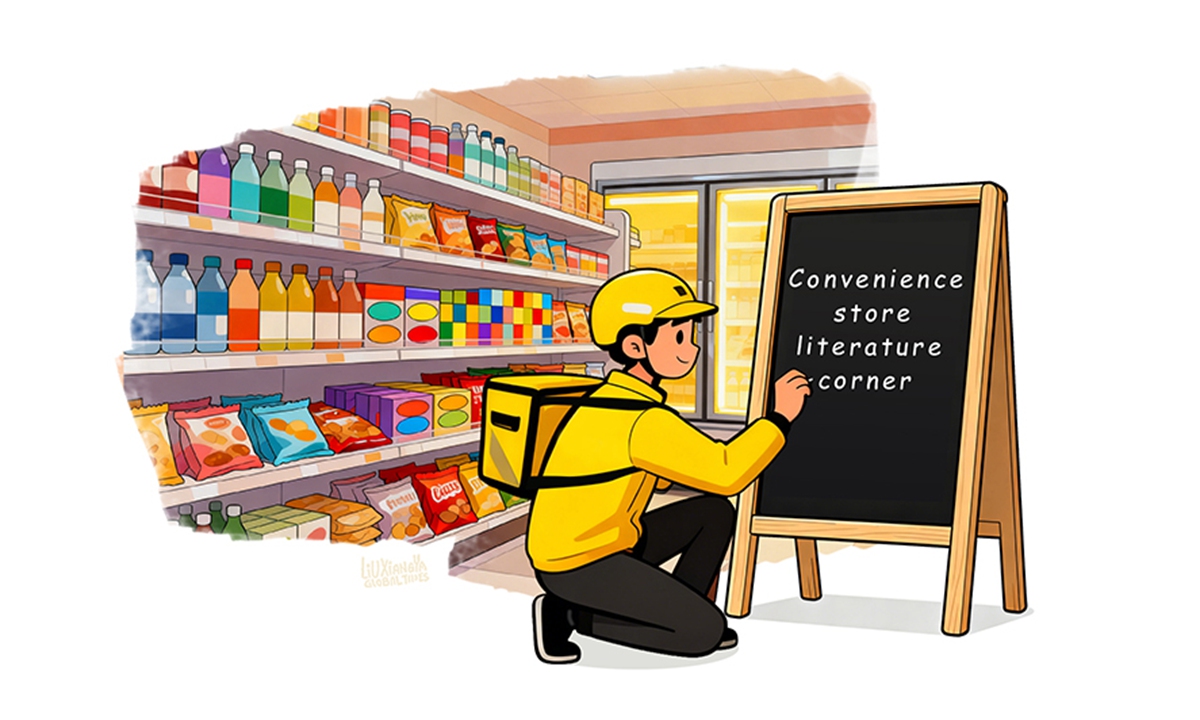
Illustration: Liu Xiangya/GT
In certain convenience stores across Central China's Henan Province, warm, handwritten words on a simple blackboard, launched by renowned Chinese author Liu Zhenyun, have captured Chinese netizens' hearts on social media.Emblazoned with Liu's opening line, "Everyone walking on the street, you have all worked so hard," the blackboard is now covered with notes scrawled by passersby: a food delivery rider marking "Just finished my last order," an office worker lamenting "Mom's dishes always expire because we come home too late," and a ride-hailing driver scribbling blessings at 2 am.
These unpolished, heartfelt messages have sparked a nationwide wave of "remote writing" online, coinciding with the imminent enforcement of regulations to promote reading among the public on February 1.
This grassroots initiative represents a striking innovation in translating the regulations into live experience. Unlike traditional libraries or bookstores that often feel formal and inaccessible, "convenience store literature corners" transform commercial spaces into intimate cultural hubs with minimal cost and maximum accessibility.
Ai Limin, director-general of the Books and Periodicals Distribution Association of China, told the Global Times that creating regional hubs for reading culture through diverse activities can effectively advance national reading initiatives.
The national reading regulations emphasize integrating reading into daily life, and these blackboards have precisely achieved the goal that by turning passive consumption of texts into active public participation.
On the blackboard, a graduate student scribbled words of self-encouragement to exemplify how literary expression can thrive on the margins of daily routines.
As Liu observed in a viral video response: "Everyone's casual writing is warm; and everyone's casual writing is their true voice."
This shift from "reading as obligation" to "writing as instinct" marks a pivotal leap for national reading, proving that cultural engagement can flourish amid the hustle of buying breakfast or grabbing a late-night snack.
Beyond its role as an innovative policy practice, the phenomenon embodies the regulations' "people-centered" principle. Article 2 of the regulations mandates that national reading efforts "adhere to a people-centered approach and strengthen cultural confidence," which is a mandate vividly fulfilled by the blackboards' unadorned sincerity.
There are no grand narratives here, only raw, relatable emotions: exhaustion, longing, and quiet perseverance. These messages conveying universal values can resonate globally, offering observers not only in China but also around the world a tender insight into Chinese society beyond its economic growth narrative.
As one netizen commented online, "The exhaustion after overtime is instantly soothed. Visiting a Henan convenience store feels less like shopping but more like recharging my batteries."
This "de-ritualized" cultural space, devoid of recommended reading lists or expert commentaries, restores literature to its essence: recording life and comforting souls.
Crucially, the movement showcases the institutional strength of "social participation" enshrined in Article 3 of the reading regulations.
The collaboration between Liu as cultural leadership, commercial platform support, and the public grassroots creation forms a synergistic model that outperforms many official initiatives.
Liu's role as a "cyber wishing well," responding to netizens' demands to expand the campaign nationwide, highlights how corporate participation can amplify cultural impact.
The convenience store initiative is but one example of this broader shift. Ning Pingping, deputy general manager of the Shenzhen Publishing Group, told the Global Times that guided by the national strategy outlined in the regulations in promoting reading, reading spaces are being reimagined as "urban cultural hubs" that connect people with culture and enhance quality of life.
Ning highlighted a flagship project in Qianhai, Shenzhen, South China's Guangdong Province, designed to serve as a cultural-tourism destination, an integrated commercial complex, and a dynamic cultural engine for the Greater Bay Area. It incorporates diverse offerings such as The Three-Body Problem VR experience center, a professional theater, and a mixed ecosystem of "reading plus cultural creativity plus technology."
"Since its opening, it has attracted over 3 million visits and reached more than 60 million visits online, receiving widespread acclaim from both the public and industry experts," said Ning.
From the grassroots blackboard messages in Henan to Shenzhen's ambitious cultural complexes, these examples illustrate that fostering a "scholarly society" relies not on a solo performance by authorities, but on a chorus of voices and forces from across society.
The blackboards' rapid spread with netizens begging for expansions to other provinces proves that cultural vitality springs from bottom-up enthusiasm rather than top-down mandates.
As the reading regulations take effect, this grassroots experiment offers a blueprint, which is to nurture a reading culture, and we need more spaces that feel like emotional shelters than educational institutions. It proves that sometimes, the most potent form of reading begins with the simple, courageous act of picking up a piece of chalk.
The author is a reporter with the Global Times. life@globaltimes.com.cn
RELATED ARTICLES