ARTS / CULTURE & LEISURE
New hall opens in Xizang to foster natl community identity
Venue helps promote ethnic solidarity: expert
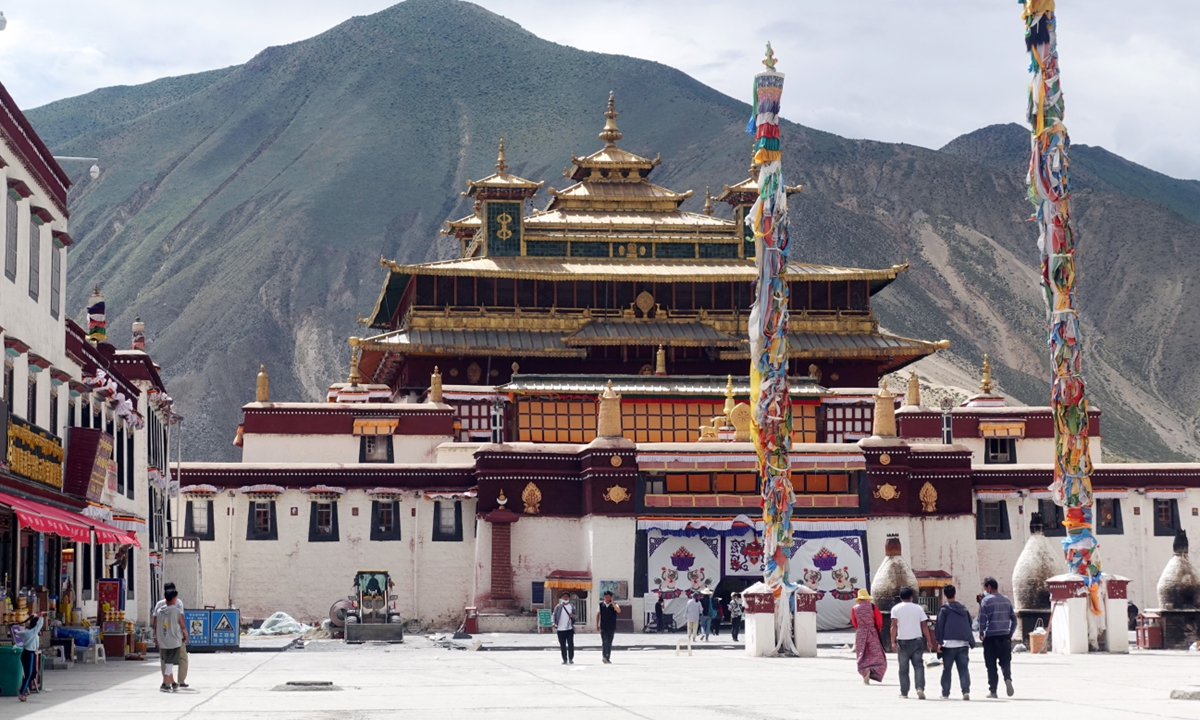
The Samye Monastery Photo: VCG
The Samye Monastery's education hall for forging a strong sense of community for the Chinese nation in Shannan city, Southwest China's Xizang Autonomous Region, officially opened to the public on Tuesday.To leverage the education hall's role in promoting ethnic unity and patriotism, the Samye Monastery management committee organized a visit on the opening day for monks, incense masters, industry workers, and practitioners.
They toured the hall and a newly established science hall, conducting a striking and profound patriotic educational event, Chinanews.com reported on Tuesday.
Tang Dong, an expert on Chinese ethnic history, told the Global Times on Tuesday that the new venue is part of efforts to help the public, especially monastic communities, foster a correct view of the history of the Chinese nation and increase the sense of identity in the Chinese nation, thereby promoting ethnic solidarity, religious harmony, and social stability.
The great Chinese nation was forged through the collective efforts of all ethnic groups. The education hall, through its exhibitions and interactive displays featuring advanced technology, helps people understand the history of the exchanges and integration among different ethnic groups, as well as the contributions made by people of all ethnic groups to the unity of the Chinese nation, Tang said.
Built in the 8th century on the northern bank of the Yarlung Zangbo River, the Samye Monastery was listed as a key cultural heritage site under national-level protection in 1996. The temple itself is also a manifestation of cultural integration, the Xinhua News Agency reported.
The monastery is seen as a perfect architectural embodiment of the harmonious fusion of Tibetan, Han, and Indian styles. It is famed for its extensive and exquisitely crafted murals and statues, which showcase a broad range of subjects and masterful techniques, as well as its wood carvings, stone sculptures, and thangkas, according to the Foreign Affairs Office of the Xizang Autonomous Region.
During the visit, the members of the monastic community received a systematic introduction to the basic national conditions of China as a unified multi-ethnic country, the historical context of the pluralistic and integrated structure of the Chinese nation, and the monastery's exemplary work in promoting ethnic unity and progress.
Through many forms such as illustrated panels, physical models, and multimedia interactions, the exhibition vividly showcased the historical tapestry of exchanges, interactions and integration among all ethnic groups, as well as the significant achievements made in the cause of ethnic unity and progress.
The science hall is equipped with modern facilities such as virtual reality (VR) devices, drones, and astronomical telescopes. Through VR headsets, monks can experience the magnificent landscapes and technological achievements of the country. They can also explore the mysteries of the universe with astronomical telescopes and acquire natural science knowledge in popular science books. This approach, which integrates traditional culture with modern technology, allows visitors to experience the nation's development and progress, thereby enhancing patriotic sentiment and scientific literacy, according to the Chinanews.com.
Next, the monastery will continue to make good use of platforms such as the education hall and the science hall to regularly carry out a variety of activities, integrating efforts to forge a sense of community for the Chinese nation into daily study, practice, and life.
The second Xizang Forum on forging a strong sense of community for the Chinese nation was held in Lhasa in September.
RELATED ARTICLES