China would have imported more if certain countries didn’t restrict export of high-tech products: senior customs official
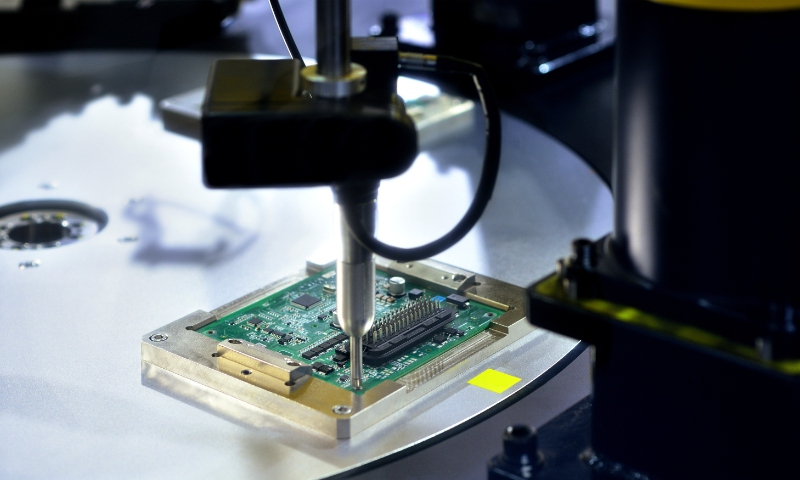
Production of semiconductor chip File photo: VCG
The export restrictions on high-tech products by certain countries to China have "politicized economic and trade issues," limiting China's potential import volume, an official with the General Administration of Customs (GAC), said at a press conference held in Beijing on Wednesday.
The remarks were made by Wang Jun, deputy administrator of GAC, in response to media questions about the continuous monthly increase in imports since the second half of 2025 and the future import outlook of China.
Data from GAC showed that, in 2025, China's imports reached 18.48 trillion yuan ($2.65 trillion), hitting a record high in volume and marking the 17th consecutive year as the world's second-largest import market.
In 2025, the international market prices for some bulk commodities declined, with import prices for crude oil and iron ore dropping by about 10 percent, dragging down the overall import value growth by 1.4 percentage points.
"Achieving the annual import growth is no easy feat under such circumstances," Wang said.
"Certain countries have politicized economic and trade issues, restricting exports of high-tech products to China by using various pretexts. Otherwise, China would have imported even more," Wang noted.
As to the reasons behind the growth, Wang highlighted that the import trends continued to improve, citing data that, starting in June, the country's overall imports have maintained year-on-year growth for seven consecutive months, with the growth rate accelerating to reach 4.4 percent in December.
Wang said that the efforts to expand imports have yielded significant results. China hosted the eighth China International Import Expo, which saw the number of participating companies reach a new high, with intended transaction value exceeding $80 billion, solidifying its role as a gateway for enterprises worldwide to access the vast Chinese economy.
Customs authorities granted market access to 190 new agricultural and food products from 65 countries and regions. Throughout last year, agricultural product imports approached 1.5 trillion yuan, while the number of overseas agricultural and food product enterprises registered with customs increased by 83,000, bringing the cumulative total to over 500,000.
Last year, China imported nearly 3 billion tons of bulk commodities, representing a 1.1% increase, and imported over 7.4 trillion yuan worth of mechanical and electrical products, marking an annual growth of 5.7%.
Last year, China's imports from over 130 countries and regions worldwide achieved positive growth, an increase of seven countries compared to 2024. Imports from Asia, Latin America, and Africa, grew by 3.9 percent, 4.9 percent, and 6 percent, respectively.
China implemented a zero-tariff policy covering 100 percent of product categories for the least developed countries with which it has established diplomatic relations, with imports from those countries growing by 9 percent last year.
"China's doors will continue to open wider, offering vast potential for import growth. The vast Chinese market remains a significant opportunity for the world," Wang said.
Global Times
RELATED ARTICLES