Zhipu AI open-sources advanced multimodal model trained on Huawei Ascend chips, marking solid step toward independent tech development
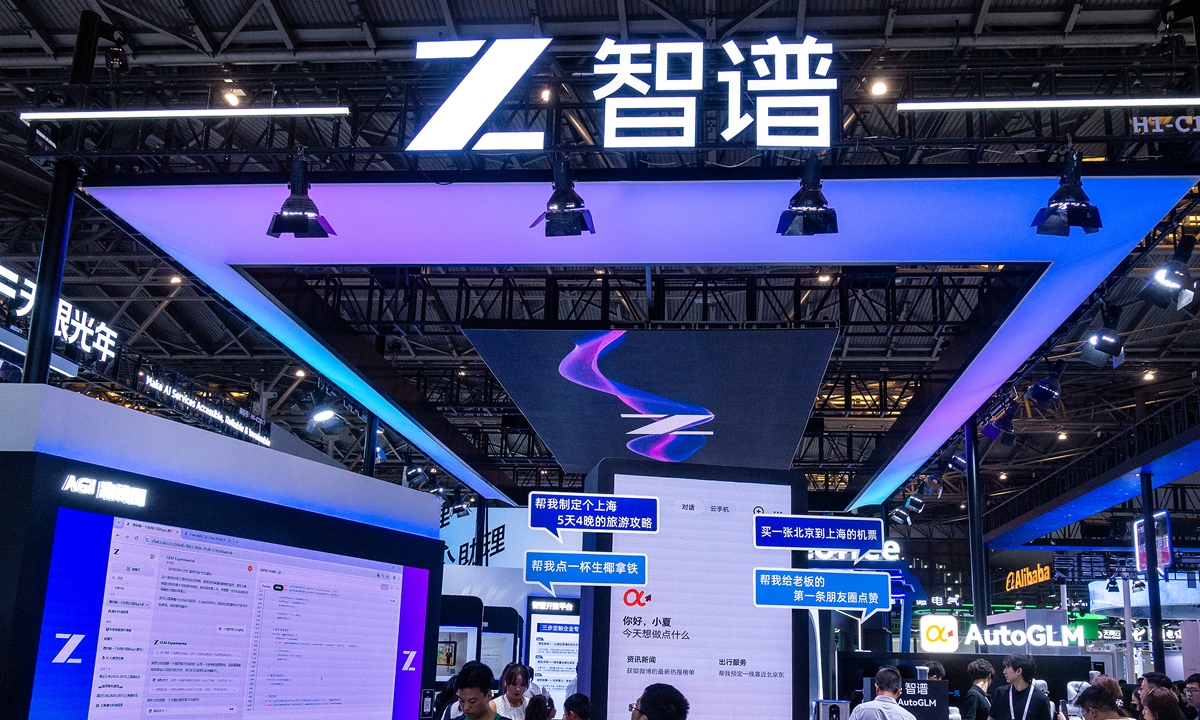
Booth of Zhipu at the exhibition hall of the 2025 World Artificial Intelligence Conference on July 28, 2025 Photo: VCG
Chinese AI startup Zhipu AI announced on Wednesday that it has partnered with Huawei to open-source GLM-Image, a new-generation image generation model that represents a state-of-the-art (SOTA) milestone in multimodal AI.
Zhipu said the GLM-Image model is the country's first multimodal AI model to be fully trained using domestically produced chips.
The open-sourcing of GLM-Image highlights ongoing efforts by Chinese AI developers and hardware providers to build a self-sustaining AI technology stack, spanning chips, frameworks, and large-scale models, a Chinese expert said.
GLM‑Image was trained end to end — from data processing to model training using Huawei's Ascend Atlas 800T A2 hardware and running on the MindSpore AI framework, making it the first open‑source multimodal model reported to reach SOTA performance after being trained on domestically developed Chinese chips, the company told the Global Times on Wednesday.
The progress marks a solid step forward for China's AI industry on the path toward independent and controllable technology. This demonstrates the feasibility of training high-performance multimodal generative models on a domestically developed full-stack computing platform, the company said.
According to Zhipu AI, GLM‑Image uses a hybrid "autoregressive + diffusion decoder" architecture that departs from the commonly used latent diffusion model (LDM) approach. The company said the new paradigm enables tighter integration between language and image generation and delivers improved results in knowledge‑intensive generation scenarios.
A research fellow at Zhipu AI told the Global Times on Wednesday that through close collaboration with Huawei, the team completed the full pipeline from data preparation to large‑scale training and inference adaptation on Ascend Atlas 800T A2 devices, with training performance approaching the practical limits of the targeted hardware after joint debugging and optimization.
"From the beginning, GLM‑Image's goal was full‑stack innovation," said Zheng Wendi, a research fellow at Zhipu AI. "We validated a new autoregressive + diffusion decoder architecture and implemented a complete training and inference adaptation on Ascend Atlas 800T A2 devices. Huawei provided timely debugging and performance-optimization support, helping us address many bottlenecks.
GLM-Image also offers a strong commercial cost profile. It integrates image generation with large language model capabilities, enabling unified multimodal outputs. Under an API-based usage model, generating a single image costs just 0.1 yuan ($0.014). An optimized, faster version of the model is expected to be released soon, the company said.
"This collaboration marks a significant advance in core technologies for the domestic AI software and hardware ecosystem, offering important validation that domestically produced chips can handle complex AI tasks," said Tian Feng, president of the Fast Think Institute and former dean of SenseTime's Intelligence Industry Research Institute. He added that it also shows China's drive for independent technological innovation has continued unabated despite external technology blockades.
In the short term, the progress is expected to boost confidence across the local AI industry chain, directly benefiting companies tied to Ascend chips and the Ascend framework, as well as partners in the Zhipu ecosystem, Tian told the Global Times on Wednesday.
Over the long term, accelerated technological self-reliance could reshape the AI computing market, reduce dependence on foreign hardware, and spur nationwide innovation. However, commercialization progress, intensifying overseas competition, and the stability of the computing‑power supply chain will still require sustained effort, Tian said.
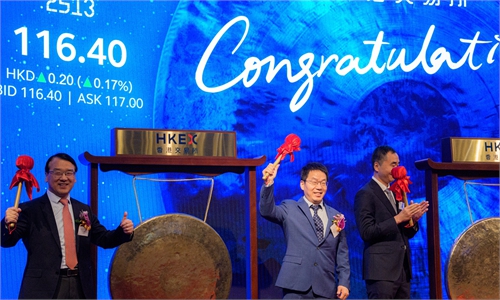
Zhipu, which OpenAI publicly identifies as a rival, has become one of the first Chinese AI firm to go public, as China's homegrown AI models move from technological exploration to large-scale commercial application. Since then, its shares have jumped more than 80 percent as investors pile in on enthusiasm about China's AI industry.
Indigenous innovation by Chinese companies is beginning to overcome the difficulties caused by the US unilateral technology blockade over the past few years. Moreover, Chinese companies are poised to continue enhancing their resilience and strengthening their research and development capabilities, said the expert.
Zhipu's move came after Huawei previously announced the full open-source release of its Ascend chip software ecosystem, aiming to support users to explore its deep potential and undertake customized development independently, the Xinhua News Agency reported in August, 2025.
Huawei said that after years of development, the company's software system Compute Architecture for Neural Networks has achieved key breakthroughs in computing optimization, communication efficiency and memory management. It is now capable of providing computing power support throughout the entire AI-model training and deployment process, Xinhua reported.
RELATED ARTICLES