ARTS / CULTURE & LEISURE
How China’s pioneering BCI system revolutionizes music therapy
Music meets neural science
By Published: Jan 14, 2026 09:29 PM

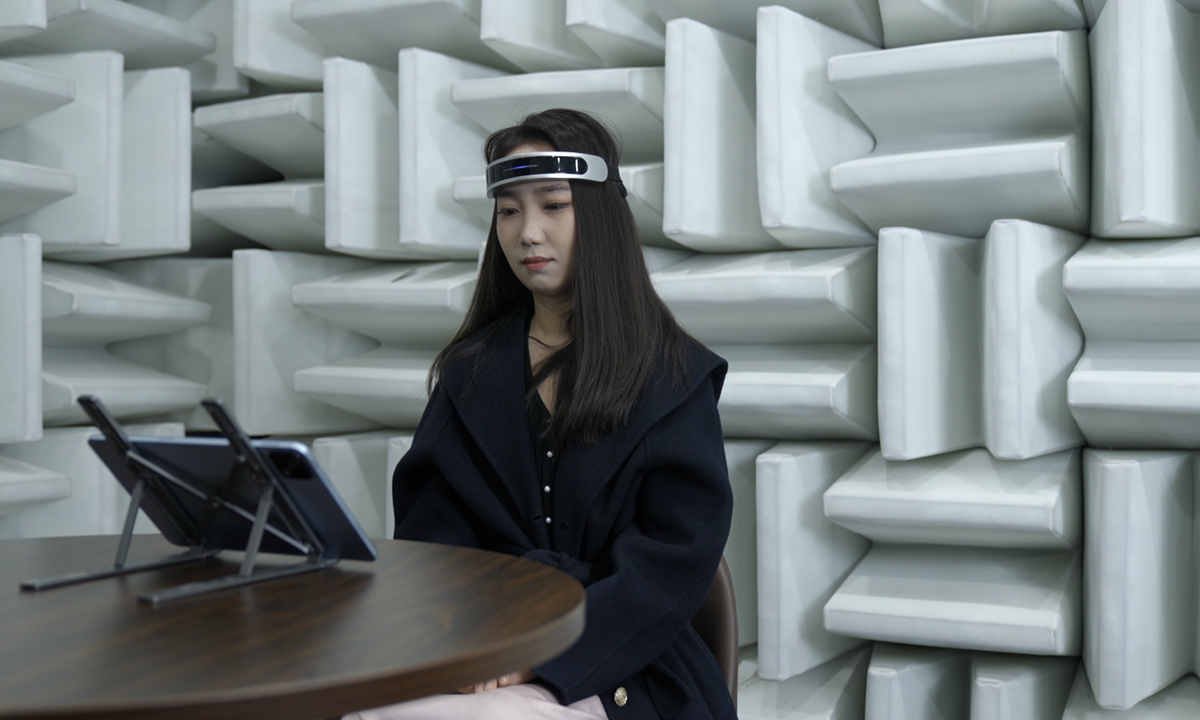
A volunteer tests the Yangyin-1 music therapy brain-computer interface system. Photo: Courtesy of Li Xiaobing
Imagine wearing a lightweight, non-invasive headband that reads brainwaves in real-time while an AI therapist's guiding voice comes through a pair of headphones - this is not a science fiction scene but a real-life test of the Yangyin-1 music therapy brain-computer interface (BCI) system developed by the Central Conservatory of Music.As China's first pioneering product deeply integrating music and neural technology, it is pushing music from an auditory art into a new scientific stage of emotional intervention that is "measurable, prescribable and closed-loop."
"This represents more than a technological advance; it marks a crucial transition for music - from subjective experience to scientific intervention," said Li Xiaobing, project leader and a professor at the Central Conservatory of Music, in a Tuesday interview with the Global Times.
"Music is the gentlest yet most powerful form of neural regulation. With the empowerment of BCIs, it will truly possess therapeutic capabilities and integrate into the future landscape of precision medicine," he noted.
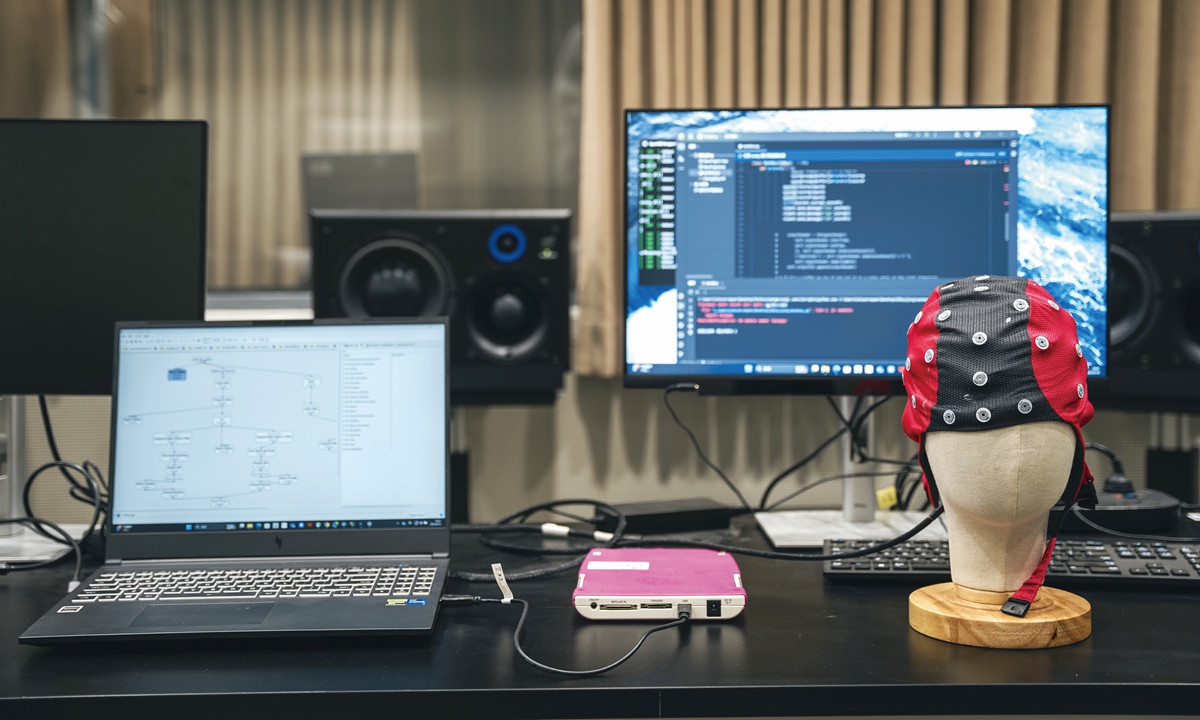
The Yangyin-1 music therapy brain-computer interface system Photo: Courtesy of Li Xiaobing
Dynamic therapy
Since its release in November 2025, dozens of volunteers have participated in testing. In a typical session, according to Li, the AI guides the user to describe details of recent events that triggered negative emotions. Combining this subjective narrative with real-time multi-modal physiological data like an electroencephalogram (EEG), the system quantifies the user's emotional state on a 0-10 scale and generates a personalized treatment plan. Each session lasts about 20 minutes, and a conventional course usually involves two to three sessions, similar in form to traditional music therapy but fundamentally different in its core approach.
"Yangyin-1 goes beyond just playing music; it is a complete closed-loop intervention system. We are not merely giving you a playlist but prescribing a dynamic musical prescription," explained Li.
The system continuously monitors neural and physiological states, uses AI to identify targetable emotional dimensions, drives a music large model to generate or adjust music within safe boundaries and tracks feedback, thereby forming a real-time interactive cycle of "assessment-prescription-adjustment."
The core of this approach lies in translating clinical experience into computable, replicable intervention. While traditional music therapy relies heavily on the therapist's subjective judgment and own experiences, the Yangyin-1 employs a dual-assessment model based on "physiological data + subjective description." It both "listens to what you say" and "watches your physiological reactions."
"Traditional methods are difficult to scale. What we aim to do is extract the scientific, structurally definable components to form a traceable and verifiable prescription system," the professor noted.
Building EEG datasets
The research team has accumulated six years of experimental data and even conducted basic research on music-neural responses in primate models. Currently, the project is collaborating with institutions like the Peking Union Medical College and Tsinghua University to advance clinical trials targeting scenarios such as insomnia and anxiety. Although the current testing scale remains relatively small due to limited device availability, it has "preliminarily verified the feasibility of the methodology."
Feedbacks from participating volunteers have been positive but also highlight areas for improvement. Some volunteers noted that the AI's initial questions felt slightly rigid, though the interaction was smoother in the middle and later stages. They acknowledged that the AI effectively helped divert attention and relax the mind, but suggested the voice could be more natural and immersive, with options for different tones and speaking speeds.
Li Sheng, one of the volunteers whose emotional score rating dropped from 7 to 0, compared traditional music therapy with AI-based music therapy. He noted that the AI's questions still feel somewhat rigid and direct, leaving considerable room for improvement. However, he also said that the AI selects music quickly and with high precision.
Moreover, privacy and security are two major concerns for users. Several participating students emphasized that the device must clearly communicate how data is processed and protected to build trust. Others expressed hope that the AI music therapist could become a "readily available emotional first-aid kit" for managing the accumulation of minor daily stresses that might not warrant seeking a professional psychotherapist.
Li, the professor, revealed that in 2026, the team plans to deepen cooperation with medical institutions to promote the translation of research results into practical applications. An ethics expert panel is also being formed to address issues like data privacy and the boundaries of emotional intervention.
"Compared with developments in the same field overseas, Yangyin-1 has indeed taken an important first step," commented Cong Caibu, a science writer focusing on the BCI field who noted that the entire application of BCIs is still in its early stages.
He analogized it to "looking back at the brick-sized mobile phones from the era of 5G," suggesting that the key to future breakthroughs lies in "establishing a sufficiently large and reliable brainwave database," which requires long-term, solid data accumulation and technological iteration.
Looking ahead, Li predicts a future of greater convenience: "In the future, users might only need a pair of earphones to access personalized music intervention support in their daily lives."
He said the system will help enhance China's international discourse power in the field of music AI through reproducible experimental paradigms, multi-modal data standards, and platform ecosystem development. As this technology moves from the laboratory into everyday life, the integration of music and technology is redefining how we manage our mental well-being.
RELATED ARTICLES