UBTECH
As 2026 dawns, China's hard-tech sector is accelerating the transition from prototype testing to full-scale commercialization, with leading firms in emerging areas such as embodied intelligence and the low-altitude economy unveiling rising production targets compared with last year.
This shift marks what industry insiders are calling the "year of scaling up," driven by policy support, technological breakthroughs, and surging market demand, potentially injecting new vitality into China's economy.
UBTECH, a Shenzhen-based pioneer in humanoid robotics, has set an ambitious production capacity target of 10,000 units for 2026. Its deliveries in 2025 exceeded 500 units.
UBTECH, widely regarded as the "first stock in humanoid robotics," agreed to acquire Zhejiang Fenglong Electric Co, a machinery parts manufacturer, in December, according to companies' statements.
"The manufacturing capability of Fenglong Electric will provide crucial support to achieve UBTECH's 2026 scale production goal of industrial humanoid robots. The acquisition will also help realize the synergy of the industrial chain," Tian Feng, president of the Fast Think Institute and former dean of Chinese artificial intelligence (AI) software giant SenseTime's Intelligence Industry Research Institute, told the Global Times on Wednesday.
News of the acquisition pushed up the share price of Fenglong Electric, which announced a trading suspension starting from Wednesday due to a significant abnormal short-term rise in its stock price.
Companies in other hard-tech areas are scaling up similarly. For example, to meet the rapidly growing demand for LiDAR in Advanced Driver Assistance Systems (ADAS) and robotics applications, Hesai Technology plans to double its annual production capacity to 4 million units in 2026, the company said in a statement sent to the Global Times on Wednesday.
The company attributed its confidence in doubling its planned annual capacity to its robust in-house intelligent manufacturing capabilities. In addition, construction of Hesai's new factory in Bangkok is progressing steadily, and the facility is expected to begin operations in early 2027.
Hesai has achieved year-on-year doubling of annual delivery volumes for five consecutive years. In 2025, Hesai also accomplished the milestone of producing 1 million LiDAR units in just two months, the Global Times learned.
These consistent breakthroughs in capacity and delivery volumes are underpinned by Hesai's long-term technological accumulation and strong market recognition, analysts said.
Chinese automaker XPeng also announced a mass production plan related to flying cars and humanoid robots.
In 2026, XPeng will usher in the landing and large-scale mass production of physical AI, officially marking a key transition from technology exploration to practical application, He Xiaopeng, co-founder and CEO of XPeng, said on January 8 during a live broadcast of the company's new product launch.
He announced the launch of Robotaxi operations in 2026, as well as large-scale mass production of humanoid robots and flying cars.
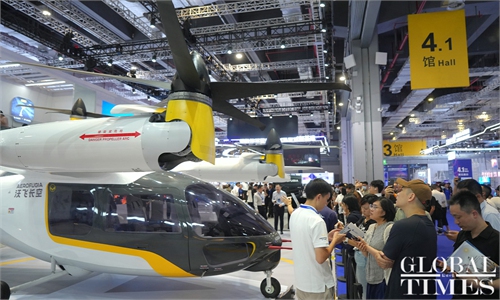
XPeng's flying car factory in Guangzhou, South China's Guangdong Province, which was at the trial production stage in November, can produce one vehicle roughly every 30 minutes when fully operational. The first customer delivery of mass-produced flying cars is scheduled for late 2026, the Global Times learned from the company.
Analysts pointed out that this mass production momentum extends beyond individual firms. This year, China will see sustained high-speed growth in emerging areas, such as the low-altitude economy, AI and humanoid robotics, transitioning from early applications to deep penetration.
Apart from the companies that are expected to scale up production in 2026, some other tech firms are moving forward in other ways.
For example, NeuroXess, a Chinese neurotechnology company specializing in brain-computer interfaces (BCI) for medical treatment, has broken ground on its "super factory" project in Ganjiang, East China's Jiangxi Province. The facility is expected to be completed and put into operation in the second half of 2026, according to the company.
"We are not merely laying the foundation for a factory - we are embarking on a new industrial path of 'technology benefiting life.' Robust backing from the local government has provided a fast track for the rapid industrialization and commercialization of cutting-edge technologies such as BCI," Tao Hu, founder and chief scientist of NeuroXess, told the Global Times on Wednesday.
Analysts noted that continued technological breakthroughs have enabled tech companies to transition from small-batch trials to large-scale production and ecosystem building.
Economically, this "year of scaling up" could drive high-quality growth, as it injects vitality into new quality productive forces, buffering external uncertainties, according to analysts.
RELATED ARTICLES