China's record-breaking 45-trillion-yuan foreign trade volume in 2025 offers a window gauging into the economy's resilience, competitiveness
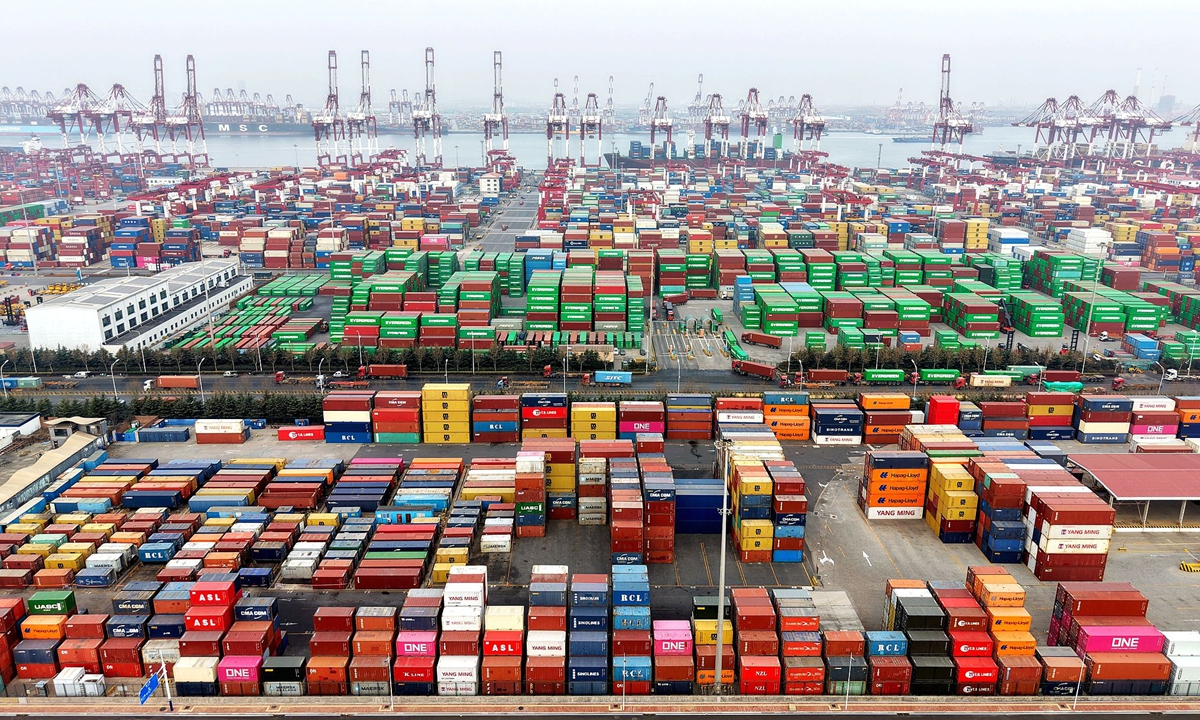
Containers are loaded at the hustle and bustle of Qingdao port in East China's Shandong Province on January 14, 2026. Photo: VCG
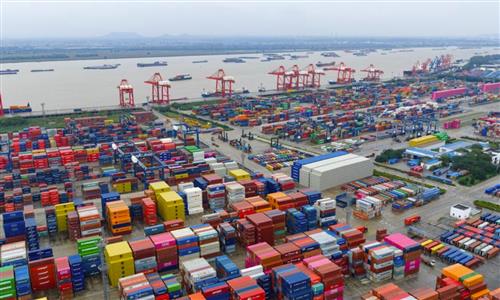
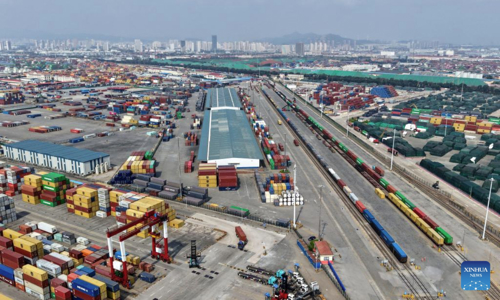
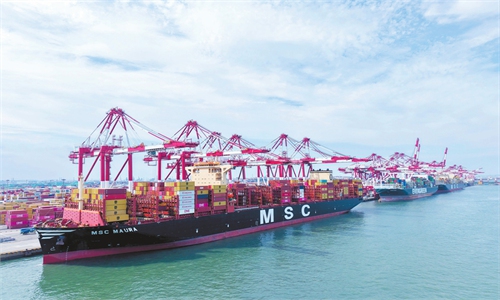
China's foreign trade in goods grew by 3.8 percent year-on-year to reach 45.47 trillion yuan ($6.51 trillion) in 2025, hitting a new record and marking the first time that the volume has exceeded the 45-trillion-yuan threshold, official data showed on Wednesday. And the country maintained its position as the world's largest trading nation in goods last year.
As China navigated through a bunch of internal and external uncertainties throughout the turbulent 2025 - ranging from rising geopolitical tensions, tariff wars to weak global demand - the record-breaking reading not only offers a window gauging into the strong resilience, adaptability and competitiveness of its foreign trade engine, but also underscores the country's irreplaceable role as both locomotive and stabilizer of the global supply chain, observers said.
China's exports grew by 6.1 percent year-on-year to reach 26.99 trillion yuan last year, while imports grew by 0.5 percent year-on-year to reach 18.48 trillion yuan, according to data released by the General Administration of Customs (GAC) on Wednesday.
"Under the complex situation where the international environment undergoes profound changes and the global economic and trade order faces major challenges, the achievements in China's foreign trade sector are extraordinary and hard-won," Wang Jun, deputy head of the GAC, said at a press conference on Wednesday on the release of the data.
"The performance has beaten the market expectation, especially taking account that the effects of China-US trade conflicts, rising global tariffs and the appreciation of the Chinese yuan against the US dollar were kicking in," Tian Yun, an economist based in Beijing, told the Global Times on Wednesday.
In 2025, China's goods imports reached 18.48 trillion yuan, setting a new historical record, and the country has maintained its position as the world's second-largest import market for the 17th consecutive year, according to Wang. "Some countries are politicizing economic and trade issues, imposing restrictions on exports of high-tech products to China under various pretexts. Otherwise, China would import even more," Wang said.
Tian noted that the 0.5-percent growth in imports, though modest, still carries great ramifications in terms of how China has been sharing its development dividends with the world - backed up by a consumer market of 1.4 billion people. This growth is particularly evident in the noticeable import growth from developing countries and least developed countries, he added.
Better quality, larger quantity
The development trajectory of China's foreign trade was vividly illustrated by the experience of Zhu Qiucheng, CEO of Ningbo New Oriental Electric Industrial Development, an exporter specializing in pet furniture and home furnishing products.
2025 proved a volatile year for Zhu amid downward pressure on global trade. But Zhu's company still managed to achieve an impressive business growth of 25 percent to 30 percent, which he believes was a combined result of market diversification strategy and product innovation efforts.
Likewise, China's export market was increasingly diversified last year. The country has established trade ties with over 240 countries and regions, and its trade with over 190 countries and regions reported positive growth, customs data showed.
While China's trade with the US plunged last year, the slew of data highlighted a 6.3 percent year-on-year increase in trade with Belt and Road partner countries, accounting for 51.9 percent of the country's total foreign trade value. China's trade with ASEAN grew by 8 percent year-on-year, trade with Latin America rose 6.5 percent year-on-year, and trade with Africa jumped 18.4 percent year-on-year, according to the GAC.
"The figures show that Chinese traders have shaken off the tariff clouds posed by the US. The group has made substantial progress in diversifying export destinations, while an increasing number of countries have been actively looking to strengthen trade ties with China in pursuit of certainty and stability," Zhou Mi, a senior researcher at the Chinese Academy of International Trade and Economic Cooperation, told the Global Times on Wednesday.
Also China's high-tech exports have been gearing momentum, a trend that is in line with the country's industrial upgrade, customs data showed.
Numerous milestones were recorded last year. For example, China's exports of high-tech products climbed 13.2 percent year-on-year to reach 5.25 trillion yuan in 2025. In particular, the exports of industrial robots jumped 48.7 percent last year, with exports exceeding imports for the first time, which transformed China into a net exporter of such robots.
Commenting on China's AI exports last year, Wang Jun said at the press briefing that China's material-handling robots are equipped with vision systems and algorithms that enable them to avoid obstacles, and welding robots can automatically scan and model work pieces and calculate optimal welding solutions. "These two types of robots have demonstrated strong capabilities in overseas infrastructure, transportation, and other large-scale construction projects, with export growth rates in 2025 reaching roughly over 60 percent," Wang said.
When asked about the product innovation and upgrade strategy, Zhu said the company draws inspiration from Pop Mart's approach and has launched IP-based, limited-edition DIY assembly wooden products, which has given it strong pricing power.
Analysts also believe the success of China's foreign traders, including Zhu, also mirrors how the world's second-largest economy, defying headwinds, forges a path of steady progress by prioritizing innovation and embracing openness. This approach also allowed the country to achieve its annual GDP growth target of around 5 percent last year, they said.
Upbeat outlook
Regarding the foreign trade situation this year, overall, global trade lacks growth momentum, and China's foreign trade development still faces a severe and complex external environment, Wang Jun said.
"At the same time, we must recognize that China's institutional strengths, market advantages, industrial system strengths, and talent resource advantages have become more prominent. Our trade partners have become more diverse, and risk resistance capabilities have been significantly enhanced. The fundamentals of China's foreign trade remain solid," the official said.
Zhou also expects China's foreign trade to grow in a stable and sound manner this year. "This year marks the beginning year of China's 15th Five-Year Plan (2026-30), so this stability not only refers to a stable increase in trade volume, but also more stabilizing economic relations with major trading partners," Zhou noted.
Tian said that although downward pressure due to geopolitical tensions could weigh in this year, it is likely that China's foreign trade could grow at around 5 percent this year, which will further drive the total volume to hit the 46-trillion-yuan threshold.
"China's standing in the global industrial and supply chain will be further cemented," Tian noted. Analysts expect that this year, China is likely to sustain and accelerate import momentum as more measures to stimulate domestic demand gradually take effect.
RELATED ARTICLES