ARTS / CULTURE & LEISURE
Tech reveals secrets behind 800-year-old Chinese mummy’s excellent preservation
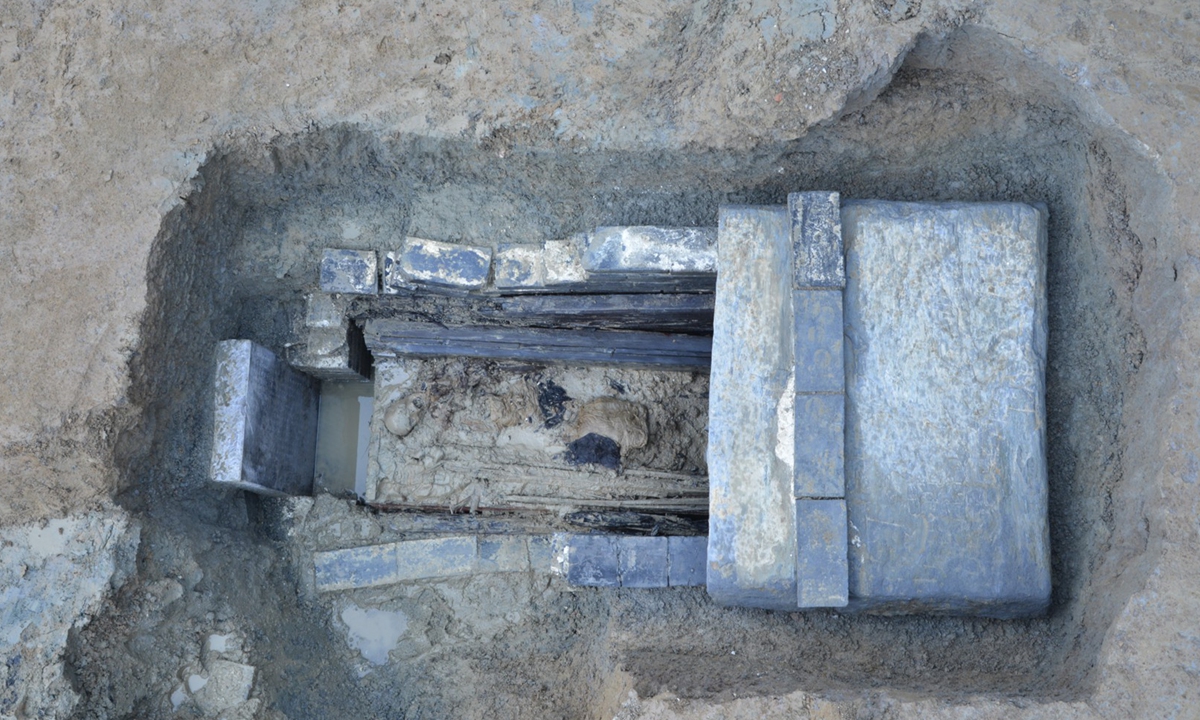
Photo: Courtesy of Wen Shaoqing
Chinese researchers have uncovered how an 800-year-old Southern Song Dynasty (1127-1279) mummy remained remarkably preserved and fragrant, shedding new light on ancient embalming practices in East Asia.The body, excavated in Changzhou, East China's Jiangsu Province in 2018, belonged to a 52-year-old man. The body measured 153.3 centimeters in length and weighed 12.2 kilograms. The mummy had exquisitely preserved skin, hair and nails. Like most Chinese and Korean mummies, he still had freely flexible joints, and his skin was soft and elastic.
For ancient genome research, the humid soils of the lower Yangtze River have long posed a challenge, often leaving ancient human remains and their DNA highly degraded after centuries. But archaeologists were surprised to find that the body was not only well preserved in appearance, with the brain and internal organs intact, but still emitted an unusually strong fragrance.
To probe the causes of this unique preservation, researchers from Fudan University spearheaded a multidisciplinary study that used full body CT scans, systematic anatomical dissection, ancient DNA sequencing, isotope analysis and chemical tests for embalming materials.
"We have found that mercury and cinnabar were directly introduced into the intestinal cavity of the corpse through an enema," said Wang Bangyan, a postdoctoral researcher at Fudan University's Human Phenome Institute. He explained that the body's preservation is attributed to a unique embalming technique developed in East Asia.
Mummies were not limited to Egypt. Ancient Chinese also mastered the use of mercury, cinnabar, and spices brought via the Maritime Silk Road to preserve bodies and keep them fragrant. In China, artificial mummification was mainly practiced during two periods: from the Warring States Period (475BC-221BC) to the Western Han Dynasty (206BC-AD25), and during the Song (960-1279) and Ming (1368-1644) dynasties. Unlike mummies in Egypt and Europe, which have been extensively studied, the embalming techniques and preservation methods of East Asian mummies have yet to undergo comprehensive scientific investigation, experts said.
Mercury and cinnabar have been used as preservatives or fixatives in both Eastern and Western mortuary practices. In medieval Europe, some elite mummies had their internal organs removed and their empty cavities filled with mercury. However, the Changzhou mummy had mercury directly introduced into the intestinal tract. Its cinnabar treatment also differed from Egyptian or European practices, being applied to the end of the intestines rather than rubbed on the body's surface.
Researchers rehydrated the Changzhou mummy's organs, producing both liquid and air samples. The resulting liquid was clear and colorless but emitted a strong, lingering fragrance. Chemical analysis revealed that the mummy contained high concentrations of aromatic substances such as ambergris, along with smaller amounts of frankincense and agarwood.
Wen Shaoqing, an associate professor at Fudan University's Institute for Scientific Archaeology, told the Global Times that the exact proportions of the aromatic embalming formula remain unclear, but the discovery has lifted the veil on ancient Chinese mummification techniques.
This multifactorial investigation of the Changzhou Mummy has reconstructed his ancestral origins, health and disease profile and life history. The study reflects a unique mortuary practice in China: Elaborately stuffing with hydrargyrum and mercuric sulfide into the digestive tract for mummification purposes. The study broadens knowledge on the technical and symbolic aspects of Eastern embalming, according to Wen.
Beyond the scientific implications, the study offers a window into Southern Song society. Wealthy landowners living in Changzhou during the Southern Song Dynasty could afford the luxury of spice-based embalming after death, reflecting the prosperity of the Maritime Silk Road spice trade and offering deeper insight into social life at the time.
The findings, titled "Multidisciplinary exploration of ancient atherosclerosis: paleo-genomic and paleo-nutritional analysis of a 13th century artificial mummy in China," were published in the Journal of Genetics and Genomics on Tuesday.
RELATED ARTICLES