E-commerce and challenges of air cargo amid decarbonization
Aviation shift in China


Gianni di Giovanni, chairman of Eni China
According to a recent ranking of the world's 20 most important airports in terms of tonnage handled, eight are located in Asia, including four in China, with the Hong Kong Special Administrative Region and Shanghai at the top of the list. In addition to this snapshot, there are numerous Chinese hubs that are driving the growth of air transport for e-commerce.This premise is essential for analyzing outbound air transport from China to the rest of the world. While China and, more broadly, Asia leads the global air cargo market, assessing the current scenario is more challenging due to incomplete data for 2025, which presents a chiaroscuro effect stemming from China-US routes.
The stop-and-go nature of tariffs has characterized moments of fluctuation depending on presidential executive orders and the resulting short-term decisions to seize opportunities for shipments with the benefit of reduced tariffs.
In Europe, demand has weakened, influenced by certain decisions and actions taken by the European Union. Additionally, it is important to consider the Middle Eastern hubs that are creating a logistical bridge between China and Europe.
Over this conventional cargo transport situation looms the cross-border traffic fueled by e-commerce.
Taking the 42nd week of 2025 as a reference, the week following the early October holidays in Asia, global tonnage transported increased by an average of 6 percent, especially from Asian airports, which saw a 14 percent weekly increase and an 8 percent year-on-year increase. During the same period, air freight rates remained stable for flights toward Europe and increased by 2 percent for those heading to the US.
Volatility was recently observed following negotiations between the US and China heads of state during the APEC meeting in South Korea. In the month before the Christmas holidays, there was no noticeable trend of overbooking, particularly when heading toward Europe.
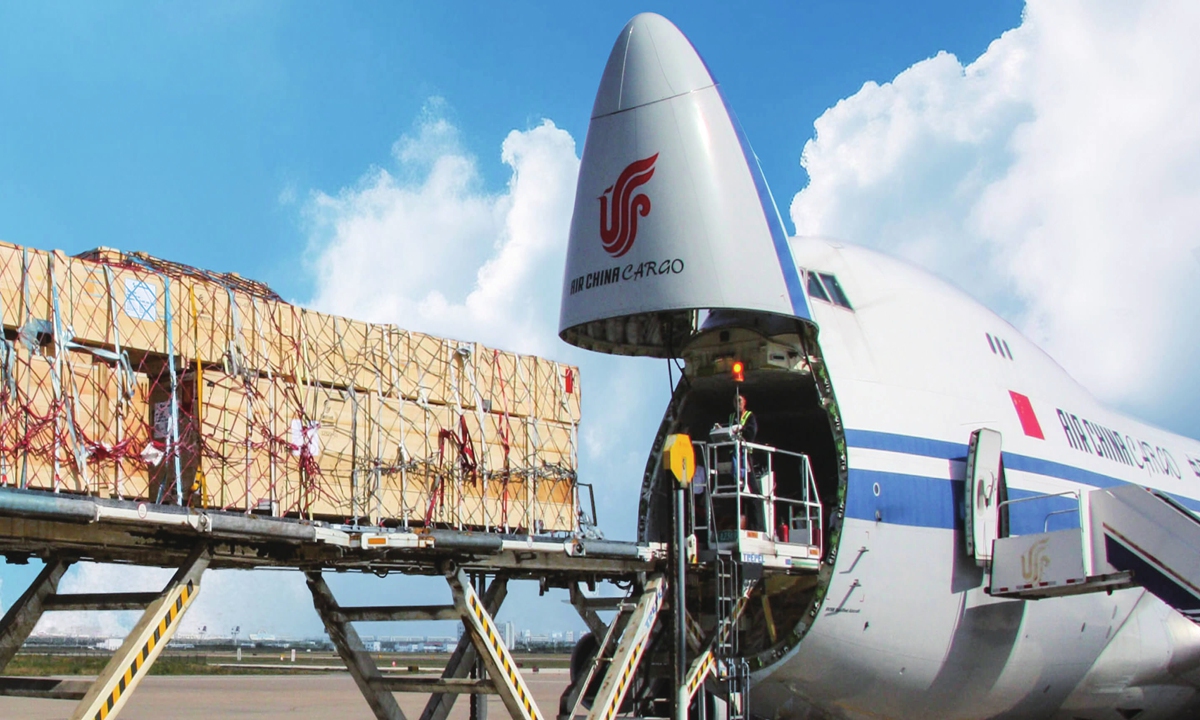
A worker loads cargo into an Air China plane.Photos: Courtesy of MF/Milano Finanza
Further confirmation of connectivity between China and Arab countries can be seen in two examples demonstrating the geopolitical shift and the attractiveness of the air segment of cross-border trade.Etihad Cargo, the division of the United Arab Emirates' Etihad Airways, signed a cooperative agreement in the summer of 2025 with a secondary but very active Chinese airport, Ezhou Huahu in Central China's Hubei Province, aimed at expanding cross-border operations, cold chain logistics, and the transport of high-value technological products.
Another example is Chengdu Airport in Southwest China's Sichuan Province, which has taken the initiative to operate directly with a cargo plane to the Middle East.
Qatar Airways Cargo and Cainiao, Alibaba's logistics company, have also entered into a collaborative agreement for more efficient distribution not only to the Middle East but also to Africa and Europe.
If global growth for 2026, according to the International Monetary Fund's estimates, is projected at 3.1 percent, the maneuvering space in air transport will not be very wide, particularly for two factors. The first is the implementation of a charge, decided by the EU, of 2 euros ($2.33) on every package valued below 150 euros starting in January, aimed at mitigating the influx of fast fashion and ultra-fast fashion products. The opening of a Shein store in Paris, France, in the traditional temple of Galeries Lafayette, was an innovative event concerning European traditions and was well received by young consumers of the brand.
In the US, the exemption for packages valued below $800 has already been eliminated, subjecting them to the corresponding tariffs.
The second factor is the cost of jet fuel, particularly in relation to attempts to reduce carbon dioxide emissions. Jet fuel accounts for 9 percent of all refined petroleum, but in Europe, oil companies avoid producing this derivative due to processing costs, resulting in a significant portion of the product being transferred daily from the Middle East, India, and Central Asia.
Some, including Italy's largest oil company, Eni, are considering alternative solutions to jet fuel and are promoting research and experimentation of sustainable aviation fuel (SAF), produced from non-fossil sources, such as used cooking oil (UCO).
"A concrete example concerns the development of SAF supply chains based on local raw materials, particularly UCO, to support the decarbonization of aviation," explained Gianni di Giovanni, chairman of Eni in China, in a recent presentation in Beijing. "Both Europe and China consider SAF the main pathway in the medium term, thanks to the compatibility of existing infrastructure." According to the International Air Transport Association (IATA), the global airline association, SAF can contribute up to 65 percent of the total emissions reduction in the sector by 2050. And China, a major air market and regional transport hub, has a unique competitive advantage in UCO feedstock. "It can be said that, for biofuels, China represents what Saudi Arabia represented for oil in the last century," concluded the manager.
However, evident challenges remain: SAF costs are still 2-5 times higher than conventional jet fuel; there are no binding blending mandates or strong demand signals. Therefore, without a stable and predictable framework, utilization rates of facilities remain low.
The EU has taken a step in the right direction by introducing Refuel EU Aviation with increasing mandates and significant support through EU ETS (approximately 1.5 billion euros in free allowances during the initial period); in the US, the SAF Grand Challenge and federal incentives are driving investments and demand.
Decarbonization and consumption appear paradoxically to be an oxymoron, but in the near future, a reconciliation must be found.
RELATED ARTICLES