IN-DEPTH / IN-DEPTH
Global South students learn from China’s water management practices; IAHS president highlights integrated innovation
By Published: Jan 15, 2026 10:41 PM

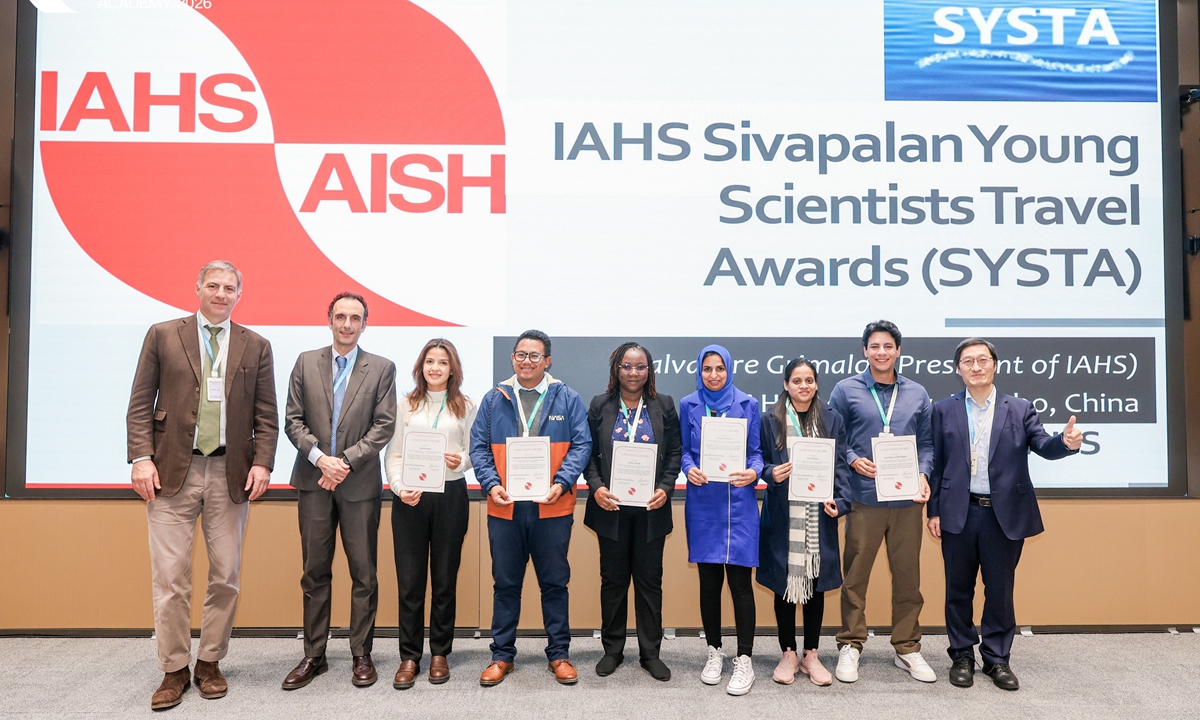
Six young scholars from different countries receive IAHS Sivapalan Young Scientists Travel Awards (SYSTA) and get funding to participate in the water governance capacity training program in China. Photo: Courtesy of Eastern Institute of Technology, Ningbo
A total of 45 university students from nearly 20 countries and regions, including Ghana, South Africa, Algeria, Madagascar, Brazil, and India, are taking part in a one-week training program from Monday to Sunday in China organized by the International Association of Hydrological Sciences (IAHS) Academy to learn from China's water management practices and global cutting-edge technologies.Amid growing global concern over water security and climate-driven disasters, the program aims to strengthen practical capacity in hydrological science and water management, particularly for developing countries. China was selected as the host country as its integrated approach to intelligent water conservancy - covering flood and drought control, water allocation, and disaster resilience - has attracted increasing international attention.
In recent years, many countries in the Global South have faced intensifying water challenges, including more frequent extreme hydrological events such as floods and droughts, alongside worsening tensions between water supply and demand. Observers note that inadequate water infrastructure and limited technological capacity remain key constraints preventing many developing countries from responding effectively to these risks.
Against this backdrop, master's and doctoral students, together with several scholars from Global South countries, have come to China for specialized training in hydrological science and water conservancy engineering. They aim to learn from China's experience in intelligent flood and drought control, optimal water allocation, ecological water projects, and a development pathway characterized by the adaptation of advanced technologies to national conditions. Many participants believe that Chinese practices - such as hydrological modeling, digital twins, advanced monitoring systems, and groundwater modeling - are closely aligned with the real needs of their home countries.
"These international students will not only systematically learn advanced water conservancy technologies, but also gain first-hand insight into how China's water projects address complex natural and social challenges," Tian Fuqiang, full professor in the Department of Hydraulic Engineering at Tsinghua University and one of the program's lecturers, told the Global Times. He said the program helps cultivate urgently needed water professionals for developing countries while strengthening technical exchange and experience sharing, injecting new momentum into global water governance cooperation.
Salvatore Grimaldi, president of the IAHS, told the Global Times that the IAHS Academy was initiated to advance IAHS's long-standing mission of inclusiveness, scientific collaboration, and societal impact. He noted that individual research alone is often insufficient to address complex water challenges, making platforms like the IAHS Academy essential for connecting young researchers and translating scientific knowledge into practical solutions.
According to Grimaldi, China's water management experience is particularly valuable because it integrates large-scale infrastructure, digital technologies, and systematic governance. Rather than relying on isolated measures, China has developed coordinated systems that link monitoring, forecasting, and decision-making, an approach he said offers important lessons for many countries facing similar constraints.
He highlighted the Intelligent Flood Sensing and Forecasting Equipment System developed by Tsinghua University as an example of such innovation. The system integrates advanced sensing, real-time data acquisition, and intelligent forecasting into a unified platform. "This kind of all-in-one solution represents a significant step forward beyond traditional fragmented approaches," Grimaldi said, adding that it holds strong potential for global application - not only in flood-prone regions, but also in arid and semi-arid areas increasingly affected by extreme rainfall and flash floods.
A Brazilian graduate student, Felipe Martins Pineroli, specializing in hydrological engineering said the training had reshaped his understanding of water management. "Before coming to China, I mainly knew about China's water conservancy achievements through academic papers," he said. "Here, I saw how digital twin technology is actually applied in large-scale reservoirs and river basin management. China's experience shows that we don't need to copy expensive Western models - we can adopt cost-effective, context-appropriate technologies. This is exactly what our country needs."
He added that he plans to bring these technologies and management concepts back to Brazil to support flood control and water management efforts at home.
The IAHS Academy is jointly organized by the IAHS, World Meteorological Organization, the UNESCO Intergovernmental Hydrological Programme, the Eastern Institute of Technology in Ningbo, and Tsinghua University.
RELATED ARTICLES