China trims US treasury holdings by $6.1 billion in November, reaching lowest since 2008: report
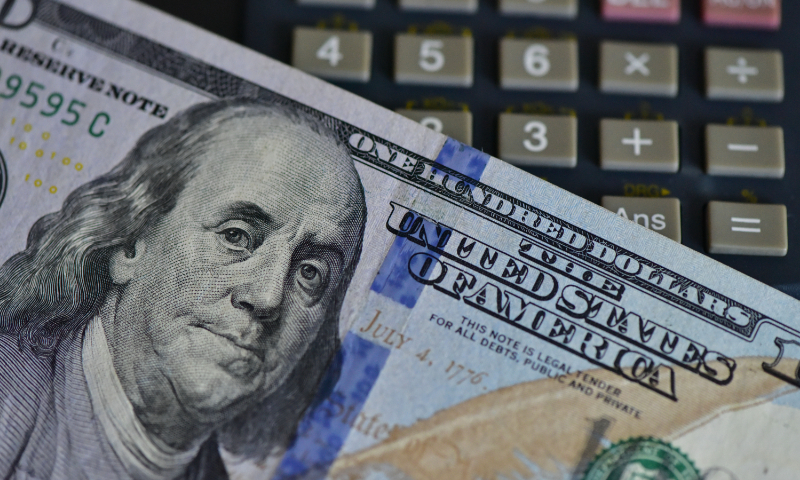
An illustration show a US dollar bill and a calculator at a bank in Fuyang, East China's Anhui Province. Photo: VCG
China's holdings of US treasuries fell to $682.6 billion in November, down $6.1 billion month-on-month, according to data released by US Department of the Treasury on Thursday (US time). An analyst attributed the reduction to China's diversification of foreign assets in recent years so as to safeguard the safety and liquidity of assets while ensuring yields.
In November, China's holdings US treasuries hit the lowest since September 2008, when holdings tumbled to $618.2 billion. China is the third-largest non-US owner of treasuries, but its holdings have declined by more than 10 percent since the beginning of 2025, Reuters reported.
In November, Japan remained the biggest non-US holder of US treasuries, while the UK came as the second-largest owner of US treasuries, the US data showed.
"The decrease in China's holdings of the US treasuries is a result of increased optimization and diversification of holdings of foreign assets seen in recent years, which helps strengthen the overall safety and stability of the portfolio," Xi Junyang, a professor at the Shanghai University of Finance and Economics, told the Global Times on Friday.
According to latest data from the People's Bank of China, the country's central bank, showed that China's gold reserves stood at 74.15 million ounces by the end of December 2025, an increase of 30,000 ounces compared with the previous month, marking the 14th consecutive month that the central bank has increased its gold reserves, the Securities Times reported.
The PBC will likely continue to increase its gold reserves in the future, as it is conducive to enhancing the stability of reserve assets and strengthening the ability to withstand external risks, while the proportion of gold in China's reserve assets remain relatively low compared with other major global economies, the professor said.
China's foreign exchange reserves totaled $3.3579 trillion at the end of December 2025, marking an increase of $11.5 billion, or 0.34 percent, from the end of November, official data showed on January 7.
The State Administration of Foreign Exchange (SAFE) stated that the US dollar index declined and global financial asset prices saw mixed movements in December, influenced by factors such as macroeconomic data and monetary policies in major economies.
Driven by exchange rate conversions and changes in asset prices, China's foreign exchange reserves increased during the month, the administration said.
As the year 2026 marks the first year of the 15th Five-Year Plan period (2026-30), the SAFE will better coordinate development and security, and continuously build a foreign exchange management system and mechanism that is "more convenient, more open, safer, and smarter," Li Bin, a deputy head and spokesperson for the SAFE, said at a press conference on Thursday.
Li highlighted that the department will adhere to advancing high-level opening-up, steadily expand the opening-up in the foreign exchange sector, and facilitate win-win cooperation. He said efforts will be made to coordinately advance the internationalization of the yuan and the high-quality opening-up of the capital account, and deepen foreign exchange management reforms in areas such as direct investment, securities investment, and cross-border financing.
"Efforts will be made to continuously improve the management and operation of foreign exchange reserves, and make every effort to ensure the safety, liquidity, and value preservation and appreciation of foreign exchange reserve assets," the official stressed.
RELATED ARTICLES