A China-Europe freight train departs from the Xi'an International Port Station in Xi'an, Northwest China's Shaanxi Province, on November 17, 2025. Photo: Xinhua
From the port of Zhangjiagang, near Suzhou city in East China's Jiangsu Province, one of the advanced industrial clusters in Eastern China not far from Shanghai, China COSCO Shipping Corporation Ltd, the leading Chinese shipping company, recently loaded 50,000 tons of goods, primarily electric vehicles, construction machinery, earth-moving equipment, and grinding balls for exhausted building materials, destined for the port of Chancay in Peru, on the other side of the Pacific Ocean from China.
After 23 days at sea, these goods will be unloaded at a terminal recently completed by COSCO, aimed at directingthe export of China toward South American markets, saving at least 12 days compared to traditional routes that use the Panama Canal. On the return trip to China, the same COSCO ships will be loaded with minerals, rare earths, and metals, primarily copper.
The new Pacific route is not the only significant development in international logistics in 2025. Since September 2025, the Arctic Route run by Chinese company Sea Legend Shipping has begun connecting Ningbo in East China's Zhejiang Province to Felixstowe in the UK, crossing the Arctic, and then touching Rotterdam, Hamburg, and Gdansk, saving a couple of weeks on travel time for goods between China and Europe via Suez and the Mediterranean.
These developments provide insight into the prospects for 2026, based on estimates for the growth of global trade. According to the International Monetary Fund, global growth in 2026 is expected to be 3.1 percent, roughly the same level (3.2 percent) as 2025. Not considering potential fluctuations in shipping rates due to peak season variations (which are becoming increasingly rare) or temporary circumstancesrelated to specific geographical situations, the landscape of maritime routes confirms trends observed in previous years, alongside the development of China-Europe freight train routes.
While the model of maritime connectivity has developed, thanks in part to China, on established foundations of maritime traffic, another significant development in the geopolitical quadrant is the explosion of rail traffic between China and Europe, which has progressively developed along the China-Europe freight train routes. This was reaffirmed at the second China-Europe Railway Express Cooperation Forum held in Xi'an city, Northwest China's Shaanxi Province, in mid-November 2025, aimed at assessingthe state of the Eurasian trade corridor.
Recently, a new service has been introduced to Hamburg, departing from Zhengzhou, a city in Central China's Henan Province that was identified as one of the first reference stations at the inception of the project. Today, China Railways Express (CR Express) operates 17 services with over 1,000 trains per year.
Having now reached full load capacity for each trip, CRE has reported shipping cost reductions of up to 40 percent, making it more competitive compared to sea freight services in terms of cost and transit time. In total, 120,000 trips have been made, connecting 128 Chinese cities with 232 cities in 26 European countries, as well as 100 cities in 11 Asian nations, as the service continues toward Southeast Asian countries.
The value of goods transported by China-Europe freight trains reached $426.4 billion by the end of 2024. From 2013 to 2024, the value grew by about 33 times, with the trains' share in China-Europe trade risingfrom 0.4 percent to 8.5 percent, according to a report released on the forum.
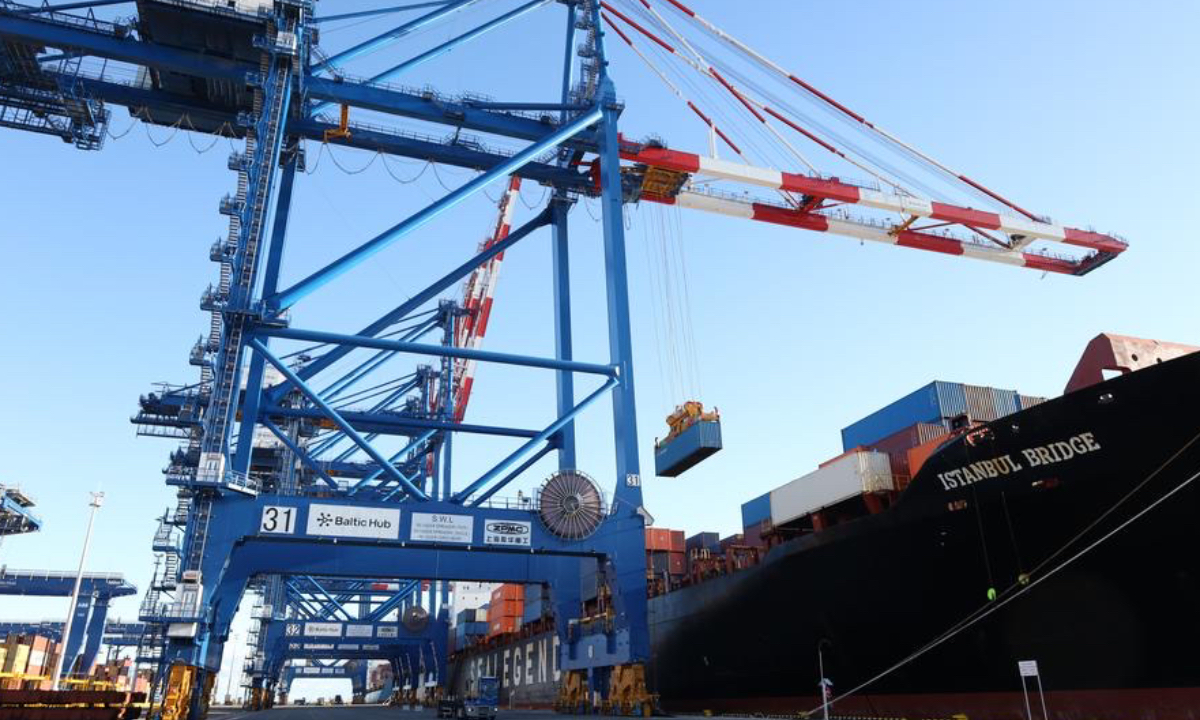
A container is being unloaded from the Istanbul Bridge, the first vessel on the China-Europe Arctic container express route, at the Port of Gdansk, Poland, on October 19, 2025.Photo: Xinhua
The concrete result of this development in international trade is that China, in the first 11 months of 2025, surpassed one $1 trillion in trade surplus, a result of diversified exports across all markets.
In the first 11 months, ASEAN remained China's largest trading partner, with bilateral trade reaching 6.82 trillion yuan, up 8.5 percent year-on-year, accounting for 16.6 percent of China's total foreign trade.
The EU was China's second largest trading partner, with trade hitting 5.37 trillion yuan, up 5.4 percent year-on-year, accounting for 13 percent of China's total foreign trade. China's trade with the US, which is China's third largest trading partner, plunged by 16.9 percent year-on-year to 3.69 trillion yuan in the January-November period, accounting for 8.9 percent of China's total foreign trade.
However, one cannot understand this surprising result for the international community without considering the volume of containers moved from Chinese ports to various destinations around the world.
China's ports handled 17.6 billion tons of cargo in 2024, and the container throughput reached 330 million TEUs (20-foot equivalent units), cementing global leadership. For instance, the Shanghai Port had moved 50 million TEUs by November 2025, nearly matching the total for all of 2024 (50.5 million).
The annual container throughput of the Ningbo-Zhoushan Port in East China's Zhejiang Province surpassed 40 million TEUs for the first time in December 2025, marking a new milestone for the world's busiest port in terms of cargo throughput.
Overall, considering transshipments to Southeast Asia used for countries not involved with the US in such heavy tariff burdens as China, the total for China is expected to reach or even exceed the record volumesof 2024 in 2025.
What insights can businesses gather from these trends? In a recent interview, Giovanni Tria, former Italian Minister of Economy and Finance, noted, "It is appropriate to create favorable conditions for mutual investments, to connect with Chinese technologies and global production chains. Only in this way can Italy transform international challenges into concrete opportunities for businesses and the national economy."
RELATED ARTICLES