US officials’ claims that Canada will ‘regret’ decision to allow Chinese EVs into market narrow-minded, failing to consider benefits for Canada’s economic development, consumer welfare: experts
By Published: Jan 17, 2026 04:49 PM

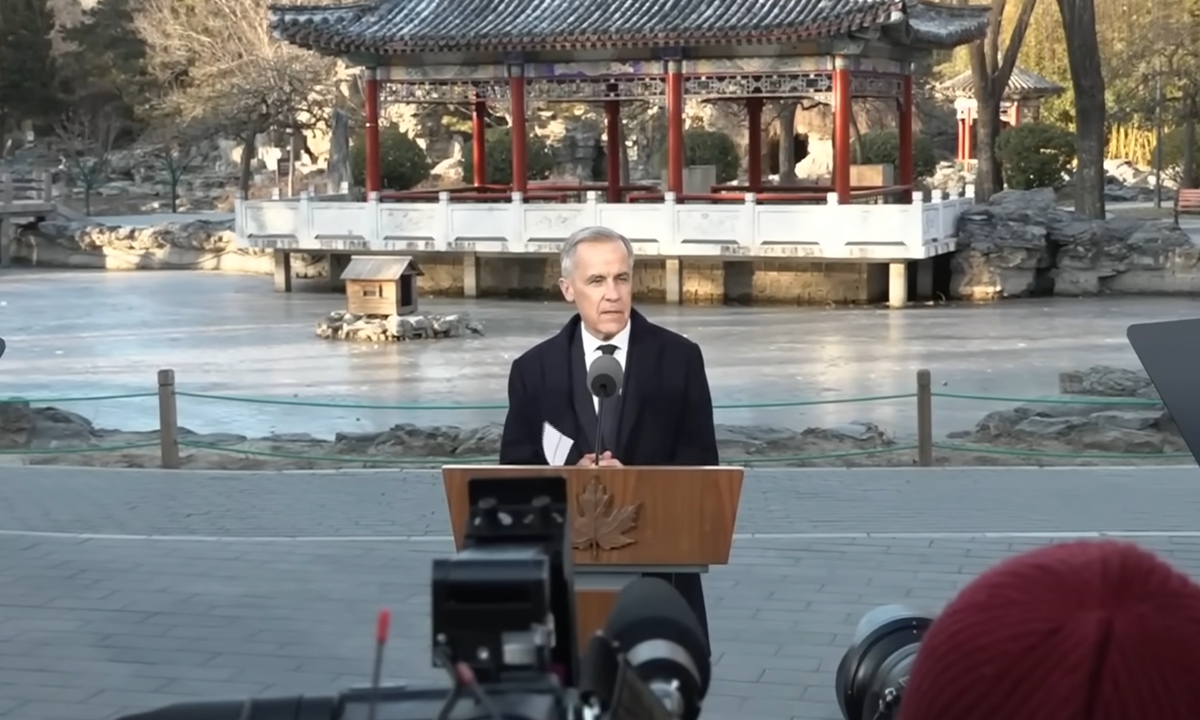
Canadian Prime Minister Mark Carney speaks in Beijing on January 16, 2025. Photo: screenshot from AP
Specific arrangements reached between China and Canada to properly address trade issues related to electric vehicles, steel and aluminum products, canola, and agricultural and aquatic product have sparked varied responses from the US and Canada itself, with certain US officials claiming Canada would regret the decision of allowing the imports of up to 49,000 Chinese EVs into the Canadian market. Chinese experts say that narrow-minded US views fail to consider the potential benefits for Canada's economic development. Against a backdrop of global economic uncertainty, they emphasized that a commitment to shaping trade rules through consultation is critical to reinforcing worldwide confidence in multilateralism.
China and Canada issued a joint statement following the China-Canada leaders' meeting on Friday. The leaders committed to strengthening exchanges at all levels and to advancing outcomes in areas including macroeconomic engagement, economic and trade cooperation, energy, finance, public security and safety, people-to-people ties and cultural exchanges, as well as multilateralism.
A separate Canadian statement specified that Canada will allow up to 49,000 Chinese EVs into the Canadian market, with the most-favored-nation tariff rate of 6.1 percent, effectively removing the additional 100 percent tariffs it imposed on Chinese EVs following the US move in 2024. It added that by March 1, Ottawa expects China to lower tariffs on Canadian canola seed to a combined rate of approximately 15 percent, and that Canadian canola meal, peas, lobster and crab will no longer be subject to the "anti-discrimination tariffs."
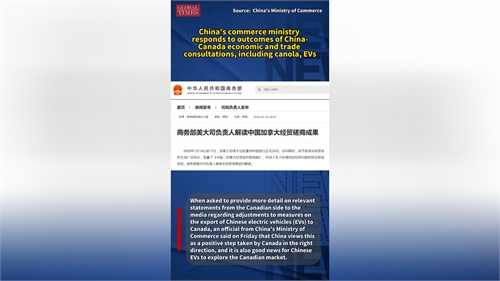
China's Ministry of Commerce said on Friday that China views Canada's adjustments to measures on the export of Chinese EVs as a positive step taken by Canada in the right direction, and it is also good news for Chinese EVs seeking to explore the Canadian market. Through friendly consultations, we should create a fairer, more stable, and non-discriminatory environment for further expanding trade and investment cooperation in the EV sector.
In response, US Transportation Secretary Sean Duffy claimed that Canada would regret its decision to allow imports of up to 49,000 Chinese EVs, and that those cars would not be allowed to enter the US, according to a Reuters report.
US Trade Representative Jamieson Greer in a separate CNBC interview called Canada's decision "problematic" and claimed: "There's a reason why we don't sell a lot of Chinese cars in the United States. It's because we have tariffs to protect American auto workers and Americans from those vehicles."
By contrast, US President Donald Trump himself expressed support for Carney, according to Reuters. "That's what he should be doing. It's a good thing for him to sign a trade deal. If you can get a deal with China, you should do that," Trump told reporters at the White House.
The mixed responses underscore the value of the China-Canada deal, Zhou Mi, a senior researcher at the Chinese Academy of International Trade and Economic Cooperation, told the Global Times on Saturday. He noted that the US officials' comments reflect a US-centered mind-set. Their assumption that Chinese products would have a negative impact is narrow-minded and fails to consider the potential benefits for Canada's economic development, especially in the EV sector, as well as consumer welfare, the expert stressed.
As of press time, Global Times reporters have not seen official responses from European governments or the EU regarding the trade arrangement between China and Canada.
But noticeably, the development has also drawn attention from European media. A BBC report, entitled "Canada's deal with China signals it is serious about shift from US," observed that the move represents a significant shift in Canada's policy on China, one that is shaped by ongoing uncertainty with its largest trade partner.
Similarly, The Guardian noted that the agreement comes after years of a deep freeze in the relationship between Ottawa and Beijing, which Carney aims to thaw in order to reduce his country's "precarious reliance on the US."
Deutsche Welle also highlighted that Carney's trip followed months of diplomatic efforts to resolve earlier tensions, underscoring Ottawa's push to diversify trade in the face of US tariff pressures.
Canadian news outlet the National Post said the tariff reduction move "is almost certainly going to raise the hackles of the US government." Bloomberg also suggested that Ottawa is facing US pressure to erect barriers to Chinese products.
Canadian Prime Minister Mark Carney said on Friday that by replacing the high tariffs with an import quota, it would help deliver the "full potential" of these partnerships and bring down costs for Canadians.
Saskatchewan Premier Scott Moe, who was in Beijing with Carney, was thrilled to see a deal he said will allow his province's canola exports to China to return to normal levels, CTV News reported.
Greg Cherewyk, president of Pulse Canada, said tariffs effectively stopped all shipments to China and Canadian yellow peas worth about $700 million a year were being displaced by Russian products, according to CTV News.
"It was really important that this didn't last as long as we had feared it would last, into the years. It was resolved in what really amounts to a short period of time," he said, adding that the timing is ideal for farmers to make seeding decisions.
When asked to compare the country's ties with the US, Carney said on Friday that Canada's relationship with China was "more predictable.". That is because Canada enjoys a "candid and consistent dialogue" with China that has led to a "more predictable and effective relationship."
"In terms of the way that our relationship has progressed with China, it is more predictable, and you see results coming from that," he said, according to the cbc.ca.
Gao Lingyun, a researcher at the Chinese Academy of Social Sciences, told the Global Times on Saturday that some in the US may be displeased with Canada's trade deal with China, but most countries would welcome the promotion of economic and trade cooperation between China and Canada.
The varied reactions reflect different considerations based on their own trade dynamics, but it doesn't change the fact that Canada is actively diversifying its export markets amid persistent US tariff pressures, and the improved China-Canada trade relations will bring opportunities to sectors including energy, technology and consumer goods, Zhou said.
The China-Canada deal could serve as a demonstration effect, showing other countries a viable trade route under American tariff pressure, which is to use pragmatic cooperation to hedge against unilateralism, and use multi-trade to reduce excessive dependence on either side, Gao said.
The China-Canada trade arrangements demonstrate that even against the background of uncertainty and turbulence, tariffs between major economies can move lower through friendly negotiation - not just higher. This serves as a positive example in an era where protectionism and unilateralism are on the rise, highlighting the potential for cooperation and mutual benefit in international trade, Gao noted.
RELATED ARTICLES