Carney highlights ‘distant, uncertain bilateral relationship’ is in change ‘with new strategic partnership’ in X posts; predictability most valuable takeaway from China visit: expert
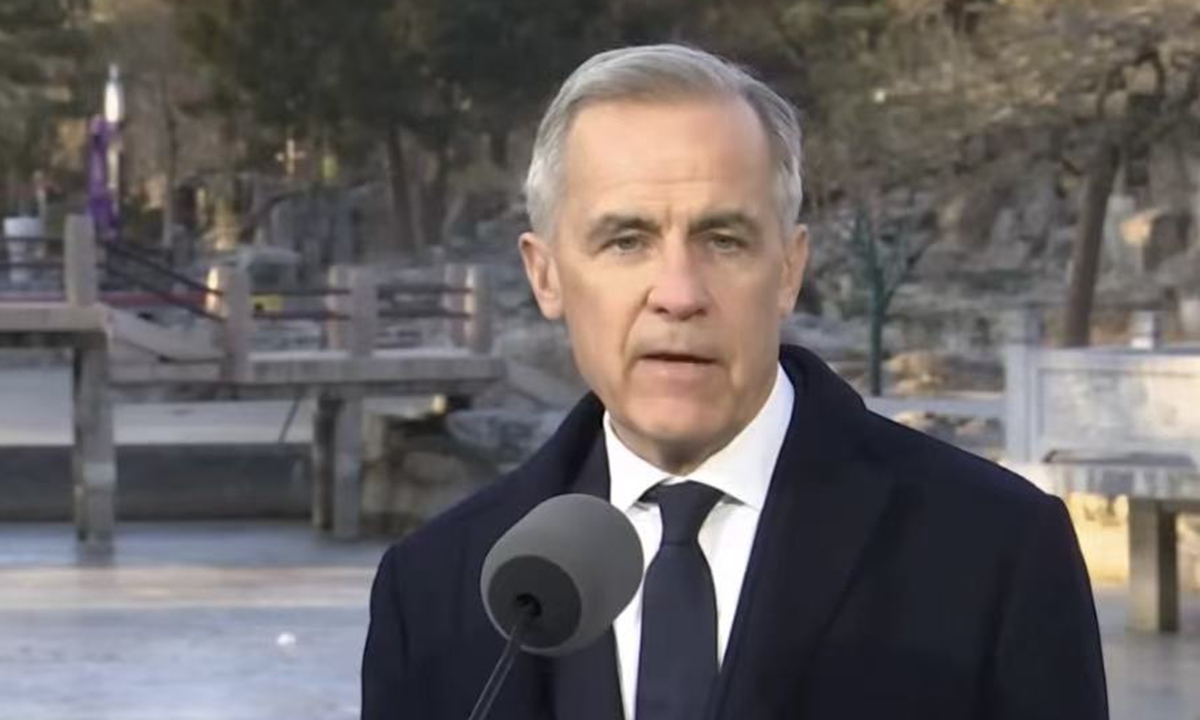
Canadian Prime Minister Mark Carney in a press conference in Beijing on January 17 Photo:Screenshot from the website
Canadian Prime Minister Mark Carney on Sunday hailed the progress made in Canada-China relationship, saying the relationship that had been "distant and uncertain for nearly a decade" is now changing, following his four-day visit to China that yielded a series of trade and economic outcomes.
"The Canada-China relationship has been distant and uncertain for nearly a decade," the Canadian prime minister wrote in a post on X, "We're changing that, with a new strategic partnership that benefits the people of both our nations."
Another post following revealed another information that China has committed to soon allowing Canadians to visit without a visa, which China has not yet confirmed or officially announced. The post noted that "nearly 2 million Canadians are of Chinese descent, many with family and friends across the Pacific."
The X posts came after Carney's four-day visit to China during which several economic and trade achievements were made between China and Canada.
According to the latest adjustment plan released by China's Ministry of Commerce (MOFCOM) on Friday, Canada will grant a quota of 49,000 units for Chinese electric vehicles (EVs) annually. Within this quota, vehicles will enjoy the Most Favored Nation (MFN) tariff rate of 6.1 percent, and the 100 percent supplementary tax will no longer be applied. The quota amount will increase annually according to a certain proportion, per the MOFCOM.
Moreover, China and Canada have reached preliminary consensus on adjusting anti-dumping measures for canola, as China's official said that China and Canada have conducted multiple rounds of consultations in a spirit of cooperation, striving to narrow the list of outstanding issues.
Radio-Canada reported on January 16 that China-Canada relations have been largely frozen over the past five years, but that the two countries are beginning to see a thaw, at least in the area of trade.
Beyond the substantial outcomes achieved through bilateral engagements, some Western media paid particular attention to the growing "predictability" in China-Canada relations. When asked whether China had become a more predictable and reliable partner for Canada than the US, Carney said in Beijing, "Our relationship with the United States, and this is no insight, is much more multifaceted, much deeper, much broader than it is with China. But yes, in terms of the way that our relationship has progressed in recent months with China, it is more predictable, and you see results coming from that," according to The New York Times.
The newspaper noted that Carney's remarks are "indicative of the rupture in the relationship between Canada and the US and the state of affairs as Canada enters the year of a critical review of its free trade with the United States and Mexico."
Predictability is the most valuable takeaway from Carney's China visit, Li Haidong, a professor at China Foreign Affairs University, told the Global Times on Sunday. Carney's statements show he has come to recognize China's long-standing emphasis on responsibility and commitment in foreign policy, including upholding the UN-centered international system, the international order based on international law, free trade and economic globalization, Li said.
In a report on Carney's China visit, Bloomberg said the prime minister's dispassionate tone masked a stunning message of realignment: China is a "more predictable" trading partner than the US now, requiring stronger ties with Beijing as a "new world order" takes hold.
The specific arrangements reached between China and Canada underscore that in a time of turbulence and uncertainty, tariffs are not destined to rise indefinitely and through consultation, they can also move downward.
Following the EV and canola tariff arrangements, some Western media took note. WardsAuto reported that Canada's new trade agreement with China "breaks with the US," which imposed an additional 100 percent tariff on China-built EVs in September 2024 on top of an existing 2.5 percent duty.
As Canada lowers tariff barriers on Chinese EVs, Europe faces US threat of a new round of tariffs unless Denmark accepts a deal over Greenland. Canada and some European countries are reassessing the value of Chinese products, Zhou Mi, a senior researcher at the Chinese Academy of International Trade and Economic Cooperation, told the Global Times on Sunday. They are increasingly recognizing the competitiveness of Chinese products, with room remaining for Europe to revisit anti-subsidy and anti-dumping rulings, reduce trade frictions and reassess existing tariffs posed on China.
RELATED ARTICLES