Foreign firms embrace Year of the Horse with marketing campaigns
By Published: Jan 18, 2026 01:20 PM

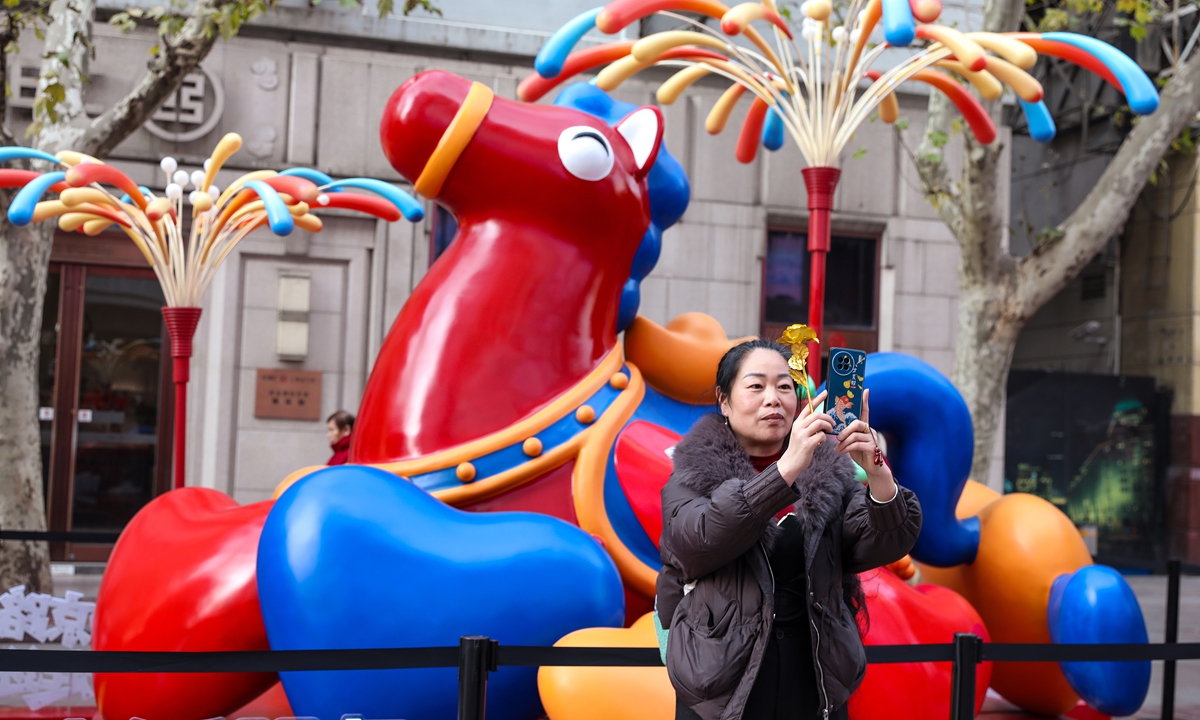
A woman takes a selfie in front of a horse sculpture with a golden ingot on its back in Shanghai on January 13, 2026. To celebrate the upcoming Year of the Horse, the sculpture is named Mashang Youqian, meaning both “money on horseback” and “immediately get rich.” Photo: VCG
As the Spring Festival approaches, foreign companies are actively expanding their presence through the launch of Year of the Horse innovative marketing campaigns, demonstrating their confidence in and deep engagement with China's consumer market.
Coca-Cola China told the Global Times on Sunday that it has launched Spring Festival fireworks cans for the Year of the Horse. The series centers on zodiac and fireworks motifs, incorporates traditional festive symbols of auspiciousness, and integrates the Chinese intangible cultural heritage of embroidery art into its marketing campaigns.
Leveraging its synergy, the company said that it will collaborate with its three major bottling partners and 46 factories to strengthen product coverage and ensure stable supplies during the impending Spring Festival holiday period.
Mondelēz China told the Global Times on Sunday that it has launched a series of Spring Festival gift boxes that blend traditional Chinese culture with creative design, featuring its well-known brands such as Oreo, Chips Ahoy! and Pacific. This initiative continuously enriches product expressions during the festive season.
The Oreo "Year of the Horse Fortune Gift Box" features an elegant design of traditional Chinese lattice windows and a galloping horse, conveying blessings for immediate success, rising fortune, and good luck in the New Year.
Universal Beijing Resort, which officially announced that 2026 will mark its grand fifth anniversary, said that it will start its Chinese New Year seasonal event on January 23.
The resort said it will launch activities including a special China Year New Year show with brand-new choreography, music arrangements, and story-telling. Fourteen beloved characters, including Po from DreamWorks Animation's Kung Fu Panda, will deliver a dynamic 20-minute spectacle offering a truly exhilarating Spring Festival audio-visual celebration, with more traditional art performance elements.
The marketing campaigns were announced ahead of the Chinese New Year, which will start on February 16, with 2026 designated as the Year of the Horse.
Foreign companies' enthusiasm for the Chinese market stems from its enormous size and vast potential, making it an indispensable arena that international players cannot afford to overlook, Peking University economist Cao Heping told the Global Times on Sunday.
Cao said that changes in the Chinese consumer market make it essential for companies to focus more intently on how to win them over, and this annual celebration of the Chinese New Year presents a significant opportunity for international companies to engage with consumers and expand their presence in the market.
Domestic demand has played a leading role in driving the economy, and some foreign institutions have predicted that the share of consumption in China's GDP will continue to increase.
Zhang Ning, the senior China economist at UBS Investment Bank, said at the 26th UBS China Conference held in Shanghai on Tuesday that household consumption currently accounts for 40 percent of China's GDP. According to a note UBS Investment Bank sent to the Global Times, he predicted that this figure is projected to potentially rise by 3 to 5 percentage points in the next five years.
China's retail sales rose 4 percent year-on-year in the first 11 months of 2025, totaling 45.61 trillion yuan ($6.54 trillion), data from the National Bureau of Statistics showed.
The Central Economic Work Conference said that domestic demand will remain as a focus in building a robust domestic market, putting the task at the top of the 2026 policy agenda.
To boost domestic demand, China's Ministry of Commerce said that it will further boost consumption and expand opening-up as part of its key work for 2026, according to a two-day national commerce work conference that ended on January 11.
RELATED ARTICLES