IN-DEPTH / IN-DEPTH
Practitioners’ Insights: Xigaze quake survivors mark a hopeful New Year in new homes signaling national support and welfare dedication
Editor's Note:
"When the happy hum of daily life fills every home, the big family of our nation will go from strength to strength." These words from President Xi Jinping's 2026 New Year message embody sincere and profound care for the people and convey touching and heartwarming strength.
"No issue of the people is too small; we care for every leaf and tend every branch in the garden of people's well-being." Since the 18th National Congress of the Communist Party of China (CPC), Xi, also general secretary of the CPC Central Committee and chairman of the Central Military Commission, has traveled extensively across the country, observing the conditions of the people, listening to their voices, and inquiring about their well-being. He cares deeply about the happiness and hardships of "every home," emphasizing that "of all the jobs in front of us, the most important is to ensure a happy life for our people."
Always placing the people above all else in hearts, upholding the original aspiration and mission of delivering benefits to the people, standing together with the people through thick and thin, and sharing a deep bond with them, and ensuring that the fruits of modernization benefit all people more extensively and equitably, China in the new era is steadily turning the people's yearning for a better life into reality, and is ensuring that the people's sense of gain, happiness, and security become more substantial, better safeguarded, and more sustainable.
The "people-centered" development concept and modernization approach has been the value that runs through the entire series of Xi Jinping: The Governance of China. In his speech made at the meeting with representatives to the first National Conference of Model Families, which was included in Volume II of the series, President Xi pointed out that "a prosperous and strong nation, the national rejuvenation and the happiness of the people are embodied by the happiness of the families and the better life of hundreds of millions of people." Volume V dedicated a section to "People-Centered Development" and compiled significant remarks by President Xi on this topic.
In the 20th installment of the special series "Decoding the Book of Xi Jinping: The Governance of China," the Global Times (GT), along with the People's Daily Overseas Edition, focuses on the "every home" and "big family of our nation" in President Xi's view and, as embodied in his heartfelt New Year message, the people-centered development concept of CPC members. We continue to invite Chinese and foreign scholars, translators of President Xi's works, practitioners with firsthand experience, and international readers to delve into the CPC Central Committee with Comrade Xi Jinping at its core's adherence to the people-centered development concept, and its epochal significance and value for us to strive in writing a new chapter of Chinese modernization.
In the 19th installment of the "Practitioners' Insights" column, Global Times reporters visited Lhaze county in Xigaze, Southwest China's Xizang Autonomous Region, to document how quake-affected people celebrated their first New Year in new homes. It shares stories of how local authorities overcame numerous challenges to achieve a post-earthquake reconstruction milestone within a year, reflecting the nation's unwavering commitment to safeguarding and improving public well-being while upholding the dignity of every family.
Local farmers' markets bustle with crowds of people shopping for New Year supplies, their tricycles loaded with fresh beef and mutton, exquisitely carved Tibetan-style furniture, and brightly colored butter sculpture decorations. Among them is a cart belonging to Sonam Tsering, a villager from Senjian village in Chawu Township. "This is our first new year in the new house, so everyone wants to celebrate it in a grand way," he told the Global Times.
A year ago, this same cart was repeatedly used to carry old belongings salvaged from earthquake ruins. On January 7, 2025, a sudden 6.8-magnitude earthquake struck, affecting 486 villages across 47 towns in 7 counties including Dingri, Lhaze, and Sa'gya in Xigaze. Tens of thousands of homes collapsed or were damaged, according to the Xizang Daily.
In the face of disasters, rescue forces were stationed on the very day after the earthquake. On the third day after the earthquake, Xizang carried out the preliminary work including the design of civilian house layouts. Construction of new homes for affected residents started in early March 2025, and by late October, newly built Tibetan-style houses were successfully handed over, allowing local people to spend the winter warmly as scheduled.
Today, Sonam Tsering's new home stands firmly among a cluster of Tibetan-style buildings along the Yarlung Zangbo River. Looking around, the Chinese national flags erected in the center of each rooftop flutter in the wind, shining brightly against the blue sky and white clouds.
As the 2026 farmers' New Year approaches, grassroots Communist Party of China (CPC) members and cadres in Lhaze County have chosen to spend the festival alongside local residents, just as they have on every major occasion throughout the past year.
On January 14, Li Xin, head of Chawu Township, visited Sonam Tsering's home with village cadres. Sitting together in the bright, spacious living room, they chatted about the heartwarming message from Chinese President Xi Jinping's 2026 New Year message: "When the happy hum of daily life fills every home, the big family of our nation will go from strength to strength."
In the article "Prioritize the People's Wellbeing in Chinese Modernization" in Volume V of the book series Xi Jinping: The Governance of China, President Xi pointed out that "meeting the people's aspirations for a better life is our ultimate goal. The essence of reform and development is to ensure that the people enjoy better lives."
Now, in every home in Lhaze, the rising warmth and happiness of daily life vividly illustrate how the "big family" is doing well. In turn, the country's wholehearted support for the people and its commitment to their welfare have inspired "every home" with internal motivation and firm confidence to strive for a better life.
'Ensuring every new home can stand the test of time'
In the office of Lhaze county's post-disaster reconstruction headquarters, a large "operation map" detailing the rebuilding of homes covers an entire wall. It clearly marks the locations for reconstruction or repair across the county's villages, alongside color-coded progress timelines. More than 10 kilometers away, at the Senjian village committee, the week's work tasks on the whiteboard are neatly listed: "Improve individual household reconstruction files," "Inspect damaged construction signs on-site"... This seamless flow from county-level coordination to village-level execution shows the final phase of Lhaze's rebuilding effort is powered by a highly organized system
Lu Fangting, head of the reconstruction headquarters office, introduced that Lhaze County has innovated its working model in post-earthquake reconstruction. This involved creating a master list to assess damage; using aerial maps and 3D modeling for precise village planning; establishing a detailed file for each affected household; and setting clear task lists with deadlines. "We are committed to ensuring every new home can stand the test of time and meet the people's expectations," Lu told the Global Times.
This planning was brought to life by dedicated executors. Once rebuilding began, 489 Party members and cadres from the county went to work sites across the villages, living and working alongside construction teams and residents.

These on-site cadres are more than just knowledgeable supervisors. On the front lines, they acted as environmental officers ensuring clean sites, information officers collecting feedback and monitoring progress, and communicators explaining policies to villagers in understandable terms.
Lu noted that the county also set up a volunteer service point at the bus station, both to welcome workers from across the country and to recruit local labor, encouraging residents to rebuild their own homes through labor-based assistance programs.
"When people see with their own eyes on the construction site that the steel bars used in their houses are so thick and the foundations are so solid, their hearts feel at ease," said Li.Zheng.
This sense of security has also transformed into profound warmth. Li Zheng noted that during the reconstruction process, it was common for local residents to spontaneously prepare butter tea and bake goods to deliver to the construction sites. Through their shared labor, construction teams from all corners of the country and Tibetan locals formed a deep bond of friendship.
'Every home' settled and secure, 'the big family of our nation' takes root in hearts
When Chawu Township head Li Xin and village cadres visited Sonam Tsering's home, Sonam Tsering and his family presented them with white Khatas, ceremonial scarves symbolizing goodwill and blessings, and extended New Year greetings. "It is the wholehearted assistance of the Party and the government that has enabled us to move into such wonderful houses that we never even dared to dream of before," Sonam Tsering said with emotion.
After the earthquake, his family of seven got a new 160-square-meter house built on the original site. The exterior walls of the house are painted bright white, and the window frames are decorated with colorful patterns of the Eight Auspicious Symbols of Buddhism. Walking through the door, one can see brand-new Tibetan-style furniture arranged in order, together with brightly polished copper kettles and various pots and pans placed neatly.
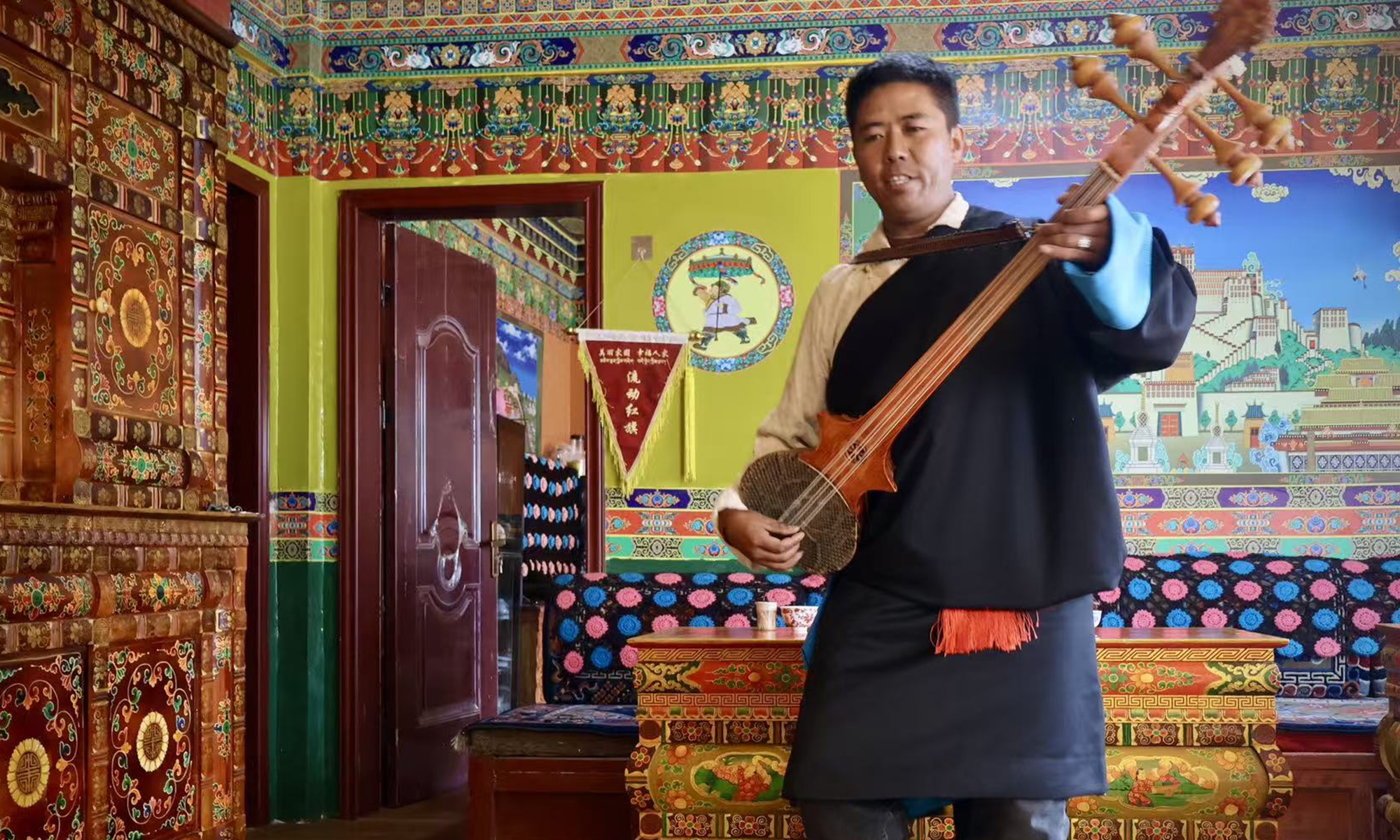
With their own lives becoming comfortable and fulfilling, Sonam Tsering and his family have also kept the "big family" of the village close to their hearts. A bright "Rolling Red Flag" was hanging on the living room wall of Sonam Tsering's home. Palbar Tsering, Party secretary of Senjian village, explained that this was an honorary award given to Sonam Tsering's family in recognition of their active participation in village garbage collection and their contribution to improving the village's appearance and environment.
Such values are not unique to Sonam Tsering in Lhaze County. In Renda village of Xiqin Township, 40 kilometers away from Senjian village, the family of Chungla also holds the belief that "prosperity of individual families leads to the thriving of the whole community" dear to their hearts. Despite having relocated after the earthquake, the parents have carefully kept all the certificates of merit their children earned from 2024 to 2025. These certificates were taken from the old house to the new one, carefully framed and hung in a prominent place in the new living room, witnessing the children's growth and progress.
Thupten, head of Renda village's working team, told the Global Times that after the earthquake, the county public security bureau and relevant departments immediately inspected the safety of teaching buildings and dormitories. For schools with severe damage, they arranged temporary accommodation in functional rooms or borrowed venues from other schools, ensuring that children's schooling was not interrupted.
"When every home is settled and secure, the big family of our nation naturally takes root in our hearts," said Li Zheng. With stable houses to live in and the dignity of living restored, the villagers have nurtured aspirations for a better life. Filled with gratitude, they are eager to do more for people around them and the village. He believes that such an extension and elevation of the villagers' sincere sentiments is the warmest and most precious reward he has gained from participating in the reconstruction work.
From 'quality housing' to 'prosperous employment'
In the living room of Gyamtsen's home, two special household items are carefully cherished — butter tea makers presented by the central delegation, emblazoned with commemorative logos marking the 50th and 60th founding anniversaries of the Xizang Autonomous Region respectively. Today, these two machines are covered with hand-woven rope covers, and the colorful patterns are infused with profound affection.
"These two milestones have witnessed our lives getting better and better step by step," said Chungla.
President Xi attended a grand gathering at the Potala Palace square in Lhasa, capital of Xizang Autonomous Region, to mark the region's 60th founding anniversary on August 21, 2025. In Xi's 2026 New Year message, he said, "I attended celebrations in Xizang and Xinjiang. From the snow-covered plateau to both sides of the Tianshan Mountains, people of various ethnic groups are united as one, like seeds of a pomegranate sticking together. With white khatas and passionate singing and dancing, they expressed their love of the motherland and the happiness they enjoy."
On August 20, 2025, when Xi listened to reports of the work of the CPC Xizang regional committee and the regional government, he pointed out that as Xizang bears unique characteristics for development, it is necessary to promote high-quality development based on its realities. It is important to advance new urbanization and rural revitalization across the board in a well-coordinated way, consolidate and expand the achievements in poverty alleviation, and make solid efforts to ensure and improve people's livelihood in such areas as employment, education, medical and health care, social security, elderly care and child care, so as to further enhance the sense of fulfillment, happiness and security among people of all ethnic groups, Xi said.
"Over the past 60 years since the founding of the Xizang Autonomous Region, people's living conditions have undergone a qualitative transformation from 'earth and brick houses' to 'modern and livable dwellings', with a comprehensive leap in living standards," said Li Zheng. He said that in the past year, President Xi's care for the people affected by disasters has served as the fundamental guideline and strong driving force for advancing post-disaster reconstruction.
"Our post-disaster reconstruction work has always adhered to the principles of 'planning guidance, prioritizing people's well-being, and balancing immediate and long-term needs.' It has been incorporated into the overall plans for Xizang's high-quality development, rural revitalization, new-type urbanization, ecological protection, and other initiatives, ultimately achieving the goal of 'reconstruction as upgrading and industrial development promoting revitalization.'"
Li Zheng said he firmly remembers the remark emphasized by President Xi, "A nation can do well only when families do well."
"From having a roof over one's head to having a quality home, people have begun to jointly consider how to ensure prosperous employment and enhance the quality of life," Li Xin noted. He mentioned that many villagers in the township have systematically learned professional skills such as blueprint reading and setting out, steel bar binding, and concrete pouring from construction masters through work-relief programs. "This year, many young men in the township plan to apply for vocational qualifications in construction trades such as bricklaying and steel fixing, turning their temporary work skills into long-term stable jobs."
To help people increase their incomes and achieve prosperity right at their doorsteps, every township has formulated development plans based on local conditions. Chawu Township has continuously upgraded its infrastructure, built roads to improve transportation connectivity, and strived to build a clean energy town, retaining villagers with convenient living conditions and sufficient employment opportunities. Meanwhile, Xiqin Township, in line with the spirit of the Fourth Plenary Session of the 20th Central Committee of the CPC, has steadily advanced toward the goal of people-centered new-type urbanization. It has tapped into local cultural and ecological resources, explored new paths for the integrated development of agriculture, culture, and tourism, and enabled villages to boast both "aesthetic appeal" and "economic value."
As the farmers' New Year approaches, the festive atmosphere in Lhaze County has become increasingly intense. Township cadres have been busy distributing lanterns and Chinese knots to villagers; the bright red decorations have filled the villages with a warm and joyful vibe. For their part, the villagers have voluntarily hoisted new Chinese national flags. In the new year, these bright flags will continue to flutter on the roofs of every new house and in the hearts of every person striving for a better life.
"When the happy hum of daily life fills every home, the big family of our nation will go from strength to strength." These words from President Xi Jinping's 2026 New Year message embody sincere and profound care for the people and convey touching and heartwarming strength.
"No issue of the people is too small; we care for every leaf and tend every branch in the garden of people's well-being." Since the 18th National Congress of the Communist Party of China (CPC), Xi, also general secretary of the CPC Central Committee and chairman of the Central Military Commission, has traveled extensively across the country, observing the conditions of the people, listening to their voices, and inquiring about their well-being. He cares deeply about the happiness and hardships of "every home," emphasizing that "of all the jobs in front of us, the most important is to ensure a happy life for our people."
Always placing the people above all else in hearts, upholding the original aspiration and mission of delivering benefits to the people, standing together with the people through thick and thin, and sharing a deep bond with them, and ensuring that the fruits of modernization benefit all people more extensively and equitably, China in the new era is steadily turning the people's yearning for a better life into reality, and is ensuring that the people's sense of gain, happiness, and security become more substantial, better safeguarded, and more sustainable.
The "people-centered" development concept and modernization approach has been the value that runs through the entire series of Xi Jinping: The Governance of China. In his speech made at the meeting with representatives to the first National Conference of Model Families, which was included in Volume II of the series, President Xi pointed out that "a prosperous and strong nation, the national rejuvenation and the happiness of the people are embodied by the happiness of the families and the better life of hundreds of millions of people." Volume V dedicated a section to "People-Centered Development" and compiled significant remarks by President Xi on this topic.
In the 20th installment of the special series "Decoding the Book of Xi Jinping: The Governance of China," the Global Times (GT), along with the People's Daily Overseas Edition, focuses on the "every home" and "big family of our nation" in President Xi's view and, as embodied in his heartfelt New Year message, the people-centered development concept of CPC members. We continue to invite Chinese and foreign scholars, translators of President Xi's works, practitioners with firsthand experience, and international readers to delve into the CPC Central Committee with Comrade Xi Jinping at its core's adherence to the people-centered development concept, and its epochal significance and value for us to strive in writing a new chapter of Chinese modernization.
In the 19th installment of the "Practitioners' Insights" column, Global Times reporters visited Lhaze county in Xigaze, Southwest China's Xizang Autonomous Region, to document how quake-affected people celebrated their first New Year in new homes. It shares stories of how local authorities overcame numerous challenges to achieve a post-earthquake reconstruction milestone within a year, reflecting the nation's unwavering commitment to safeguarding and improving public well-being while upholding the dignity of every family.
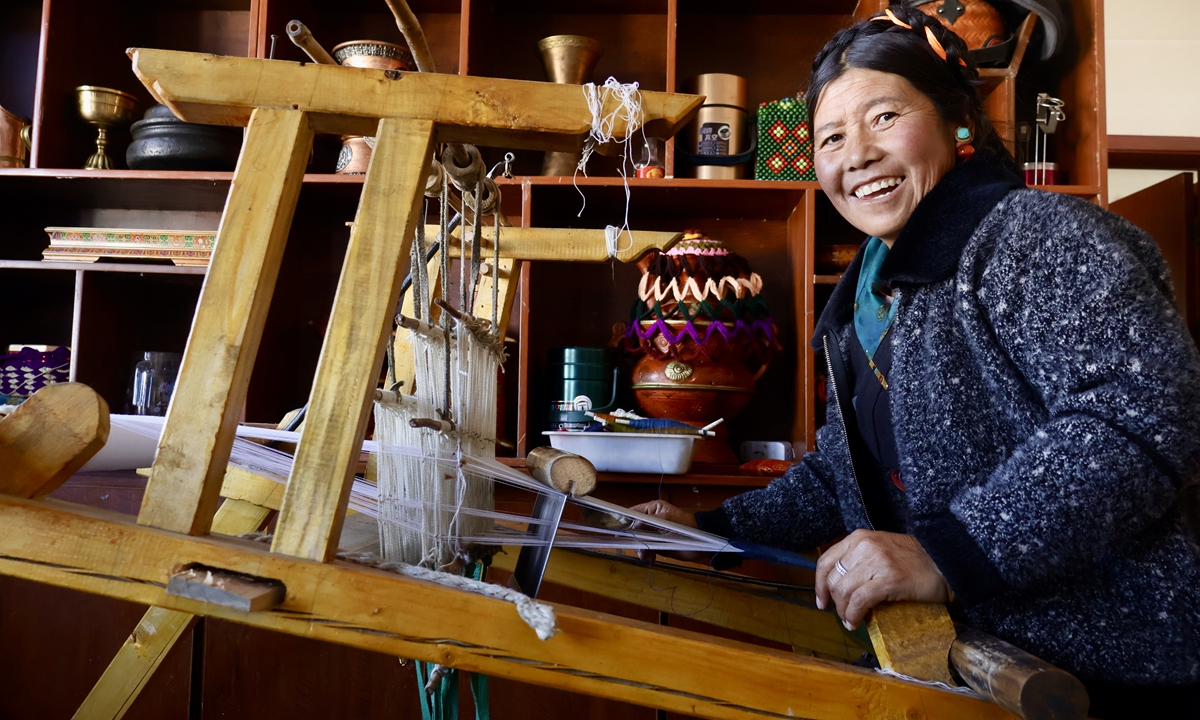
Nyima Drolma weaves fabric in her newly rebuilt home after the earthquake in Renda village in Lhaze County, Xigaze, Southwest China's Xizang Autonomous Region, on January 14, 2026. Photo: Lin Xiaoyi/GT
Early morning sunlight bathes the streets of Lhaze County, Southwest China's Xizang Autonomous Region, as the joyous atmosphere of the farmers' New Year on the first day of the twelfth month of the Tibetan calendar permeates the land at the foot of Himalaya Mountains.Local farmers' markets bustle with crowds of people shopping for New Year supplies, their tricycles loaded with fresh beef and mutton, exquisitely carved Tibetan-style furniture, and brightly colored butter sculpture decorations. Among them is a cart belonging to Sonam Tsering, a villager from Senjian village in Chawu Township. "This is our first new year in the new house, so everyone wants to celebrate it in a grand way," he told the Global Times.
A year ago, this same cart was repeatedly used to carry old belongings salvaged from earthquake ruins. On January 7, 2025, a sudden 6.8-magnitude earthquake struck, affecting 486 villages across 47 towns in 7 counties including Dingri, Lhaze, and Sa'gya in Xigaze. Tens of thousands of homes collapsed or were damaged, according to the Xizang Daily.
In the face of disasters, rescue forces were stationed on the very day after the earthquake. On the third day after the earthquake, Xizang carried out the preliminary work including the design of civilian house layouts. Construction of new homes for affected residents started in early March 2025, and by late October, newly built Tibetan-style houses were successfully handed over, allowing local people to spend the winter warmly as scheduled.
Today, Sonam Tsering's new home stands firmly among a cluster of Tibetan-style buildings along the Yarlung Zangbo River. Looking around, the Chinese national flags erected in the center of each rooftop flutter in the wind, shining brightly against the blue sky and white clouds.
As the 2026 farmers' New Year approaches, grassroots Communist Party of China (CPC) members and cadres in Lhaze County have chosen to spend the festival alongside local residents, just as they have on every major occasion throughout the past year.
On January 14, Li Xin, head of Chawu Township, visited Sonam Tsering's home with village cadres. Sitting together in the bright, spacious living room, they chatted about the heartwarming message from Chinese President Xi Jinping's 2026 New Year message: "When the happy hum of daily life fills every home, the big family of our nation will go from strength to strength."
In the article "Prioritize the People's Wellbeing in Chinese Modernization" in Volume V of the book series Xi Jinping: The Governance of China, President Xi pointed out that "meeting the people's aspirations for a better life is our ultimate goal. The essence of reform and development is to ensure that the people enjoy better lives."
Now, in every home in Lhaze, the rising warmth and happiness of daily life vividly illustrate how the "big family" is doing well. In turn, the country's wholehearted support for the people and its commitment to their welfare have inspired "every home" with internal motivation and firm confidence to strive for a better life.
'Ensuring every new home can stand the test of time'
In the office of Lhaze county's post-disaster reconstruction headquarters, a large "operation map" detailing the rebuilding of homes covers an entire wall. It clearly marks the locations for reconstruction or repair across the county's villages, alongside color-coded progress timelines. More than 10 kilometers away, at the Senjian village committee, the week's work tasks on the whiteboard are neatly listed: "Improve individual household reconstruction files," "Inspect damaged construction signs on-site"... This seamless flow from county-level coordination to village-level execution shows the final phase of Lhaze's rebuilding effort is powered by a highly organized system
Lu Fangting, head of the reconstruction headquarters office, introduced that Lhaze County has innovated its working model in post-earthquake reconstruction. This involved creating a master list to assess damage; using aerial maps and 3D modeling for precise village planning; establishing a detailed file for each affected household; and setting clear task lists with deadlines. "We are committed to ensuring every new home can stand the test of time and meet the people's expectations," Lu told the Global Times.
This planning was brought to life by dedicated executors. Once rebuilding began, 489 Party members and cadres from the county went to work sites across the villages, living and working alongside construction teams and residents.
A view of the Lhaze County market buzzing with activity in Xigaze, Xizang Autonomous Region Photo: Lin Xiaoyi/GT
"The houses need to be safe and warm. So how should we read the construction drawings? What high-quality building materials are needed to meet the 8-degree seismic resistance standard for reconstructed houses?" recalled Li Zheng, Party secretary of Xiqin Township of Lhaze County. Over the past year, Li Zheng and other cadres stayed at construction sites, closely monitoring every construction detail, and gradually evolved from novices to knowledgeable supervisors.These on-site cadres are more than just knowledgeable supervisors. On the front lines, they acted as environmental officers ensuring clean sites, information officers collecting feedback and monitoring progress, and communicators explaining policies to villagers in understandable terms.
Lu noted that the county also set up a volunteer service point at the bus station, both to welcome workers from across the country and to recruit local labor, encouraging residents to rebuild their own homes through labor-based assistance programs.
"When people see with their own eyes on the construction site that the steel bars used in their houses are so thick and the foundations are so solid, their hearts feel at ease," said Li.Zheng.
This sense of security has also transformed into profound warmth. Li Zheng noted that during the reconstruction process, it was common for local residents to spontaneously prepare butter tea and bake goods to deliver to the construction sites. Through their shared labor, construction teams from all corners of the country and Tibetan locals formed a deep bond of friendship.
'Every home' settled and secure, 'the big family of our nation' takes root in hearts
When Chawu Township head Li Xin and village cadres visited Sonam Tsering's home, Sonam Tsering and his family presented them with white Khatas, ceremonial scarves symbolizing goodwill and blessings, and extended New Year greetings. "It is the wholehearted assistance of the Party and the government that has enabled us to move into such wonderful houses that we never even dared to dream of before," Sonam Tsering said with emotion.
After the earthquake, his family of seven got a new 160-square-meter house built on the original site. The exterior walls of the house are painted bright white, and the window frames are decorated with colorful patterns of the Eight Auspicious Symbols of Buddhism. Walking through the door, one can see brand-new Tibetan-style furniture arranged in order, together with brightly polished copper kettles and various pots and pans placed neatly.
With their own lives becoming comfortable and fulfilling, Sonam Tsering and his family have also kept the "big family" of the village close to their hearts. A bright "Rolling Red Flag" was hanging on the living room wall of Sonam Tsering's home. Palbar Tsering, Party secretary of Senjian village, explained that this was an honorary award given to Sonam Tsering's family in recognition of their active participation in village garbage collection and their contribution to improving the village's appearance and environment.
Palbar Tsering, Party secretary of Senjian village in Chawu Township, Lhaze County, performs Duixie, a traditional Xizang tap dance, at the home of villager Sonam Tsering, on January 14, 2026. Photo: Lin Xiaoyi/GT
This care for the "big family" is also reflected in their aspirations for the next generation. Sonam Tsering has three children: His eldest daughter works as a teacher in Nagqu, his second daughter serves as a rural revitalization science and technology staffer in the county, and his youngest son runs the family's grocery store after participating in the village's reconstruction work. "We hope our children will acquire good skills and abilities — not just to live a better life themselves, but also to contribute to society," this is Sonam Tsering's simple family motto.Such values are not unique to Sonam Tsering in Lhaze County. In Renda village of Xiqin Township, 40 kilometers away from Senjian village, the family of Chungla also holds the belief that "prosperity of individual families leads to the thriving of the whole community" dear to their hearts. Despite having relocated after the earthquake, the parents have carefully kept all the certificates of merit their children earned from 2024 to 2025. These certificates were taken from the old house to the new one, carefully framed and hung in a prominent place in the new living room, witnessing the children's growth and progress.
Thupten, head of Renda village's working team, told the Global Times that after the earthquake, the county public security bureau and relevant departments immediately inspected the safety of teaching buildings and dormitories. For schools with severe damage, they arranged temporary accommodation in functional rooms or borrowed venues from other schools, ensuring that children's schooling was not interrupted.
"When every home is settled and secure, the big family of our nation naturally takes root in our hearts," said Li Zheng. With stable houses to live in and the dignity of living restored, the villagers have nurtured aspirations for a better life. Filled with gratitude, they are eager to do more for people around them and the village. He believes that such an extension and elevation of the villagers' sincere sentiments is the warmest and most precious reward he has gained from participating in the reconstruction work.
From 'quality housing' to 'prosperous employment'
In the living room of Gyamtsen's home, two special household items are carefully cherished — butter tea makers presented by the central delegation, emblazoned with commemorative logos marking the 50th and 60th founding anniversaries of the Xizang Autonomous Region respectively. Today, these two machines are covered with hand-woven rope covers, and the colorful patterns are infused with profound affection.
"These two milestones have witnessed our lives getting better and better step by step," said Chungla.
President Xi attended a grand gathering at the Potala Palace square in Lhasa, capital of Xizang Autonomous Region, to mark the region's 60th founding anniversary on August 21, 2025. In Xi's 2026 New Year message, he said, "I attended celebrations in Xizang and Xinjiang. From the snow-covered plateau to both sides of the Tianshan Mountains, people of various ethnic groups are united as one, like seeds of a pomegranate sticking together. With white khatas and passionate singing and dancing, they expressed their love of the motherland and the happiness they enjoy."
On August 20, 2025, when Xi listened to reports of the work of the CPC Xizang regional committee and the regional government, he pointed out that as Xizang bears unique characteristics for development, it is necessary to promote high-quality development based on its realities. It is important to advance new urbanization and rural revitalization across the board in a well-coordinated way, consolidate and expand the achievements in poverty alleviation, and make solid efforts to ensure and improve people's livelihood in such areas as employment, education, medical and health care, social security, elderly care and child care, so as to further enhance the sense of fulfillment, happiness and security among people of all ethnic groups, Xi said.
"Over the past 60 years since the founding of the Xizang Autonomous Region, people's living conditions have undergone a qualitative transformation from 'earth and brick houses' to 'modern and livable dwellings', with a comprehensive leap in living standards," said Li Zheng. He said that in the past year, President Xi's care for the people affected by disasters has served as the fundamental guideline and strong driving force for advancing post-disaster reconstruction.
"Our post-disaster reconstruction work has always adhered to the principles of 'planning guidance, prioritizing people's well-being, and balancing immediate and long-term needs.' It has been incorporated into the overall plans for Xizang's high-quality development, rural revitalization, new-type urbanization, ecological protection, and other initiatives, ultimately achieving the goal of 'reconstruction as upgrading and industrial development promoting revitalization.'"
Li Zheng said he firmly remembers the remark emphasized by President Xi, "A nation can do well only when families do well."
"From having a roof over one's head to having a quality home, people have begun to jointly consider how to ensure prosperous employment and enhance the quality of life," Li Xin noted. He mentioned that many villagers in the township have systematically learned professional skills such as blueprint reading and setting out, steel bar binding, and concrete pouring from construction masters through work-relief programs. "This year, many young men in the township plan to apply for vocational qualifications in construction trades such as bricklaying and steel fixing, turning their temporary work skills into long-term stable jobs."
To help people increase their incomes and achieve prosperity right at their doorsteps, every township has formulated development plans based on local conditions. Chawu Township has continuously upgraded its infrastructure, built roads to improve transportation connectivity, and strived to build a clean energy town, retaining villagers with convenient living conditions and sufficient employment opportunities. Meanwhile, Xiqin Township, in line with the spirit of the Fourth Plenary Session of the 20th Central Committee of the CPC, has steadily advanced toward the goal of people-centered new-type urbanization. It has tapped into local cultural and ecological resources, explored new paths for the integrated development of agriculture, culture, and tourism, and enabled villages to boast both "aesthetic appeal" and "economic value."
As the farmers' New Year approaches, the festive atmosphere in Lhaze County has become increasingly intense. Township cadres have been busy distributing lanterns and Chinese knots to villagers; the bright red decorations have filled the villages with a warm and joyful vibe. For their part, the villagers have voluntarily hoisted new Chinese national flags. In the new year, these bright flags will continue to flutter on the roofs of every new house and in the hearts of every person striving for a better life.
RELATED ARTICLES