EU inks trade deal with Mercosur despite farmers’ fierce opposition; ‘huge amount' of agricultural products likely to be redirected to bloc
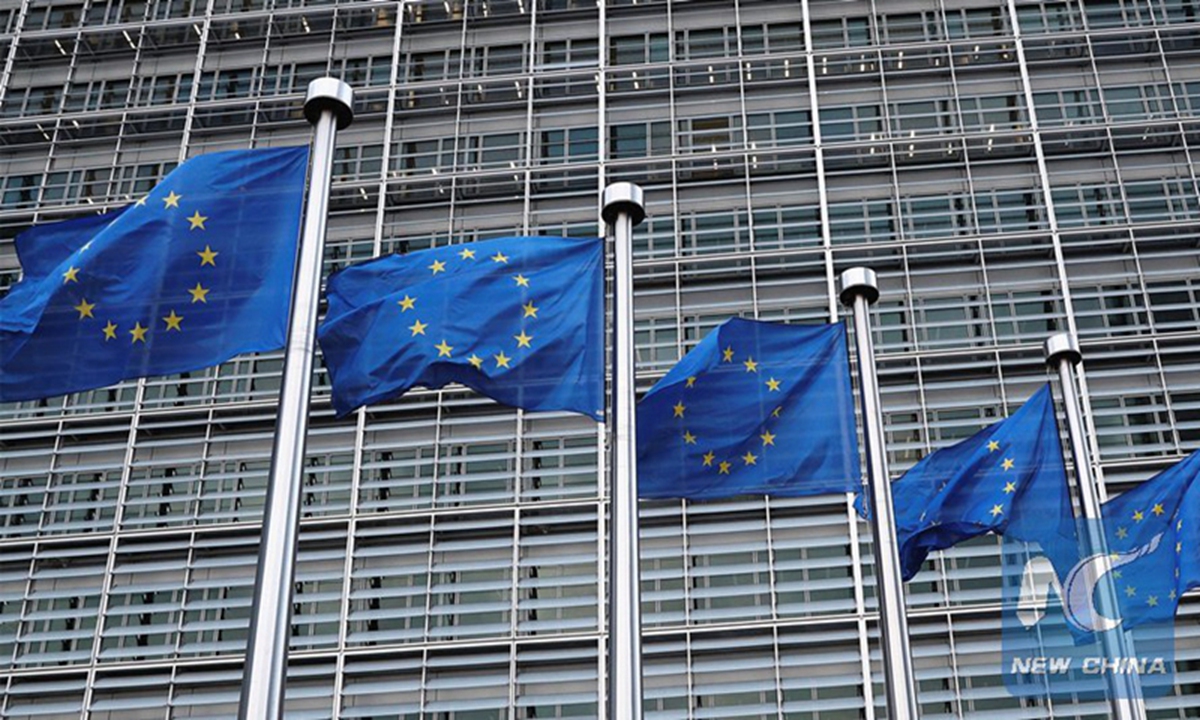
The European Union flags in front of EU headquarters in Brussels, Belgium. Photo: Xinhua
The EU on Saturday formally signed a free trade agreement with the Southern Common Market (Mercosur), despite facing fierce opposition from EU farmers. Amid some changes in the international market, the deal, once it enters into force, could redirect a huge number of agricultural products from South America to the EU market, a senior Chinese industry expert who requested anonymity told the Global Times on Sunday.
Industry leaders and trade experts said the agreement, reached amid rising global protectionism, signals a positive move toward market opening and multilateral cooperation, but warned that if implemented, the deal could accelerate trade diversion toward the EU, with an expected influx of South American agricultural products placing added pressure on European farmers already under strain.
Under the agreement, the EU and Mercosur aim to create a market of more than 700 million people, accounting for roughly a quarter of global GDP and ranking among the world's largest free trade zones. The two sides pledged to eliminate tariffs on more than 90 percent of goods traded bilaterally and to establish common rules governing industrial and agricultural trade, investment and regulatory cooperation.
The deal is expected to facilitate market access for European exports such as automobiles, machinery and wine, while easing entry for Mercosur agricultural products including meat, sugar, honey and soybeans, according to Xinhua.
EU and Mercosur leaders have framed the pact as a milestone for trade diversification and multilateralism. At the signing ceremony, European Commission (EC) President Ursula von der Leyen described it as a moment of "connecting continents," saying both sides were choosing fair trade over tariff barriers, according to Bloomberg. Brazilian President Luiz Inácio Lula da Silva hailed the agreement as a "victory for multilateralism" in a social media post.
Yet analysts caution that trade diversification does not automatically translate into gains for all sectors. Shifts in trade patterns often intensify internal competition, with agriculture - where profit margins are thin and costs are difficult to pass on - typically bearing the greatest pressure.
That dynamic helps explain why consensus within Europe remains elusive. Although the agreement has been signed, it still requires approval by the European Parliament before it can take effect.
The signing on Saturday was expected to take place in December but was postponed after resistance from some countries led by France, where farmers protested over fears of being undercut by cheaper produce from Mercosur, Financial Times reported.
Jian Junbo, director of the Center for China-Europe Relations at Fudan University's Institute of International Studies, said that farmers' groups in major agricultural countries such as France, Spain and Italy have long been the main opponents of such agreements, and their political influence should not be underestimated.
According to the report, the European Parliament will vote on Wednesday on a motion that could refer the agreement to the European Court of Justice, potentially delaying ratification by around 18 months. Four MEPs and EU officials told the FT they expect the motion to be rejected, with a final vote anticipated around May, though the Greens and the far-right Patriots are likely to oppose the deal.
If Mercosur agricultural products gain expanded access to the EU market, the impact on European agriculture could be substantial, potentially increasing unemployment risks among farmers, said Chen Fengying, a research fellow at the China Institutes of Contemporary International Relations, told the Global Times on Sunday.
After EU member state representatives voted to approve the deal on January 9, Copa-Cogeca, the EU's main body representing farmers and agricultural cooperatives, said the agreement remains "fundamentally unbalanced and flawed," pledging continued mobilization ahead of the European Parliament vote.
For farmers whose profit margins are already narrow and who rely heavily on policy support, even a limited increase in import quotas could generate market pressure far exceeding expectations, Yu Lu, vice chairman of the China Chamber of Commerce of Foodstuffs and Native Produce, told the Global Times on the same day.
Market pressures
In the days leading up to the final signing, farmers' protests erupted in Paris, with around 350 tractors rolling through the French capital to protest low incomes and EU-South America trade agreements they believe threaten their livelihoods, according to Euronews.
French Agriculture Minister Annie Genevard acknowledged that farmers' anger was "deep" and their demands "legitimate," according to Euronews. The ministry announced €300 million in support measures, though the package -largely tied to adoption of the 2026 budget -failed to quell protests.
Polish farmers also staged protests last week, warning that low-cost agricultural imports from countries such as Brazil and Argentina could undermine domestic farming and food security, Xinhua reported earlier.
Yu noted that Mercosur countries benefit from natural conditions and large-scale production, giving them cost and supply advantages that translate into more competitive pricing. EU agricultural products, while known for higher standards and quality, are generally more expensive.
Data released on January 15 by Brazil's Systematic Survey of Agricultural Production (LSPA) showed the country's total grain output reached 346.1 million tons in 2025, up 18.2 percent year on year and the highest level since records began in 1975. Output of soybeans, corn, cotton and robusta coffee all hit record highs.
Based on these comparative advantages, Yu said that while high-end market segments in Europe may continue to favor EU products, Mercosur exports are likely to be more competitive in meeting basic demand, intensifying pressure on European agriculture.
According to the European Commission, the EU is Mercosur's second-largest trading partner in goods, after China and ahead of the US, accounting for 16.8 percent of Mercosur's total trade in 2024. That year, EU agricultural imports from Mercosur rose 4.2 percent, led by an 18.7 percent increase from Argentina. Import growth strengthened in 2025, with EU imports from the bloc up 7.5 percent year on year in the first 11 months.
The EU-Mercosur agreement is expected to deepen economic ties and lower tariff barriers, but its long-term viability will hinge on how policymakers manage uneven sectoral impacts and whether political actors judge that overall gains justify localized costs, analysts said.
By contrast, analysts point to China's approach to agricultural trade as offering a different reference point. Yu said China ranked second globally in agricultural imports in 2024, accounting for 10.2 percent of the world total, underscoring the openness and stability of its market and its willingness to share demand with global trading partners.
RELATED ARTICLES