China's retail sales surpass 50t yuan in 2025, highlighting ‘resilience’: NBS
Data highlights consumption ‘resilience’ despite challenges
By Published: Jan 19, 2026 11:18 AM

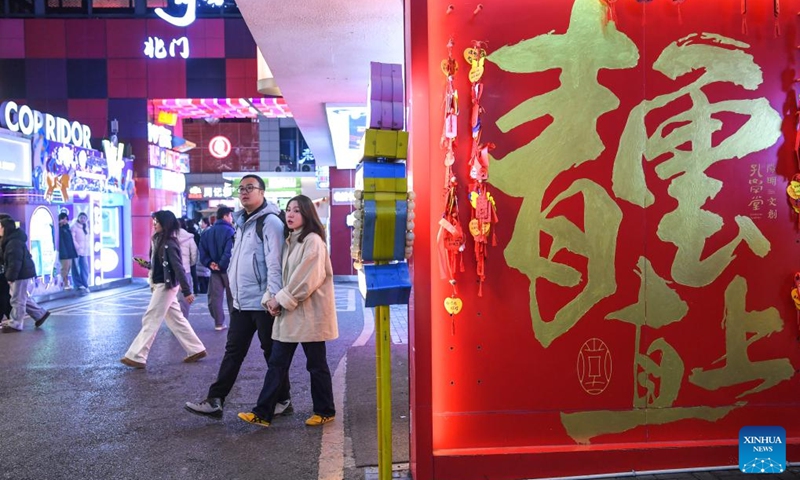
People visit the Qingyun Market in Guiyang, southwest China's Guizhou Province, Jan. 5, 2026. The city of Guiyang has been committed to the update and renovation of old commercial blocks, streets and factory areas. The renewed streets, such as Taiping, Minsheng, and Qingyun Roads have become vibrant spaces for relaxation and spending, driving urban consumption vitality and enhancing the city's youthful appeal. Photo: Xinhua
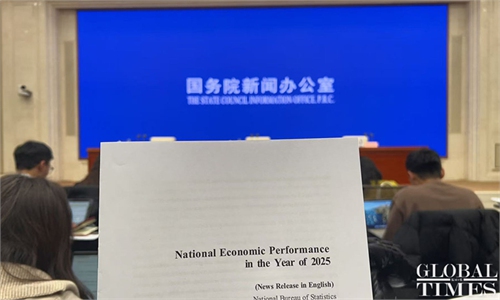
China's retail sales expanded by 3.7 percent year-on-year to 50.12 trillion yuan ($7.19 trillion) in 2025, according to data released by the National Bureau of Statistics (NBS) on Monday. A Chinese expert noted that the country's consumption has shown resilience during the past year, featuring an improved structure, and it is set to continue serving as a major engine of growth in the new year.
Consumption played a prominent role as a ballast, ranking the Chinese market among the top tier of the global retail market, NBS head Kang Yi said at a press conference on Monday.
The contribution of domestic consumption to China's GDP growth last year exceeded 50 percent, reaching 52 percent and rising 5 percentage points compared with the previous year. Consumption served as the primary driving force and stabilizing anchor of economic growth, said the official.
China reported a full-year GDP growth rate of 5 percent year-on-year in 2025, meeting the annual growth target of around 5 percent.
Looking ahead to 2026, despite facing pressures and challenges, there remain numerous positive factors supporting consumption growth, and the consumer market is expected to achieve steady expansion, Kang said.
The official cited strengths in China's vast consumer base and tremendous potential amid an ongoing consumption upgrading toward higher-quality products and services.
Sun Chuanwang, a professor at Xiamen University, told the Global Times on Monday that China's consumption sector showed resilience in 2025, despite challenges such as insufficient domestic demand.
"Resilience is the key word in describing China's consumption performance in 2025. In addition to the continual quantitative increase, the structure of consumption pattern is also evolving, with upgrading and innovation leading the trend," Sun said, noting the robust performance in services consumption and the shift by consumers to spend more on experiences, health and entertainment.
During the year, China's online retail sales reached 15.97 trillion yuan, up 8.6 percent year-on-year. Online retail sales of goods reached 13.09 trillion yuan, up 5.2 percent, accounting for 26.1 percent of total retail sales, NBS data showed on Monday.
According to the NBS, sales of daily necessities and goods related to trade-in programs showed strong growth momentum. Retail sales of telecommunication equipment increased by 20.9 percent last year while retail sales of household electric appliances surged by 11 percent.
The potential of services consumption was continuously unlocked, with last year's services sector sales increasing 5.5 percent year-on-year, outpacing the growth of goods sales by 1.7 percentage points.
In particular, retail sales of tourism consulting and leasing services, transportation services, and cultural, sports, and leisure services all maintained double-digit growth, while total domestic box office revenue increased by more than 20 percent year-on-year, NBS data showed.
Emerging sectors such as the silver economy, ice-and-snow economy, and debut economy are gaining sustained momentum, increasingly becoming new drivers of consumption growth, said the NBS head.
Kang said that the consumer goods trade-in policy will remain in place and undergo continuous optimization, while the first batch of ultra-long-term special treasury bond funds, amounting to 62.5 billion yuan, has already been allocated in advance.
The removal of unreasonable restrictions in the consumption sector is steadily progressing and the implementation of these policies will provide strong support for consumption growth, the official said.
In the new year, Sun said that China's consumption sector is expected to gain further traction as local governments are expected to introduce consumption stimulus policies, focusing on optimizing or innovating consumption scenarios, tapping into local resources, and creating differentiated experiences to better meet consumers' demand for high-quality services.
Policies aimed at boosting consumption will continue to take effect, the NBS head said, highlighting intensified efforts this year to implement initiatives aimed at revitalizing domestic consumption, along with new plans to increase the incomes of urban and rural residents.
Wang Qing, chief macroeconomic analyst at Golden Credit Rating International, told the Global Times on Monday that boosting household consumption will be a key focus of policies aimed at stabilizing growth in the new year. Wang predicted faster total retail sales growth as well as services retail sales growth for the whole year on policy support.
A timely boost from domestic demand will be needed to help mitigate downward pressure expected to be felt in the export sector amid an increasingly complex economic landscape in 2026, Wang said.
The Central Economic Work Conference, held in December, stipulated that expanding domestic demand would be the top priority of China's economic policy in 2026.
On January 16, a State Council executive meeting mulled measures to boost consumption by accelerating the formation of new growth points in services consumption, the Xinhua News Agency reported.
The meeting called for continued efforts to boost consumption by fully leveraging the integrated effects of different policies, linking improvement in people's wellbeing to consumption growth, and giving full play to the fundamental role of consumption in driving economic growth.
RELATED ARTICLES