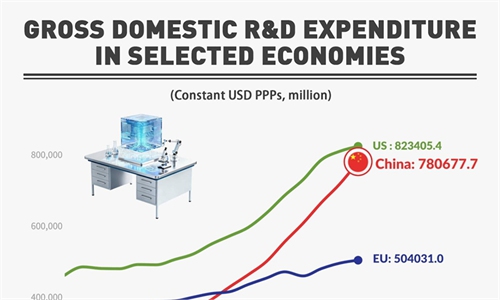
China’s R&D spending intensity reaches 2.8% in 2025, surpassing OECD economies for 1st time
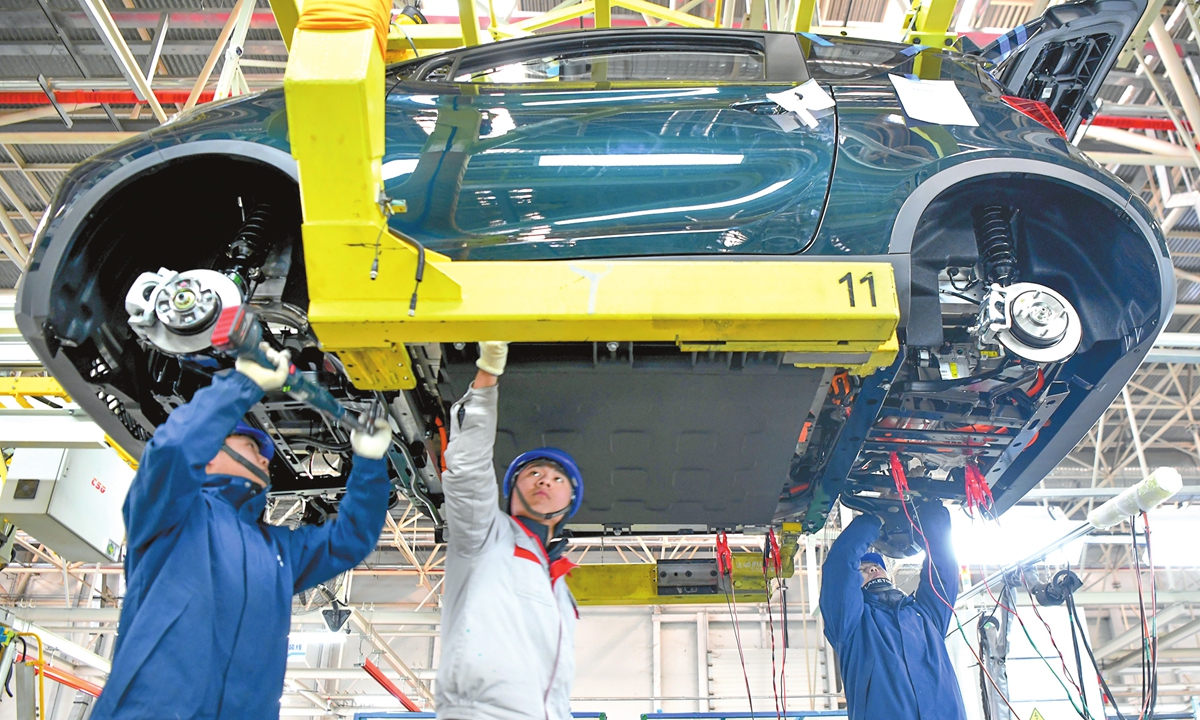
Workers assemble a new-energy vehicle at a manufacturing plant in Shijiazhuang, North China's Hebei Province, on December 24, 2025. From January to November this year, China's automobile production reached 31.231 million units, up 11.9 percent year-on-year, and sales reached 31.127 million units, up 11.4 percent year-on-year, according to official data. Photo: VCG
China's economy showed a clear shift toward innovation-driven development, with research and development (R&D) spending intensity reaching 2.8 percent - up 0.11 percentage points from a year earlier and surpassing the average of economies in the Organisation for Economic Co-operation and Development (OECD) for the first time, the National Bureau of Statistics (NBS) said on Monday.
Meanwhile, China's innovation-index ranking stood among the global Top Ten for the first time, according to data released by the World Intellectual Property Organization.
From new advances in basic research to breakthroughs in key technologies, and from deeper integration between technological and industrial innovation to the broad rollout of digital applications, China has seen a steady stream of achievements in frontier fields such as artificial intelligence (AI), quantum computing and brain-computer interfaces, with new quality productive forces continuing to gain momentum, NBS head Kang Yi said at a press briefing on Monday explaining last year's economic data.
Bian Yongzu, executive deputy editor-in-chief of Modernization of Management magazine, told the Global Times that official data show China's R&D capacity has risen markedly, strengthening its global position in innovation. This is reflected not only in the rapid growth of patent filings, but also in improving patent quality, supported by a large manufacturing base, a vast research workforce and government policies.
In 2025, the value added of digital product manufacturing among industrial enterprises above the government's designated size grew by 9.3 percent year-on-year, with output of servers and industrial robots posting rapid growth. Green electricity, renewable energy and the broader green economy expanded robustly, while new-energy vehicles (NEVs) accounted for more than 50 percent of domestic new car sales, Kang said.
China's technological strength gained further momentum in 2025, with spending on research and experimental development reaching 3.93 trillion yuan ($550 billion), ranking second globally for many consecutive years. China became the first country to hold more than 5 million valid domestic invention patents, while its Patent Cooperation Treaty filings topped the world for the sixth straight year, Kang said, when asked about the key features of new quality productive forces.
Breakthroughs in major technologies continued, from the maiden flight of the "Jiutian" drone and the Tianwen-2 mission to the commissioning of the first electromagnetic catapult aircraft carrier and the debut of the CR450 high-speed train, underscoring steady progress toward high-level technological self-reliance, Kang added.
Industrial upgrading gathered pace, Kang said. Investment and capacity expansion continued in emerging sectors such as high-end equipment, green energy and intelligent manufacturing, with deeper integration between technological and industrial innovation delivering tangible results. In 2025, equipment manufacturing and high-tech manufacturing accounted for 36.8 percent and 17.1 percent of value added by industrial enterprises above the designated size, respectively.
The low-altitude economy expanded rapidly and embodied intelligence advanced steadily, with output of civilian drones and industrial robots rising 37.3 percent and 28 percent year-on-year. Progress in intelligent manufacturing accelerated, as the number of smart factories increased and industrial internet applications extended across all 41 major industrial categories.
Digital penetration deepened further, Kang said. Digital industries, consumption and infrastructure expanded across the economy, integrating into both production and daily life. In 2025, value added from digital product manufacturing rose 9.3 percent year-on-year, while the information transmission, software and information technology services sector grew by 11.1 percent.
Wang Peng, an associate research fellow at the Beijing Academy of Social Sciences, told the Global Times that China's breakthroughs in frontier fields such as quantum technology and AI are strengthening its standing in the global technology competition. Advances in quantum computing and communications are giving China an edge in next-generation infrastructure and security, while the closer alignment of AI innovation with industrial use is helping the country move from catching up to shaping rules.
At the same time, rising patent quality and volume are reinforcing technological self-reliance and building barriers in key sectors, boosting China's leverage in global technology cooperation, he said.
"Green leadership became more pronounced," Kang said. China stepped up efforts to build a clean and low-carbon energy system, with clean power generation rising 8.8 percent in 2025 and the share of non-fossil energy in total consumption increasing by about 2 percentage points.
Bian noted that the expansion of patent activity is building long-term technology advantages for Chinese enterprises, enabling stronger competitiveness and continued reinvestment in innovation, which in turn reinforces the resilience of the national innovation ecosystem.
According to Bian, technology progress is consistently accelerating China's economic transformation, particularly in green upgrading. Advances in renewable energy are reducing reliance on fossil fuels, while breakthroughs in AI are being rapidly applied in manufacturing, boosting efficiency and product quality.
China's combination of strong research institutions and a comprehensive manufacturing base allows innovation to be commercialized quickly, giving the country a structural edge in global competition.
RELATED ARTICLES