EU weighs €93b tariff retaliation as Trump threatens allies over Greenland; US Treasury chief reaffirms annexation push, says Europe 'projects weakness'
By and Zhang Yiyi Published: Jan 19, 2026 02:11 PM

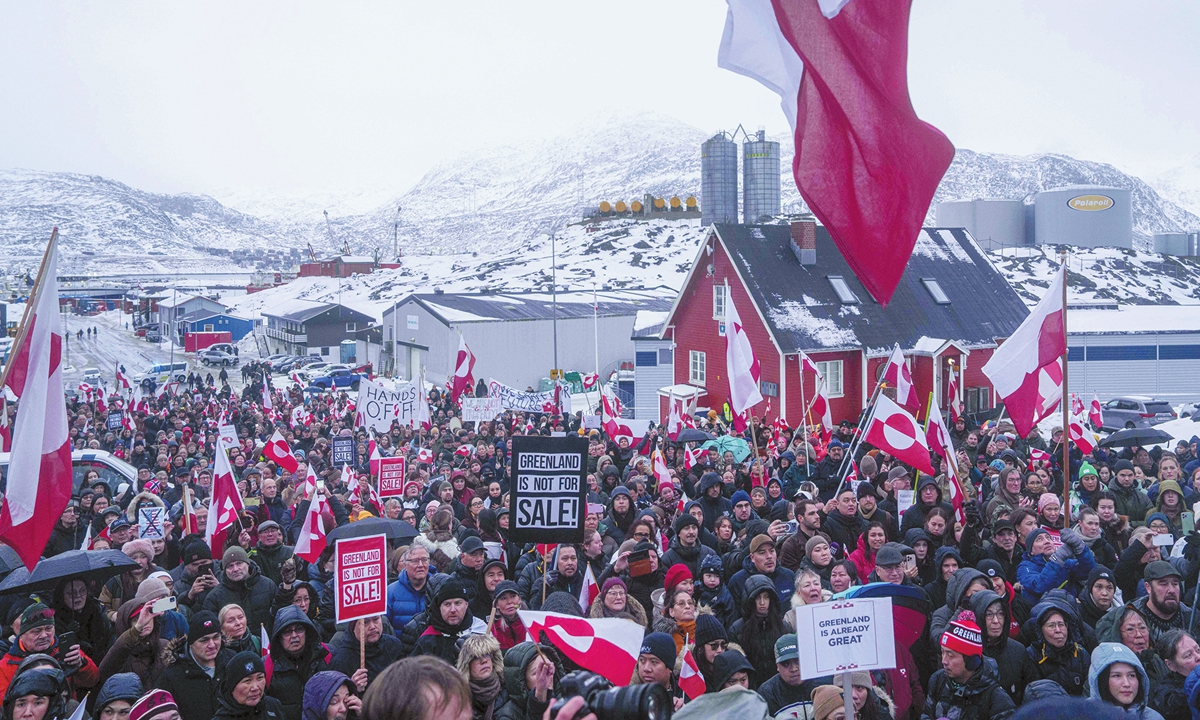
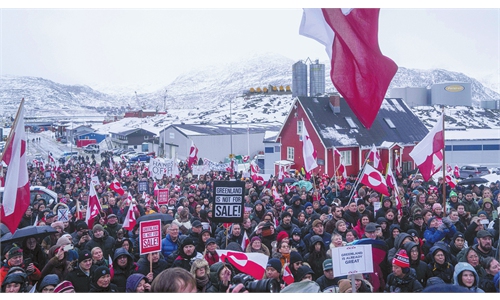
People protest against US President Donald Trump's policy toward Greenland in front of the US consulate in Nuuk, Greenland, on January 17, 2026. Photo: VCG
EU countries are reportedly considering hitting the US with €93 billion ($108 billion) worth of tariffs in retaliation or restricting American companies from the bloc's market in response to President Donald Trump's threats to NATO allies opposed to his campaign to take over Greenland. US Treasury Secretary Scott Bessent claimed that "Europeans project weakness" and the US "projects strength", and "enhanced security is not possible without Greenland becoming part of the US," according to multiple media reports.As the US steps up pressure on Europe to test the responses of relevant parties and force the EU into concessions that would further entrench US influence, Europe may be unlikely to yield quickly. While the EU has often been "tough on the weak and cautious with the strong," this episode puts its strength—and its professed principles—to the test, and may lead to a broader, more realistic policy reassessment, a Chinese expert said.
The EU's consideration of €93 billion worth of tariffs or restrictions on American companies' access to the bloc's market came after Trump - who has demanded Denmark's consent for the US to take control of Greenland - vowed on Saturday evening to impose 10 percent tariffs by February 1 on goods from the UK, Norway, and six EU countries that sent troops to the Arctic island for a military exercise this week, according to the Financial Times.
It noted that the move "marks the most serious crisis in transatlantic relations for decades."
The Financial Times report also reported that EU's "retaliation measures are being drawn up to give European leaders leverage in pivotal meetings with the US president at the World Economic Forum in Davos this week, officials involved in the preparations said."
"There are clear retaliation instruments at hand if this continues . . . [Trump's] using pure mafioso methods," said a European diplomat briefed on the discussion. "At the same time we want to publicly call for calm and give him an opportunity to climb down the ladder." "The messaging is . . . carrot and stick," they added, according to the Financial Times report.
On Greenland, the US and Europe are locked in a "tug-of-war," with no substantive steps taken so far. Washington's objective is clear: to secure substantive control over the island… Given Washington's hardline style and reliance on pressure tactics, the US may believe it can extract concessions on certain terms. Europe, however, is unlikely to yield quickly, Zhou Mi, a senior researcher at the Chinese Academy of International Trade and Economic Cooperation, told the Global Times on Monday.
The US is intensifying pressure over taking control of Greenland. In an interview with NBC News on Sunday, when asked whether President Trump was serious about annexing Greenland, US Treasury Secretary Scott Bessent claimed the president believes "enhanced security is not possible without Greenland becoming part of the US."
Bessent claimed "down the road, this fight for the Arctic is real. make it part of the United States, and there will not be a conflict because the United States right now, we are the hottest country in the world. We are the strongest country in the world. Europeans project weakness. US projects strength."
When asked how a US takeover of Greenland by force would differ from Russia's move in Crimea, Bessent dodged a direct answer, but claimed: "I believe that Europeans will understand that this is best for Greenland, best for Europe, and best for the US." Asked whether military action remained on the table, Bessent claimed that "I believe that the Europeans will understand that the best outcome is for the US to maintain or to receive control of Greenland."
While for the Europe, aside from mulling tariffs on the US, a landmark transatlantic trade deal will not be approved by EU lawmakers if Trump hits European countries with new tariffs as part of his efforts to wrest control of Greenland from Denmark, according to a report from the Politico.
In a statement online, Manfred Weber, president of the European People's Party (EPP), said that the escalating US-Europe tensions meant the EU Parliament would not vote in favor of the pact, which sets US tariffs on imports from the EU at 15 percent in exchange for the bloc not applying levies on American exports, per Politico.
France has called for the bloc to hit back with the anti-coercion instrument (ACI) which has never been used since its adoption in 2023. The tool includes investment restrictions and can throttle exports of services such as those provided by US Big Tech companies in the EU. Paris and Berlin are coordinating a joint response, with their respective finance ministers due to meet in Berlin on Monday before travelling to Brussels for a gathering with their European counterparts, a French ministry aide said, according to the Financial Times.
How the current transatlantic tensions will evolve - and when they may ease - remains uncertain, Zhou said, noting that divisions of interest within the EU persist and member states differ in their assessments, shaped by varying security, economic, and US-related considerations. Germany's decision to pull out from the military exercise underscores these divergences.
The German reconnaissance team that arrived in Greenland on Friday left the Arctic island on a civilian flight to Copenhagen on Sunday. It comes as US President Donald Trump threatened new tariffs on eight countries involved in the mission, according to a report from the Deutsche Welle.
US officials' recent remarks about pushing to take Greenland highlight that Washington is driven by overlapping motives: cementing a personal political legacy, securing strategic resources to gain leverage in future competition, and using pressure to test reactions and force the EU to make concessions, said Zhou.
The Guardian said in an analysis on Sunday that the coming weeks will test whether Trump has overreached with Greenland-related tariffs, amid growing calls for the EU to adopt a tougher stance. It noted that "Trump's tariff shock suggests the EU's strategy of flattery and appeasement has failed."
Zhou said that Europe has long played "tough on the weak and cautious with the strong." The EU's double standards, he noted, stem from its limited security capacity and strategic autonomy, which constrain its ability to reset ties with Washington.
For Europe, the current episode is both a test of strength and a test of how far the EU is truly willing to go in defending its stated principles. Only when confronted with unavoidable, high-cost challenges does the EU tend to shift its positions, and the current situation may therefore lead to a more realistic reassessment of policy within the bloc, the expert said.
RELATED ARTICLES