China's top anti-monopoly bureau launches official accounts on major social media platforms

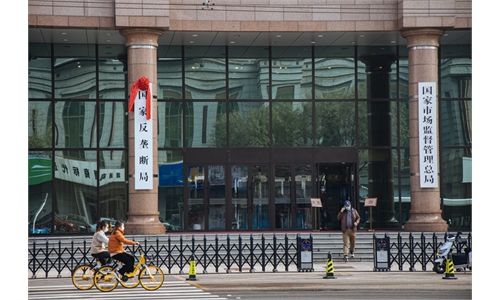
Photo shows the nameplate of National Anti-monopoly Bureau, which is in the same building of the State Administration for Market Regulation in Beijing. Photo: CFP
China's national anti-monopoly bureau under the State Administration for Market Regulation (SAMR) launched on Monday its official accounts on WeChat, Weibo and Douyin, the three major social media platforms, following preparatory work.
The move was made to strengthen public outreach on anti-monopoly and fair competition policies and foster a sound culture of fair competition across society, according to the notice released on the SAMR's website. All three accounts are named "China Anti-Monopoly."
Closely aligned with anti-monopoly enforcement and policy work, the corresponding accounts will carry out authoritative releases, coverage of major activities, policy interpretation, case information and exchanges with local authorities. The goal is to build a national anti-monopoly outreach and service platform integrating news and information, official announcements, policy interpretation, enforcement transparency, and interactive services, said the notice.
The launch has drawn widespread attention online. The Global Times reporter observed that the bureau's WeChat account has already drawn nearly 10,000 views and more than 200 likes as of press time.
The move is expected to provide authoritative policy releases, interpretations, and case disclosures, helping companies better understand anti-monopoly boundaries and compliance requirements, Li Changan, a professor at the Academy of China Open Economy Studies under the University of International Business and Economics, told the Global Times on Monday.
The platform will also enhance transparency, promote fair competition and improve policy predictability, thereby creating a more stable institutional environment for fair competition and high-quality development, the expert said.
Global Times
RELATED ARTICLES