Chinese embassy in Sweden rebuts unfounded accusations by some Swedish politicians, urges openness over confrontation
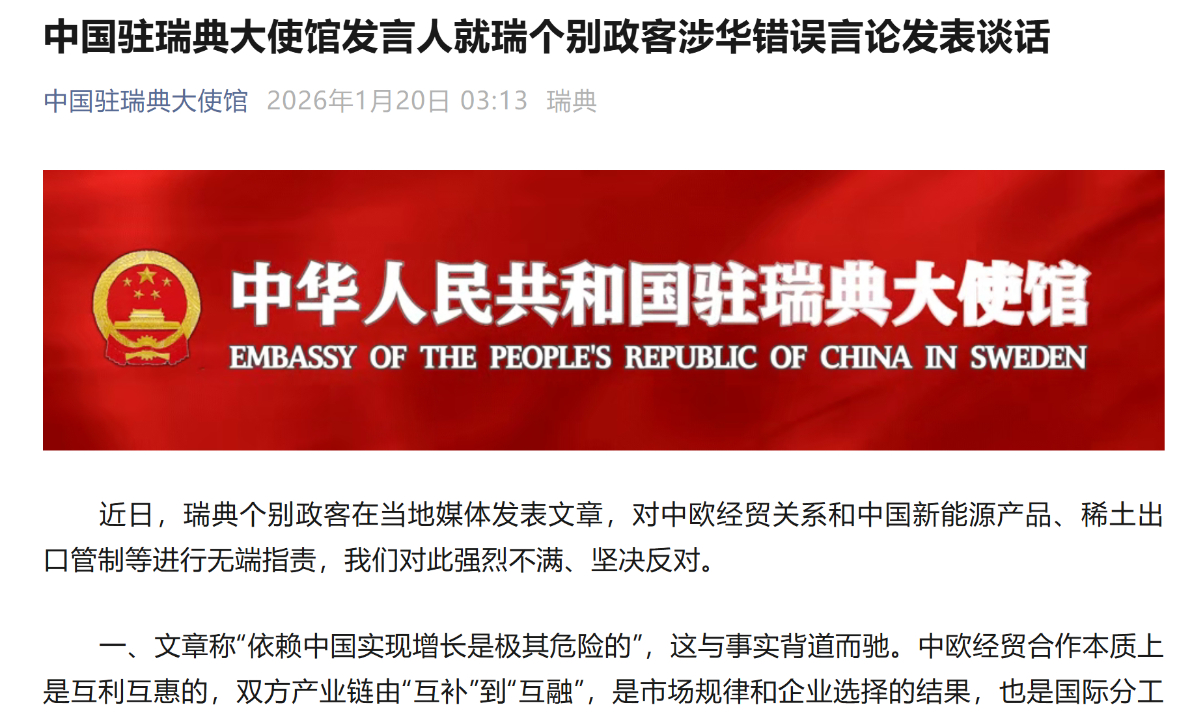
Photo: Screenshot from the official WeChat account of the Chinese embassy in Sweden
The Chinese Embassy in Sweden on Tuesday expressed strong dissatisfaction and firm opposition to unfounded accusations made by a small number of Swedish politicians against Chinese products and trade measures, calling on all sides to uphold two-way openness rather than build walls and barriers.The embassy's remarks followed an opinion article published in local media by two Swedish politicians, which leveled accusations over issues including China-EU economic and trade relations, China's new energy products, and China's export controls on rare earths.
According to the article, China's autonomous vehicles and solar panels could become surveillance tools, a claim the embassy dismissed as pure speculation. The embassy stressed in a statement on its official WeChat account that the Chinese government has always attached great importance to data privacy and security.
In 2020, China took the lead in proposing the Global Data Security Initiative, calling on all countries to commit to measures that prevent and stop cyber activities that infringe upon personal information, and to oppose the abuse of information technology to conduct large-scale surveillance against other countries or illegally collect personal data of foreign citizens.
"China has never required, and will never require, enterprises or individuals to collect or provide data and information located overseas for the Chinese government in violation of local laws," the embassy said.
China's new energy products, the embassy noted, have gained broad consumer recognition thanks to innovative technologies developed through intense market competition and reliable quality, and have made positive contributions to global green development. "Claims that these products pose data security risks are entirely groundless and driven by ulterior motives," read the statement.
On rare earth export controls, the embassy said rare earths have clear dual-use, civilian-military attributes. China conducts licensing reviews in accordance with laws and regulations, in line with internationally accepted practices and in better fulfillment of its international obligations, including non-proliferation commitments.
Recently, the Chinese government has approved general license applications submitted by Chinese exporters that meet relevant requirements. China stands ready to continue strengthening communication and cooperation with all parties to promote compliant trade in controlled items and safeguard the security and stability of global industrial and supply chains, per the embassy.
The article by the Swedish politicians also claimed that relying on China for growth is extremely dangerous. The embassy said this runs counter to facts.
China-EU economic and trade cooperation is essentially mutually beneficial. The integration of industrial chains, evolving from complementarity to deeper interlinkage, is the result of market forces, business choices and the international division of labor, the embassy said.
China and the EU are each other's second-largest trading partners, with two-way investment stock reaching about $260 billion, official data showed.
"China is deeply involved in the EU's competitiveness strategy in areas such as green energy, intelligent manufacturing, biomedicine, smart cities and third-party markets, forming a mutually beneficial and symbiotic relationship," the embassy noted.
Recently, China and the EU reached an understanding on the electric vehicle case, demonstrating that both sides have the capability and willingness to properly resolve differences through dialogue and consultation. This not only benefits the sound development of China-EU economic and trade relations, but also helps safeguard the rules-based international trading order, per the embassy.
Under the current international situation, as major global economies, the embassy call on both sides to adhere to two-way openness rather than erect barriers, promote trade and investment liberalization instead of protectionism, and provide enterprises on both sides with a fair, transparent, non-discriminatory and predictable business environment, injecting greater stability, certainty and positive energy into the building of an open world economy.
Regarding the allegation by the article claiming China neither follows the same rules nor respects agreements, the embassy said "it is not true."
China is a staunch supporter of the multilateral trading system, according to the statement, saying that it has not only fully honored its commitments upon accession to the WTO. but has also actively expanded unilateral opening-up.
China's overall tariff level has been reduced to 7.3 percent. Restrictions on the negative list for foreign investment access have been cut to 29 items, with market access restrictions in the manufacturing sector fully removed. The number of service sectors opened has reached more than 120, far exceeding China's WTO commitments.
China's economy has maintained steady and sustained growth, contributing around 30 percent to global economic growth over the long term. "It has become one of the most stable and reliable engines and anchors of the world economy," per the embassy.
Regarding the Swedish politicians' accusations over China's intellectual property rights, the embassy said the claims are equally unfounded.
China places great emphasis on intellectual property protection, has established a comprehensive legal framework in line with international norms, and has set up specialized intellectual property courts and tribunals. "China is increasingly becoming one of the preferred jurisdictions for international intellectual property litigation," the embassy's statement said.
Since joining the WTO, China's total imports and exports of intellectual property royalties have increased more than 20-fold. Facts show that China has evolved from a follower of intellectual property rules into an important participant and contributor to their formulation, the embassy said.
Global Times
RELATED ARTICLES