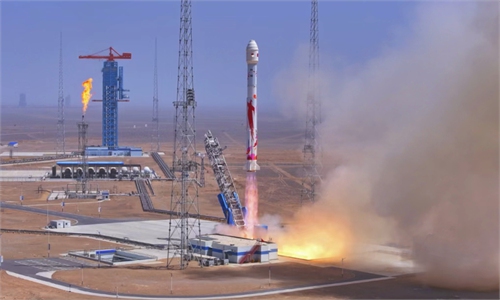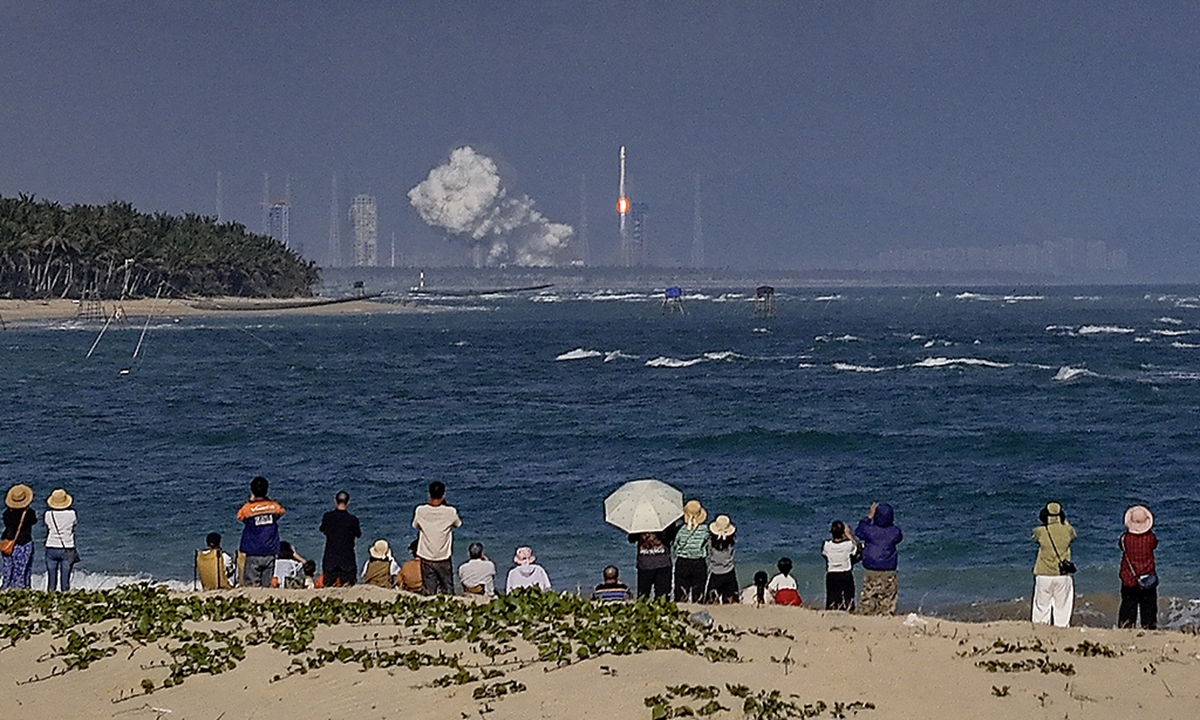
People watch the launch mission of a Long-March 12 carrier rocket at the Hainan commercial space launch site on January 19, 2026. Photo: VCG
China completed a total of 50 commercial space launches in 2025, accounting for 54 percent of the country's overall space launch missions, as the sector has maintained rapid growth last year, China National Space Administration (CNSA) said on Tuesday.
Of the launches, 25 were carried out by commercial launch vehicles. The Hainan commercial space launch site was officially put into operation and conducted nine launches in 2025, bringing the cumulative number of launches there to 10, and another 16 missions involved the launch of other commercial satellites, according to CNSA.
Throughout the year, 311 commercial satellites were successfully placed into orbit, representing 84 percent of the total number of satellites launched by China in 2025.
The administration also noted that progress in reusable launch vehicle technology has accelerated, as the Zhuque-3 reusable rocket completed its maiden flight, successfully achieving second-stage orbital insertion and carrying out key technology verification, including first-stage reentry and recovery.
Against this backdrop of accelerating advances in China's reusable rocket technologies, further progress has been reported within the country's commercial aerospace sector.
After completing China's first sea-based commercial aerospace launch of 2026 on January 16, Chinese private space firm Galactic Energy announced on Tuesday that the main engine, CQ-90, for its large reusable launch vehicle PALLAS-2 has successfully completed a full-system hot-fire test, the company told the Global Times on Tuesday.
PALLAS-2, with a diameter of 4.5 meters, is available in two configurations. In its standard configuration, the rocket has a lift-off mass of about 757 metric tons, a lift-off thrust of around 910 metric tons, and a low-Earth orbit (LEO) payload capacity of 20 metric tons. In the core booster configuration, the rocket has a lift-off mass of approximately 1,950 metric tons, a liftoff thrust of about 2,730 metric tons, and a LEO payload capacity of 58 metric tons.
The successful test marks another major breakthrough in the independent development of liquid rocket engines. It lays a solid propulsion foundation for the maiden flight of the Pallas-2 large reusable launch vehicle, said the company.
RELATED ARTICLES