China to cancel export tax rebates for photovoltaic, battery products, conducive to promoting green transition, curbing 'rat race' competition: MOF
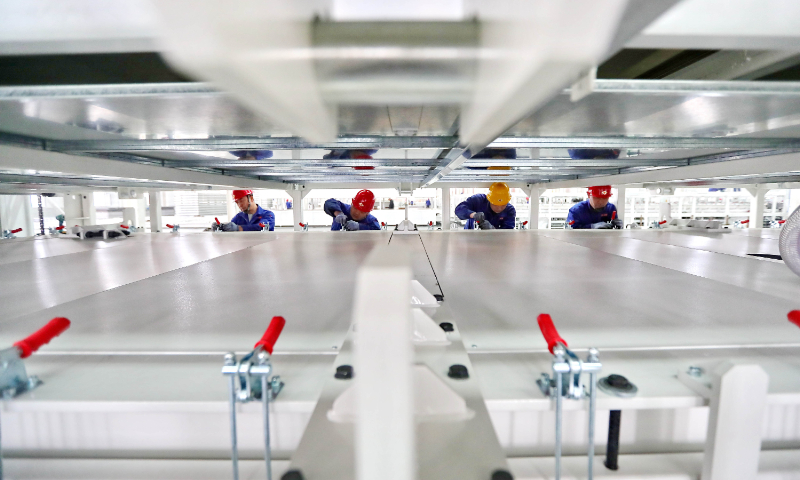
Workers make solar panel laminating machines at a factory in Qinhuangdao, North China's Hebei Province, on April 10, 2024. A manufacturing center for photovoltaic smart equipment went into operation in January, with an annual capacity of 800 solar panel laminators, which are used to produce solar battery modules. Photo: VCG
China's Ministry of Finance (MOF) has announced the country will cancel export tax rebates for photovoltaic (PV) products and phosphorus chemicals starting April, and a phased elimination of export tax rebates for batteries over two years, marking a significant policy shift aimed at promoting high-quality development, resource efficiency, and green transformation, meanwhile curbing "rat race competition," an official of MOF said on Tuesday.
Export tax rebates have long been a key institutional arrangement supporting China's foreign trade. The policy has been adjusted over time in line with economic and social development needs, Li Xianzhong, an official of the MOF, said on Tuesday at a press conference.
The MOF and State Taxation Administration announced the cancellation of the export tax rebate rates for products including PV and phosphorus chemicals, effective from April 1, 2026, according to an announcement published on January 8.
As seen from an appendix detailing the products subject to the suspension of export tax rebates posted by MOF, toughened (tempered) safety glass for aircraft, spacecraft, and vessels, PV cells assembled or not assembled in modules or made up into panels, as well as electronic cigarettes and similar personal electric vaporizing devices were included.
The export tax rebate for battery products will be phased out over two years, which included primary lithium batteries, lithium-ion accumulators and zinc-air primary cells and primary batteries, according to MOF.
Li said that this is a further policy adjustment made in light of China's actual circumstances, building on the reduction of export tax rebate rates for photovoltaic, battery, and related products in December 2024.
Li emphasized that as China accelerates its transition toward green, low-carbon, and high-quality development, this policy adjustment serves multiple strategic goals.
"By removing the rebate incentive, the measure encourages more efficient use of resources, reduces environmental pollution and carbon emissions, and supports the country's broader push for a comprehensive green economic and social transformation," said Li.
The changes are also designed to guide rational industrial restructuring and accelerate industrial upgrading. The policy helps address "rat race competition" and boost high-quality development. The MOF will work together with relevant departments to ensure the effective implementation and execution of the policies, said Li.
Global Times
RELATED ARTICLES