China to draft action plan in 2026 to prop up domestic demand through 2030: senior official
Nation possesses unique advantages to address supply-demand imbalance, led by upgrades, digital economy: official
By Published: Jan 20, 2026 08:28 PM

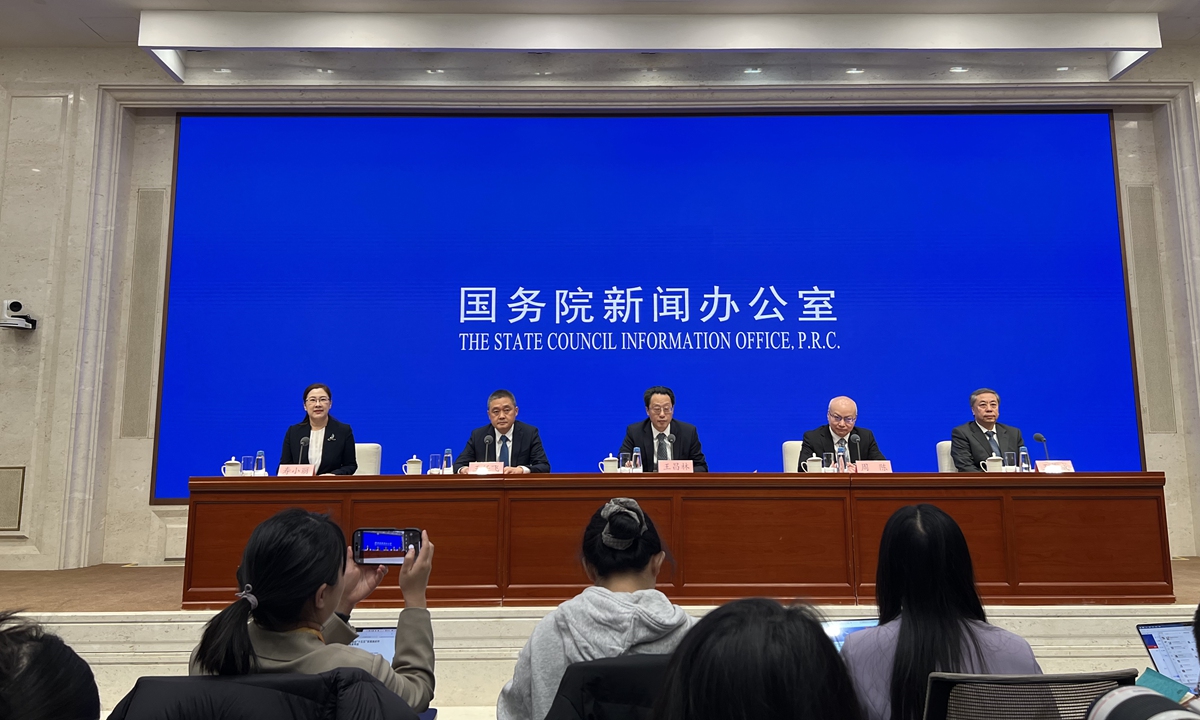
Wang Changlin, deputy head of the NDRC, speaks at a State Council Information Office press conference on January 20, 2026. Photo: Chu Daye/GT
In light of the need arising from a new round of technological revolution and industrial transformation, the National Development and Reform Commission (NDRC) will this year start to study and formulate an action plan to expand domestic demand from 2026-2030, to "guide new supply with new demand and create new demand through new supply" by providing strong innovative measures and other types of support, a top official of the country's top economic planner said on Tuesday.
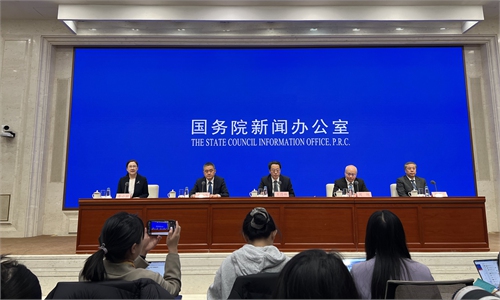
Wang Changlin, deputy head of the NDRC, made the remarks at a State Council Information Office press conference to provide a briefing on efforts to implement the guidelines of the Central Economic Work Conference (CEWC) held in December, in order to achieve a good start for the 15th Five-Year Plan period (2026-30).
The CEWC, held in December, stipulated that expanding domestic demand would be the top priority of China's economic policy in 2026.
While noting that the current economic operation faces the issue of "strong supply but weak demand," the NDRC's Wang said that strengthening domestic market circulation would be the focal point of macro-policies in the new year, and domestic demand would be expanded in all aspects, with a focus on adapting to the trend of the upgrading of demand in China.
At the press conference, NDRC officials also announced that policies to boost consumption, bolster people's incomes and promote the building of a unified national market would be drafted in the new year.
Chinese analysts said that China may lean toward tapping the potential of technological progress in the process of boosting demand in the new year, banking on the rapid development of the country's high-tech sectors, such as the wide application of artificial intelligence technologies.
The Chinese economy advanced under pressure in the past year. On Monday, China reported a full-year GDP growth rate of 5 percent year-on-year in 2025, meeting the target of about 5 percent.
National Bureau of Statistics head Kang Yi said at a press conference on Monday that the contribution of final consumption expenditure to China's overall economic growth in 2025 exceeded 50 percent, reaching 52 percent and rising 5.0 percentage points compared with the previous year, with consumption serving as the primary driver and stabilizing anchor of economic growth.
Having acknowledged the challenging tasks, NDRC officials on Tuesday highlighted the positive factors for the nation to promote consumption growth in 2026, including continually improving the economic structure, the emergence of new growth drivers, the strengthening of overall development momentum and the steady advancement of new quality productive forces.
Zhou Chen, an NDRC official, said that in 2026, both consumption and investment, as well as technology and industry, are set to unleash immense development potential and "new technologies, new products, and new scenarios will flourish."
Hu Qimu, deputy secretary-general of Forum 50 for Digital-Real Economies Integration, told the Global Times on Tuesday that the announcements by the top economic planner at the start of the year represent a timely pronunciation in line with the guideline of the CEWC.
The announcement carries policy continuity, as addressing the issue of insufficient demand and ineffective supply has been a priority task commanding the attention of top policy-makers for some time, Hu said.
"Relying on technology would be a vital means for the implementation of programs to boost domestic demand," Hu said, noting that the application of technology will help upstream production to churn out more high-quality products that the market needs, make the circulation of goods and services more efficient at a lower cost and help generate more high-paying jobs.
In order to boost domestic demand, the NDRC's Zhou revealed that efforts are underway to study and formulate measures for job stability and expansion, as well as plans to increase the incomes of urban and rural residents. The aim is to enhance people's consumption capacity and optimize consumption upgrading, Zhou said.
Also, actions to expand and upgrade the services sector will be promoted in 2026, with substantive policies to be introduced to vigorously support the high-quality and efficient development of the services industry.
Regarding the "trade-in" program for consumer goods, fund allocation will be optimized, with the economic planner vowing to comprehensively consider factors such as consumption potential and policy implementation effectiveness to reasonably determine the scale of fund allocation for different regions.
The NDRC is also planning and advancing a number of landmark and pioneering major projects in the high-tech industries during the 15th Five-Year Plan period, the NDRC's Zhou said, noting that the country's innovation chain, industrial chain, and talent chain are accelerating their integration.
In 2025, China's digital economy value-added is estimated to have reached 49 trillion yuan ($7.03 trillion), accounting for about 35 percent of GDP, and the sector is set to create even greater market space in the future, the official said.
More than 360 million people applied for subsidies under the consumer goods trade-in program in 2025, driving related product sales to exceed 2.6 trillion yuan, according to the NDRC. This directly contributed to an increase of 0.6 percentage points in retail sales.
China's Ministry of Finance (MOF) and several other government departments on Tuesday announced a series of policy measures, including interest subsidies for medium-sized, small and micro-sized enterprises, aimed at ramping up domestic demand and inducing more investment to fully unleash economic potential and strengthen economic resilience.
Retroactive to January 1, for qualifying fixed-asset loans and certain new policy-based financial instruments utilized by medium-sized, small and micro enterprises, the central government will provide interest support with an annual subsidy rate of 1.5 percentage points, with a subsidy duration of no more than two years, according to an announcement by the MOF.
RELATED ARTICLES