IN-DEPTH / IN-DEPTH
GT investigates: Who is ICE? How an immigration law enforcement agency is transformed into 'political instrument'
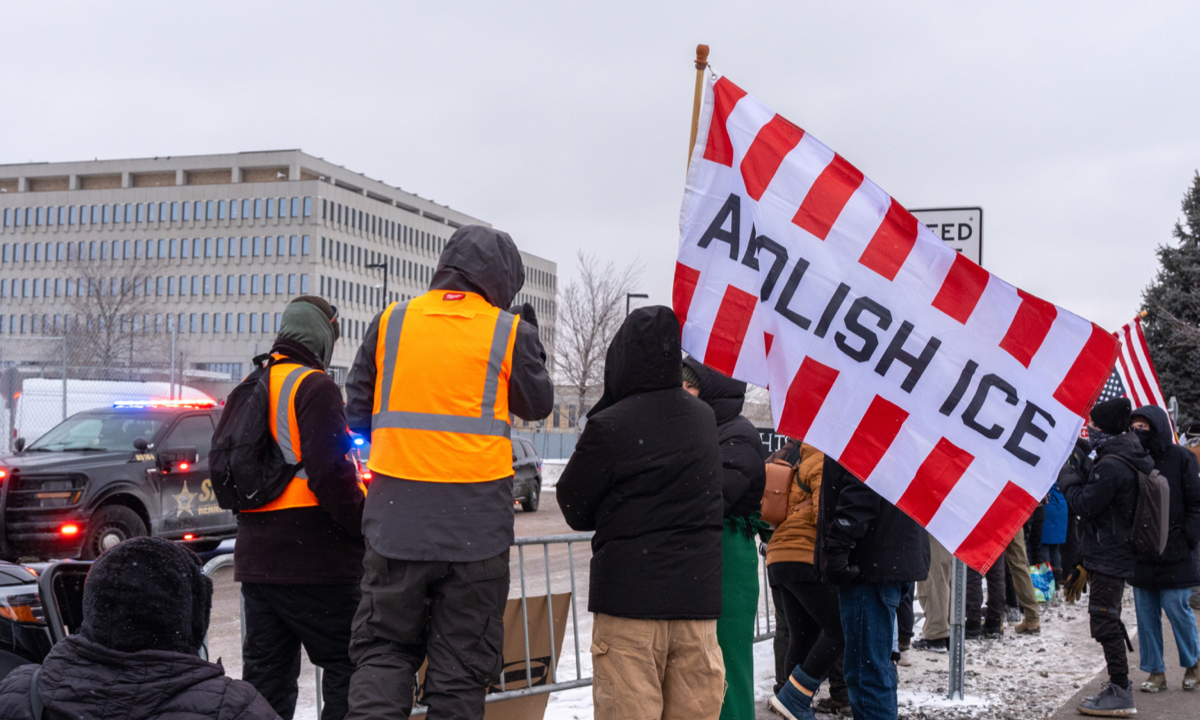
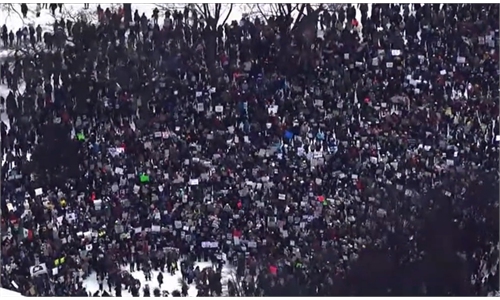
Protesters demonstrate against Immigration and Customs Enforcement (ICE) on January 18, 2026, after Renee Good was fatally shot by an ICE officer last week in Minneapolis. Photo: VCG
Who is ICE (US Immigration and Customs Enforcement)? The agency has become a trending topic on social media platforms in recent days after an ICE officer fatally shot Renee Nicole Good in Minneapolis, sparking nationwide protests against the agency across the US.
Public outrage and curiosity about the agency intensified further following the spread of a viral video on X on January 14. According to the video footage, during a tense confrontation in Minneapolis, Minnesota, with two local civilians, an ICE officer made a startling claim that he earns an alleged annual salary of $200,000 with only a high school diploma. The remark sparked widespread online debate over law enforcement pay and qualifications about ICE officers.
Is the officer telling the truth about ICE? What exactly is ICE? What kind of people are working for them? And why, at this particular moment, has the agency gained visibility and become the flashpoint of bitter domestic division in the US?
The fatal shooting of Good and the ensuing controversy over ICE stem from the contradictions in the US immigration policy and are related to factors such as the roots of racial discrimination, and the expansion of law enforcement power, Wu Xinbo, director of the Center for American Studies at Fudan University, told the Global Times.
'Powerful and sophisticated'
According to ICE's official website, the agency is a law enforcement component of the US Department of Homeland Security (DHS). It was created in 2003 through a merger of the investigative and interior enforcement elements of the former US Customs Service and the Immigration and Naturalization Service. ICE has more than 20,000 employees in 400 offices in the US, and 46 foreign countries and regions. The agency has three operational directorates: Enforcement and Removal Operations (ERO), Homeland Security Investigations (HSI), and the Office of the Principal Legal Advisor (OPLA).
Yet ICE is more than just a component. The agency itself emphasizes that it wields "a unique combination of civil and criminal authorities." "With those authorities, ICE quickly became a powerful and sophisticated federal law enforcement agency," its website states.
ICE sees its mission as encompassing both public safety and national security, the BBC stated in an article on ICE on Thursday.
ICE's power is mainly implemented in local states via the assistance of Section 287(g) of the Immigration and Nationality Act (the 287(g) program). The program allows the federal government to partner with local law enforcement officers to perform certain immigration enforcement functions in localities that have entered into agreements with the federal government. This means that police officers who are traditionally focused on community safety and enforcing state and local laws - not immigration - can be trained by ICE to arrest and detain people for civil immigration violations, according to an article on the program on the website of the American Immigration Council (AIC).
However, since the signing of the first agreement under the 287(g) program by the Florida Department of Law Enforcement in 2002, the program has attracted a wide range of critics over racial profiling and civil rights violations, according to the article on the AIC website.
From the beginning, ICE signed 287(g) agreements with sheriffs who ran on anti-immigrant campaign platforms and sought to participate in the program as a political trophy in local anti-immigration campaigns, according to a report published by the American Civil Liberties Union (ACLU) in 2022.
A typical example for the group is Joe Arpaio, a man dubbed "America's Toughest Sheriff." A group of Latino Americans filed a class action lawsuit against Arpaio in 2007 claiming Arpaio's policing policies amounted to racial discrimination, dragging the controversial program into national attention, according to a CNN report in July 2017.
According to the ACLU report, the number of local agencies that signed 287(g) with ICE was 34 at the end of Obama's administration. After the first Trump administration's recruitment efforts, the number had surged to 140 and remained at the same level during the Biden administration. Through a close view, the ACLU found that, among sheriffs participating in the program in 2022, at least 59 percent had histories of anti-immigrant or xenophobic rhetoric, 55 percent advocated inhumane immigration policies, and 65 percent of agencies showed patterns of racial profiling or civil rights violations.
The Global Times found a recruitment posting for deportation officers for ICE on USAJOB, the US Office of Personnel Management website. The posting stated that "this entry-level role requires no college degree," meaning applicants with only a high school diploma or less are eligible. Also, the Global Times found that the posting's "Conditions of employment" listed only three "must" requirements: Be a US citizen, successfully pass a background investigation, and complete and pass a pre-employment drug test. It further stated that maintaining firearm proficiency is "mandatory," because officers "will be required to carry a firearm while performing the duties of this position."
New York-based journalist Laura Jedeed recently recounted in Slate magazine how she applied for an ICE agent position. Using a resume that downplayed her current reporting work and highlighted previous military service, Jedeed received a very short interview - under six minutes - with minimal questions and no probing of her public opposition to ICE. Moreover, without having proactively submitted key paperwork (such as a background-investigation consent form), she said the system nonetheless moved to "hire" her as a deportation officer. "...it seems far more likely that ICE is running an extremely leaky ship when it comes to recruitment," Jedeed wrote in the piece published on January 13.
"How are we to trust ICE allegedly thorough investigations of the people they detain and deport when they can't even keep their HR paperwork straight?" Jedeed asked in the article.
In a sharp contrast to their low qualification, ICE officers are receiving a surprisingly high salary, which is another major controversy over the group.
On the website of USAJOB, a recruitment posting for "deportation officers," active from June to September 2025, listed a base salary range of $49,739 to $89,528 per year, plus "up to $50,000 in signing and retention bonuses." ICE's own website also advertises benefits such as "up to $60,000 in student loan repayment" and "up to 25 percent in premium pay," the Global Times found on the website.
In other words, when combined, these benefits could potentially bring a deportation officer's total annual compensation to roughly $200,000, exactly as the officer in the abovementioned viral video on X claimed. This amount enables a person to be within the top 10 percent of US household incomes, according to a report by CNBC on December 19, 2025.
"It is wild how some jobs pay a lot for questionable ethnics," read an X user's comment on the abovementioned viral video on X.
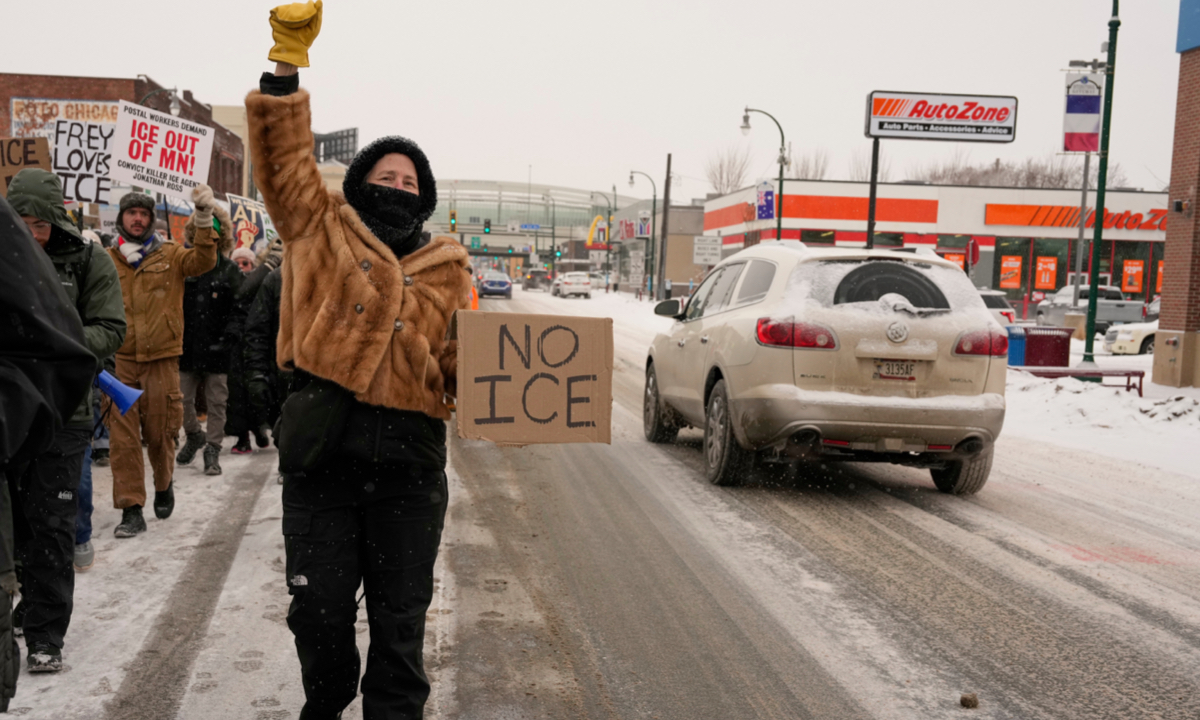
Protesters demonstrate against Immigration and Customs Enforcement (ICE) on January 18, 2026, after Renee Good was fatally shot by an ICE officer last week in Minneapolis. Photo: VCG
Significant expansion
Despite the controversies, the Trump administration significantly expanded ICE, in missions, budget, and scale, letting the agency "take the lead in carrying out the Trump administration's mass deportation initiative," which was a central promise of their election campaign, the BBC said in an article on Thursday.
The number of detainees in ICE custody has reached a new record high, surpassing 70,000 for the first time in the deportation agency's 23-year history, according to a CBS News report on Friday citing internal DHS data it obtained.
According to an announcement on ICE's website on May 1, 2025, the agency led a so-called first-of-its-kind statewide operation from April 21 to April 26 in 2025 that led to the arrest of 1,120 immigrants it claimed were "criminal illegal." It is the largest number in a single state in one week in ICE's history.
The One Big Beautiful Bill signed in July 2025 provides more than $75 billion in supplemental funding over four years for ICE to expand interior enforcement operations, allowing for an unprecedented expansion of immigration detention and deportations operations within the US, according to the National Immigration Forum (NIF), an organization advocating immigrants' rights in the US.
The expansion is expected to increase ICE's annual budget from $8.7 billion to more than $27 billion, according to the NIF. The figure surpasses the annual military budgets of at least 23 countries in the top 40 military spenders in 2024, according to data released by the Stockholm International Peace Research Institute.
On January 20, 2025, the first day the second Trump administration took office, they issued an executive order, which requires ICE to authorize State and local law enforcement officials, as the Secretary of Homeland Security determines are qualified and appropriate, under the section 287(g) program to the maximum extent permitted by law, according to ICE's website.
As of September 2025, the number of local law enforcement agencies across the US that had signed the 287(g) program agreement with ICE had swelled to more than 1,000, a historic high, according to the AIC.
ICE is also hiring more people. According to the agency's website, on December 18, 2025, DHS had received over 220,000 applications for more than 10,000 ICE officer positions.
'A political instrument'
In a post on X on January 8, DHS claimed that in the fatal shooting of Renee Nicole Good in Minneapolis, the ICE officer, Jonathan Ross, fired in self-defense after Good "weaponized her vehicle against law enforcement." Homeland Security Secretary Kristi Noem claimed during a press conference on January 7 that Good hit the ICE agent Ross, according to CBS News.
The investigation into the case is still ongoing. The FBI briefly opened a civil rights probe into Ross before shifting its focus to whether the agent was assaulted, CNN reported on Monday citing two anonymous sources. Previously, the Minnesota Bureau of Criminal Apprehension said on January 8 that the FBI blocked the BCA from participating in the investigation after the two sides initially agreed to jointly probe the shooting, CNN reported.
But to many observers and media, it is immigration issue itself that has been "weaponized." ICE has been transformed "from an agency focused on legalistic immigration into a political instrument and propaganda tool," read an article by The Atlantic in August 2025.
On Thursday, Michigan's Congressman Shri Thanedar introduced the Abolish ICE Act, legislation that would dismantle the US Immigration and Customs Enforcement and end its current enforcement authority, according to an announcement on Thanedar's website.
"Since ICE's establishment in 2003, they've prioritized aggressive enforcement and violence rather than due process. Americans are being terrorized... We must fundamentally change the way we approach immigration: It's time to abolish ICE," read the announcement.
Behind the roaring controversy over ICE, lies intensifying partisan confrontation within the US, experts reached by the Global Times pointed out. According to Wu, during the Biden administration, looser policies allowed significant inflows of undocumented immigrants into Democratic states; the Trump administration's deportations have targeted these areas, revealing an underlying partisan dynamic where immigration has become a focus in interparty struggles.
About two weeks after Good's death, protests against ICE still continue in Minnesota. An Associated Press report said the immigration crackdown has made chaos and tension a new normal in the Twin Cities, the Minneapolis-Saint Paul metropolitan area with a population of approximately three million people.
As the tension between anti-ICE protesters and the ICE continue to roar, social divisions may exacerbate in the US. Racial and ethnic divisions in the US are likely to deepen. Incidents of violent law enforcement would become frequent along with the abuse of power by law enforcement agencies, Wu warned.
RELATED ARTICLES