IN-DEPTH / IN-DEPTH
What has happened in Iran over past ten days? A close look at Tehran in eye of storm

People gather at Dam Square in Amsterdam during a solidarity rally for Iran on January 14, 2026. Photo: VCG
The situation in Iran has gripped the attention of multiple parties in recent days. As Iran announced on Saturday that it would gradually resume internet services that had been suspended since January 8, public opinion generally holds that the protests that have continued for more than ten days in the country have tended to subside. Nevertheless, under the threat of intervention from the US and Israel, the situation remains highly uncertain.
What exactly was the situation in Iran over the past ten days? How does this wave of protests differ from what Western media reported? The Global Times interviewed Li Xuanxuan, a Chinese doctoral candidate at the School of Country & Region Studies, Northwest University, who just returned to China from Tehran on Friday. As a visiting scholar who has long stayed in Iran, he observed the entire process of this round of protests in Tehran up close, documenting the local people's living conditions, social order and the economic impacts.
This story is also part of the Global Times' "Witness to History" series, which features first-hand accounts from individuals who were at the forefront of historic moments.
A shortage of flight tickets to leave Iran?
Li told the Global Times that he took Mahan Air Flight W5081, a direct flight from Tehran to Guangzhou, South China's Guangdong Province. It departed at 9:15 pm local time on January 15 and arrived in Guangzhou at 9 am Beijing time on January 16.
He observed that the passenger load factor of this was not high, at around 30 percent.
There are four seats in the middle row of the aircraft, and basically every passenger could occupy an entire row to lie down, making the cabin look quite empty. At least judging from this flight, there was no sign of a concentrated evacuation of large numbers of people or fully-booked flights, he said.
However, the frequency of international flights departing from Tehran has indeed dropped significantly. Many airlines have adjusted their routes to avoid Iranian airspace. Take the day Li flew back to China as an example, there were only about 20 outbound flights from Imam Khomeini International Airport throughout the day, compared with the usual 40 to 50 under normal circumstances. In terms of destinations, the routes were also very concentrated, he said. Apart from Mahan Air's flights to China, other flights were mainly bound for a handful of cities such as the Shiite holy city Najaf in Iraq and Istanbul in Turkey, according to him.
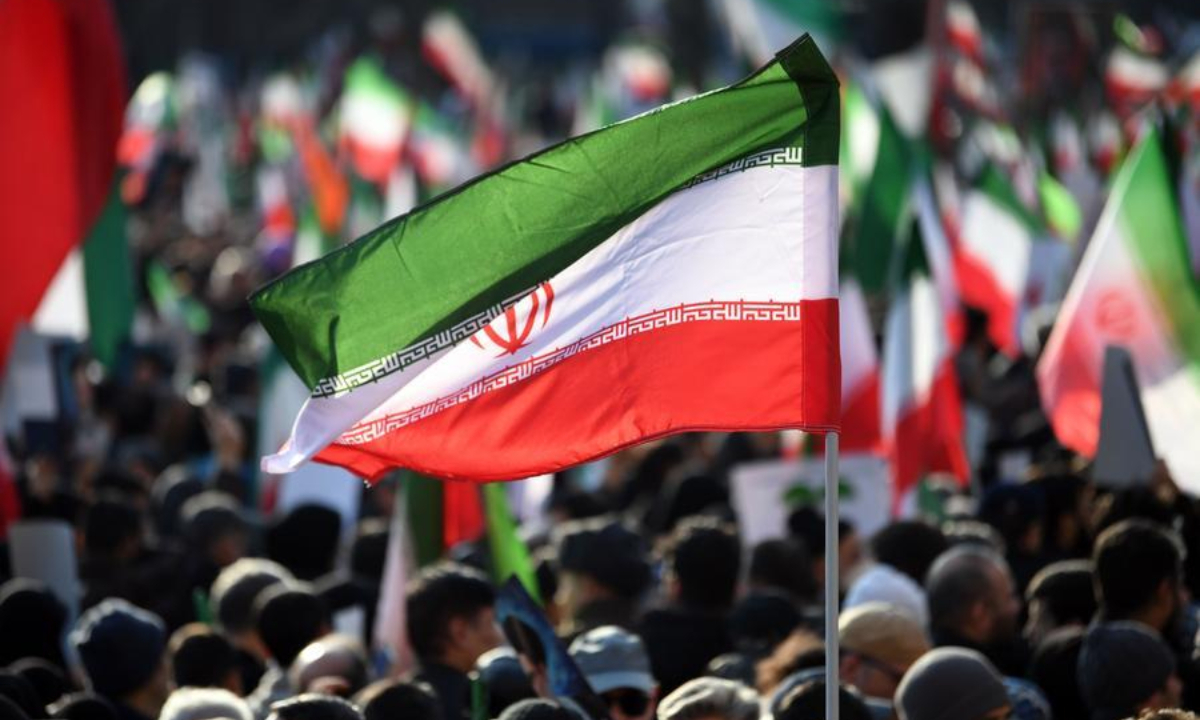
People take part in a demonstration in Tehran, Iran, on Jan. 12, 2026. Tens of thousands of pro-government citizens took to the streets across Iran on Monday, responding to calls from Iranian authorities to demonstrate solidarity. (Xinhua/Shadati)
Basic supplies remain adequate, available
Li told the Global Times that the latest wave of protests in Iran roughly began on December 28, 2025, first erupting in Tehran's Grand Bazaar. This was an area Li passed through daily for commuting, grocery shopping and attending classes. After the protests broke out, he made several special trips there to observe the situation on the ground.
At 11 am on January 6, Li said he saw that around 90 percent of the shops in Grand Bazaar had reopened for business, while only a small number of stores remained closed, with a few people gathering outside their entrances. Overall, however, public order had largely returned to normal, and commercial activities were proceeding as usual, he said.
On that very same day, some Western media outlets reported that the bazaar remained completely shut down. Such report was clearly inconsistent with what he had witnessed firsthand, Li noted.
Furthermore, compared with the supply shortages that emerged during the 12-day Israel-Iran conflict in mid-2025, this round of protests did not directly disrupt the supply of goods. The basic daily lives of residents in downtown Tehran were also not significantly affected, according to Li. In the neighborhood where Li resided, almost no shops closed their doors because of the protests.
Nationwide Internet shutdown to de-escalate situation
Iran has implemented an indiscriminate internet blackout. During this period, even with international roaming services provided by Chinese telecom operators, Li was unable to access the internet normally. In the first few days of the blackout, telephone signals were also very poor, significantly impacting travel and communication. As a result, Li reduced his frequency of outings. Local prices also rose to some extent - for instance, the price of a carton of milk he regularly consumed increased by about 20 percent.
A few days later, telephone services and some official government websites within Iran gradually resumed, and ride-hailing and map applications became functional again. However, social communication apps like WeChat, which require access to international networks, remained inaccessible. Some Chinese businesspeople and expatriates in Iran managed to contact China via satellite networks. Meanwhile, some of Li's Iranian friends attempted to connect to Starlink system using a circulated "Persian-language internet access guide," though almost none succeeded.
It is evident that Iran placed high importance on cybersecurity during this period, implementing a series of measures to de-escalate the situation, with a clear objective: to bring the protests under control.
A society with intense political engagement
Based on Li's observations, the main participants in this wave of protests were primarily bazaar merchants and young people, especially university students. However, the demands of these two groups differed, and in the absence of effective organization and mobilization, it was difficult for them to form a unified force.
Bazaar merchants are a highly significant group in Iran. In many countries undergoing the transition from tradition to modernity, traditional marketplaces like bazaars often face challenges or even gradual disappearance, replaced by new commercial centers. In Iran, however, bazaars are not only an economic pillar of traditional commerce but also a barometer of social and political trends. Any "rumors" circulating within the bazaars can have a broader impact on Iranian society - a characteristic not seen in traditional markets in other countries.
Bazaar merchants are extremely sensitive to prices and the foreign exchange market, making them more acutely aware of the depreciation of the Iranian rial than other groups. Therefore, in this round of protests, bazaar merchants have shown little inclination to resolve issues through extreme conflict. Instead, they prefer limited resistance to secure their legitimate rights and interests. This also differs fundamentally from the prolonged market closures observed in Iran's historical bazaar protests.
In contrast, the demands of Iran's youth diverge significantly from those of the bazaar merchants. Influenced by high unemployment rates and long-term exposure to Western media narratives, some young people are more inclined to push for changes in the political system. Overall, Iranian society is highly divided and fragmented. Expecting university students in Tehran and bazaar merchants to stand together to achieve a common goal remains quite challenging.
Li believes that Iran has always been a society with intense political engagement, where protests are, in fact, an integral part of its political operations. Since the 1979 Islamic Revolution, nationwide large-scale demonstrations have been frequent. With each protest, predictions have emerged about the potential collapse of the regime, yet the Islamic Republic of Iran has endured to this day, Li said.
He argues that when analyzing social movements in Iran, it is essential to understand that while protests occur frequently, not everyone aims to overthrow the regime, nor does it necessarily indicate that the government is unable to control the situation.
RELATED ARTICLES

