Chinese firms’ green, AI tech in focus at WEF
Participation helps form broader consensus for cooperation: expert
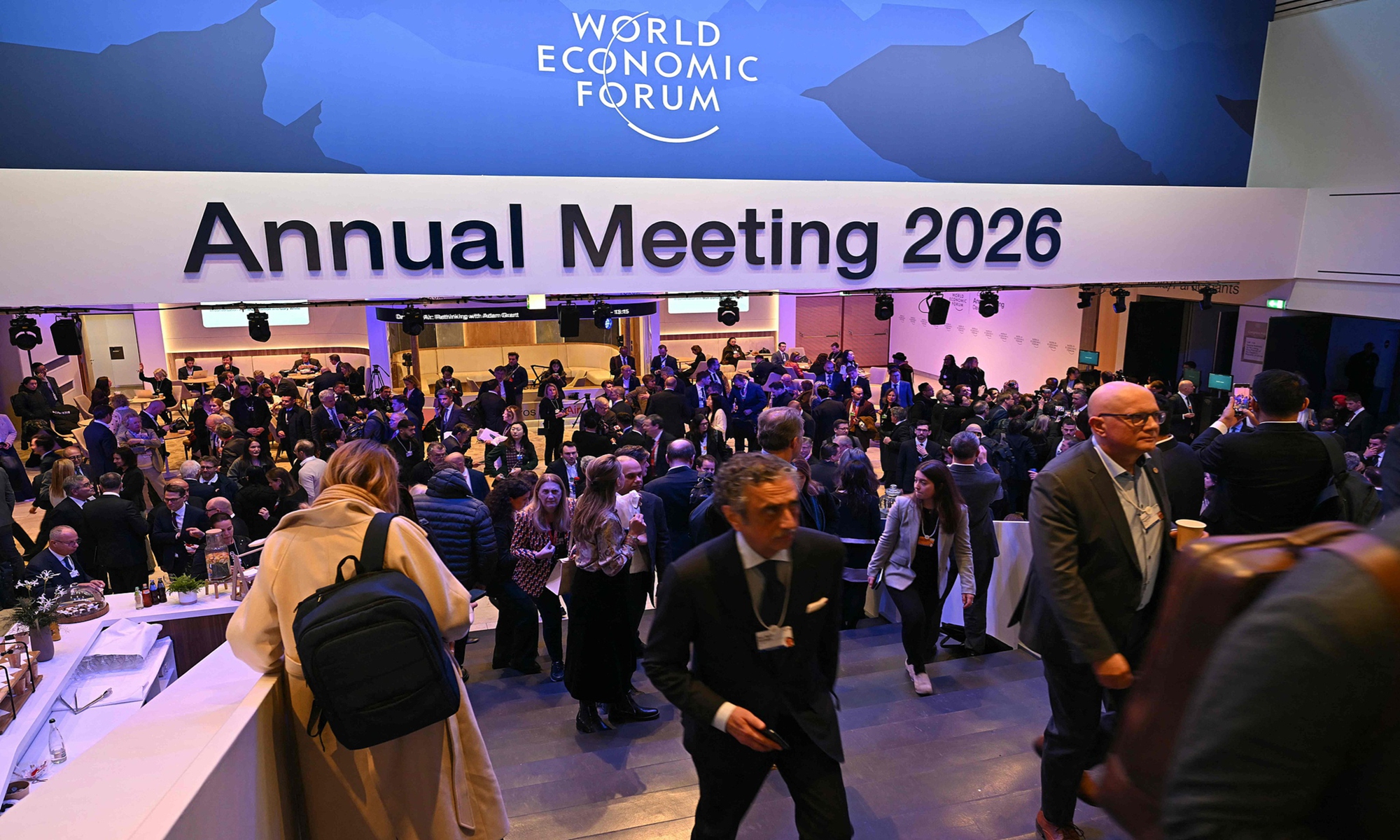
Visitors attend the World Economic Forum (WEF) annual meeting in Davos on January 20, 2026. The World Economic Forum takes place in Davos from January 19 to January 23, 2026. Photo: AFP
Chinese clean energy and high-tech companies are actively participating in the 2026 annual meeting of the World Economic Forum (WEF), which opened on Monday in Davos, Switzerland, where the green transformation and artificial intelligence (AI) have become hot topics, several firms told the Global Times on Tuesday.
Chinese firms' participation in the WEF helps the international community better understand the innovation capabilities and development approaches of Chinese companies, while fostering broader consensus and cooperation on AI governance and the green transformation, a Chinese expert said.
As a "barometer" of the global economy and a "watchtower" for the exchange of ideas, the Davos forum is dedicated to building global consensus and galvanizing collective action, LONGi said in an article shared with the Global Times on Tuesday.
During this year's WEF, the Chinese solar technology giant will participate in multiple dialogues to share its ideas and achievements in energy equity, system transformation and sustainable development, while working with others to explore how technological innovation and global cooperation can help advance the goal of affordable clean energy for all and support a more inclusive, resilient and sustainable global energy future, said the company.
In addition to green development, AI is another hot topic at the forum. On Monday, the WEF released a report highlighting multiple AI applications that are already delivering tangible performance gains, and showing how pioneering organizations are moving beyond pilot projects to achieve AI at scale.
The forum also announced the second cohort of the "AI Application Stars" initiative, featuring 20 pioneering companies that are actively deploying high-impact AI solutions in areas such as disease detection, energy optimization and supply-chain resilience. Several Chinese companies are on the list including CATL, Ant Group and Wumart Group and Dmall (China), for their respective innovation and applications related to AI.
Chinese technology company Envision is participating in this year's WEF. Through multilateral cooperation and technological innovation, the company is actively exploring the convergence of AI and energy to support global prosperity, Zhang Lei, founder and CEO of Envision, told the Global Times.
By advancing Physical AI through breakthroughs such as the Dubhe Energy Foundation Model, and by working with partners including Masdar to accelerate the deployment of AI energy systems, the Chinese firm aims to unlock abundant, affordable renewable energy, align climate action with economic growth, and contribute to a more resilient and sustainable global energy future, said Zhang.
AI-related topics also drew the attention of Gong Rujing, chairperson of Yidu Tech, an industry player in China's AI-driven healthcare sector, who has participated in the forum multiple times, including the ongoing meeting in Switzerland.
Gong told the Global Times that the company focuses on providing medical data infrastructure for hospitals and regulators, and building intelligent agents to improve efficiency for doctors, administrators and researchers.
"Through AI, we can make research and development more efficient and apply these technologies to a broader market," she said, noting that Yidu Tech has built about 400 disease-specific databases to support research into rare and unknown diseases in collaboration with global medical experts.
In an interview with the Xinhua News Agency, Maroun Kairouz, managing director at the World Economic Forum, highlighted China's development in clean energy and AI, noting that these achievements have not only strengthened the resilience of China's economy but also created new opportunities for other countries in areas such as clean energy and technology trade, helping address shared challenges in an uncertain global environment, according to the Xinhua News Agency.
According to a separate Xinhua report, Borge Brende, president of the WEF, also highlighted in an interview that "China's global leadership in the manufacturing of wind turbines and solar equipment, as well as its significant role in electric vehicle production, with BYD and other Chinese EV brands gaining worldwide recognition."
China has clear advantages in AI and the green transformation, Wang Peng, an associate research fellow at the Beijing Academy of Social Sciences, told the Global Times on Tuesday. He said that China's complete industrial system and vast application scenarios support the rapid rollout and scaling of new technologies, while improving policy support and a more favorable business environment encourage companies to increase research and development investment and deepen international cooperation.
"These strengths enable Chinese companies to set domestic examples and contribute more replicable solutions to global efforts on climate change and technology inclusiveness," said Wang.
Such discussions among businesses at this year's WEF also help the international community better understand Chinese companies' innovation capabilities and development approaches, and foster broader consensus and cooperation on AI governance and green transformation, according to the expert.
RELATED ARTICLES