China’s ultra-large market advantages shine as pro-consumption policies boost vitality
Accelerates shift toward consumption-led growth: expert
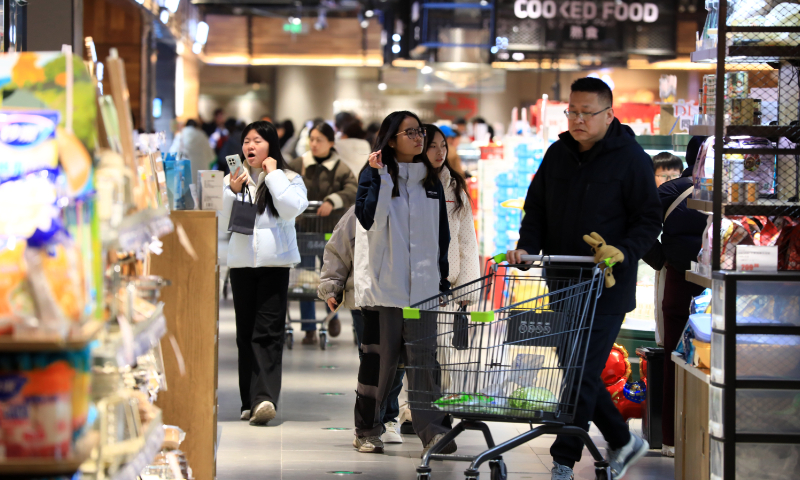
Consumers shop at the food section of a supermarket in Huaian, East China's Jiangsu Province, on December 31, 2025. Photo: VCG
The Ministry of Commerce (MOFCOM) said on Wednesday that, thanks to strong policy support, the advantages of China's super-large market continue to emerge, as shown by newly released retail sales data of 2025.
The ministry also said that retail sales successively reached new milestones of 40 trillion yuan ($7.18 trillion), 45 trillion yuan, and 50 trillion yuan during the 14th Five-Year Plan (2021-25) period, remaining the primary engine of economic expansion.
A Chinese expert said that the nation's development model is accelerating its shift from investment-driven to consumption-driven, and consumption has become a crucial pillar of economic development.
China's total retail sales reached 50.1 trillion yuan in 2025, up 3.7 percent year-on-year, the MOFCOM said, of which the retail sales of goods rose 3.8 percent, while catering sector revenues increased 3.2 percent in 2025. Final consumption expenditure contributed 52 percent to economic growth.
Trade-in programs for consumer goods generated 2.61 trillion yuan in related sales last year. Passenger vehicle sales reached 23.744 million units, up 3.8 percent, with new-energy passenger vehicles accounting for 53.9 percent of the market.
Retail sales of home appliances totaled 1.17 trillion yuan, rising 11 percent and exceeding the level of 1 trillion yuan for a second consecutive year.
Retail sales of sports and recreational goods grew 15.7 percent, driven by strong demand for ice-and-snow, hiking and cycling equipment.
MOFCOM figures showed that sales of smart eyeglasses, smart watches and smart bands on major platforms each surged by more than 40 percent. Cosmetics sales rose 5.1 percent, with "Oriental aesthetics" shaping beauty consumption trends, while gold and jewelry sales climbed by 12.8 percent as products blending traditional cultural elements with modern designs gained popularity among consumers.
Homegrown guochao brands, known as "China-chic," gained widespread popularity last year, with time-honored labels and emerging consumer brands collaborating across sectors to roll out innovative products and consumption scenarios that resonated with shoppers, the ministry said.
The "IP plus consumption" model also gained strong momentum, as sales of movie-related merchandise during the 2025 summer season more than doubled year-on-year, helping fuel a broader consumer boom.
China's development model is accelerating its shift from one driven primarily by investment to one in which consumption plays the leading role, Tian Yun, a Beijing-based economist, told the Global Times on Wednesday.
During the 14th Five-Year Plan period, consumption was able to maintain steady and sustained growth and served as a key pillar of economic development, the result of multiple factors working in tandem, Tian noted.
The national government continued to roll out macro measures to boost consumption and expand domestic demand, spanning fiscal, financial and other policy tools, with a more proactive stance playing a clear role in stabilizing and expanding consumption.
China will formulate and release an implementation plan this year for its strategy to expand domestic demand for the 2026-2030 period, Wang Changlin, deputy head of the National Development and Reform Commission, told a press conference on Tuesday, per Xinhua.
Policies are expected to be strengthened during the 15th Five-Year Plan period, with their effects becoming more pronounced, Tian added.
Releasing consumption potential will require sustained efforts on multiple fronts, including maintaining supportive macro policies, steadily raising household incomes, and further lowering consumption and transaction costs through deeper market integration.
Recent official data showed that China met its full-year GDP growth target, with the economy expanding 5 percent year-on-year to 140.19 trillion yuan in 2025, according to data released by the National Bureau of Statistics on Monday.
Observers noted that the upbeat data underscored the resilience and vitality of the world's second-largest economy despite multiple downward pressures, and this growth momentum will continue to position China as a beacon of stability and the locomotive of the world economy.
"At present, consumption growth is more visibly influenced by changes in the domestic and external environment. Against this backdrop, policy efforts should place greater emphasis on structural adjustment. Specifically, part of the funding previously channeled mainly into infrastructure and real estate should be redirected toward the livelihood sector, with stronger support for forward-looking social spending," according to Tian.
RELATED ARTICLES