Canada’s Carney warns of ‘rupture’ in global order at Davos, seen as veiled reference to Washington; Chinese expert says remarks reflect reassessment of world order under US pressure
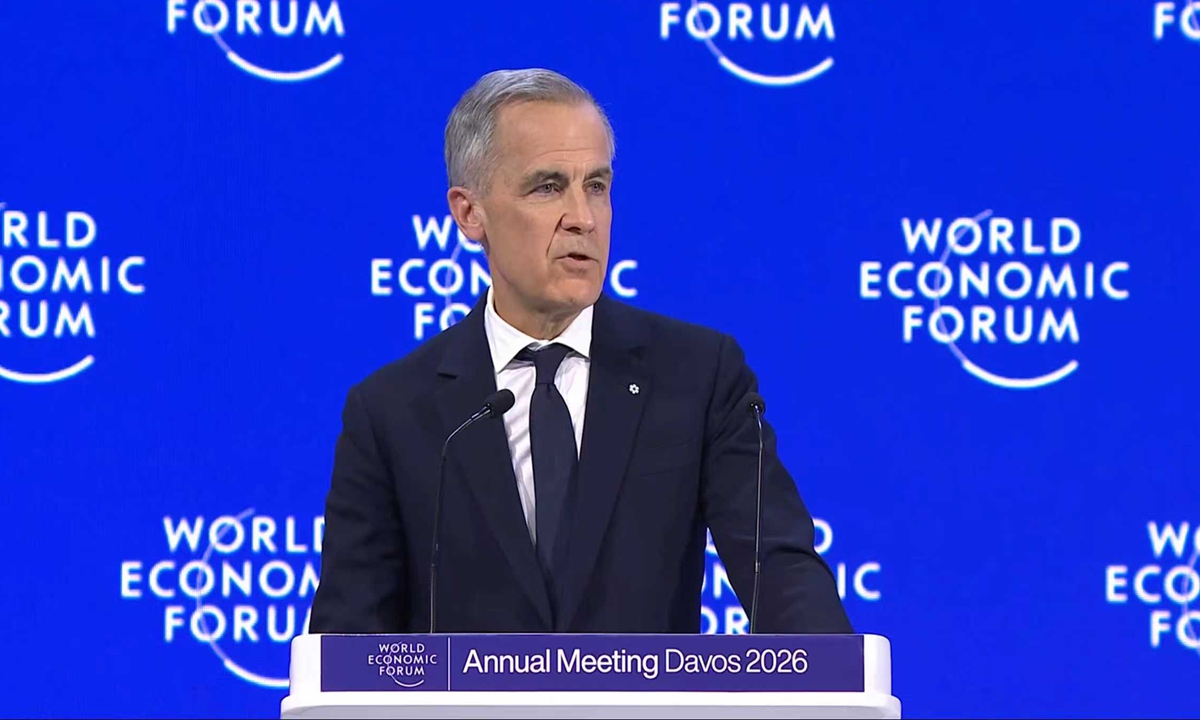
Mark Carney, Prime Minister of Canada, delivers a special address at the annual meeting of the World Economic Forum in Davos, Switzerland, on January 20, 2026. Photo: Screenshot from a video of Carney's speech on the official website of the World Economic Forum.
Canadian Prime Minister Mark Carney on Tuesday delivered a closely watched speech at the World Economic Forum in Davos, Switzerland, warning that the world is "in the midst of a rupture" of the international order and urging middle powers to be both principled and pragmatic, while citing newly concluded strategic partnerships with China and Qatar as part of Canada's efforts to diversify its external relations.A Chinese expert said Carney's remarks suggest that under growing pressure and threats from the US, Ottawa has developed a renewed understanding of both the global order and its relationship with Washington. He noted that the speech carries clear implications within the Western political discourse, adding that Canada's strategic rapprochement with China should not be viewed as a short-term tactical move, but rather as a sign of greater strategic clarity.
Carney's remarks quickly drew wide attention from Western media, many of which interpreted the speech as a pointed reflection on the erosion of the postwar order following US actions in recent years. The New York Times reported that Carney described the end of the era underpinned by US hegemony, calling the current phase "a rupture."
"He never mentioned President Trump by name, but his reference was clear," the newspaper wrote. The BBC and CNN also highlighted the speech, noting that its criticism, though unnamed, was widely read as directed at Washington.
The Global News went further, saying that the "rules-based" international order is collapsing — a collapse driven primarily by the US, which for generations championed that order — a reality that would come as no surprise to people in Venezuela, Greenland or Denmark.
The outlet paired its coverage with an AI-generated image posted by US President Donald Trump on Tuesday, depicting European leaders in the Oval Office while Trump sits behind the Resolute Desk. To Trump's left was a map of the Americas, with Canada — along with Venezuela and Greenland — shown with the stars and stripes of the American flag grafted over them.
Quoting Carney's Davos speech, the BBC said the Canadian leader warned that "great powers have begun using economic integration as weapons, tariffs as leverage, financial infrastructure as coercion, supply chains as vulnerabilities to be exploited."
The broadcaster added that after Trump returned to office, he frequently referred to Canada as the "51st state" and threatened to join Canada and the US through "economic force," before Washington imposed steep tariffs on its northern neighbor and major trading partner.
During his address, Carney went on to elaborate on what he sees as the responsibility of middle powers in the current international environment. "What does it mean for middle powers to live the truth?" Carney said. "First, it means naming reality. Stop invoking rules-based international order as though it still functions as advertised. Call it what it is - a system of intensifying great power rivalry, where the most powerful pursue their interests, using economic integration as coercion."
Carney also addressed Arctic issues, saying, "On Arctic sovereignty, we stand firmly with Greenland and Denmark, and fully support their unique right to determine Greenland's future," while noting that Canada "strongly opposes" tariffs over Greenland. According to the BBC, these remarks drew applause from the audience.
The speech also prompted discussion among journalists and commentators about its authorship. Matina Stevis, Canada bureau chief of the New York Times, wrote on X that Carney wrote his own speech, citing official sources. "It is unusual for a leader to do so for a major speech, normally they give input & have 1 or more speech-writers do it. Although it's quite clear this is Carney through and through to anyone who's been listening to him," she wrote.
Online reactions were largely positive. An account under the handle @politicsusa46 posted a clip of the speech on X, saying, "This is what true global leadership looks like. Canada should be immensely proud today, because they are leading the fight back when others dare not."
Another user, @tparsi, wrote, "Never thought we would hear this level of honesty from a Western leader, and certainly not Canada, given the direction of Canada in the past 25 years. Canada's shift towards multialignment is quite clear — and this level of honesty from Carney on Western 'fiction' about the old order will be warmly welcomed in much of the Global South."
Meanwhile, @rcbregman called it a "riveting, extraordinary and brutally honest speech," adding, "God, I wish we would have European leaders like this."
Carney's address reflected Canada's reassessment of the current international landscape as a middle power. Li Haidong, a professor at China Foreign Affairs University, told the Global Times on Wednesday that Carney's use of the word "rupture" underscored how severe Ottawa judges the situation to be.
From Canada's perspective, the assessment is realistic, Li said, noting that the US has on more than one occasion floated the idea of turning Canada into its 51st state.
"For Canada's own survival, it needs new thinking and new approaches," Li said. "It cannot rely solely on the US and risk losing its strategic autonomy. Instead, it needs more countries to work together."
Li added that Carney's reference to a strategic partnership with China is particularly notable. After his earlier visit to China, Carney had said that Canada's relationship with China had become "more predictable" than its relationship with the US, according to the BBC. "Developing ties with China could be an important part of Canada's effort, as a middle power, to build balance in its external relations," Li said.
As US arrogance and bullying toward European countries increasingly draw attention, Li noted, there is also greater room for coordination between Canada and Europe in their approaches toward Washington. Strengthening China-Canada relations, he added, may also serve as a signal Ottawa is sending to Europe — that engaging more deeply with China could be one way to better balance its position in a shifting global order.
Li further noted that Carney's speech avoided conventional diplomatic platitudes. Instead, he said, it reflected new thinking shaped by real pressure from the US, while also articulating sentiments that resonate deeply within parts of Europe. In this sense, the remarks carry a representative quality, reflecting concerns shared by many Western countries amid mounting uncertainty over the global order.
RELATED ARTICLES