'Tech bazaar' Shenzhen Huaqiangbei draws over 7,000 overseas buyers daily: official report
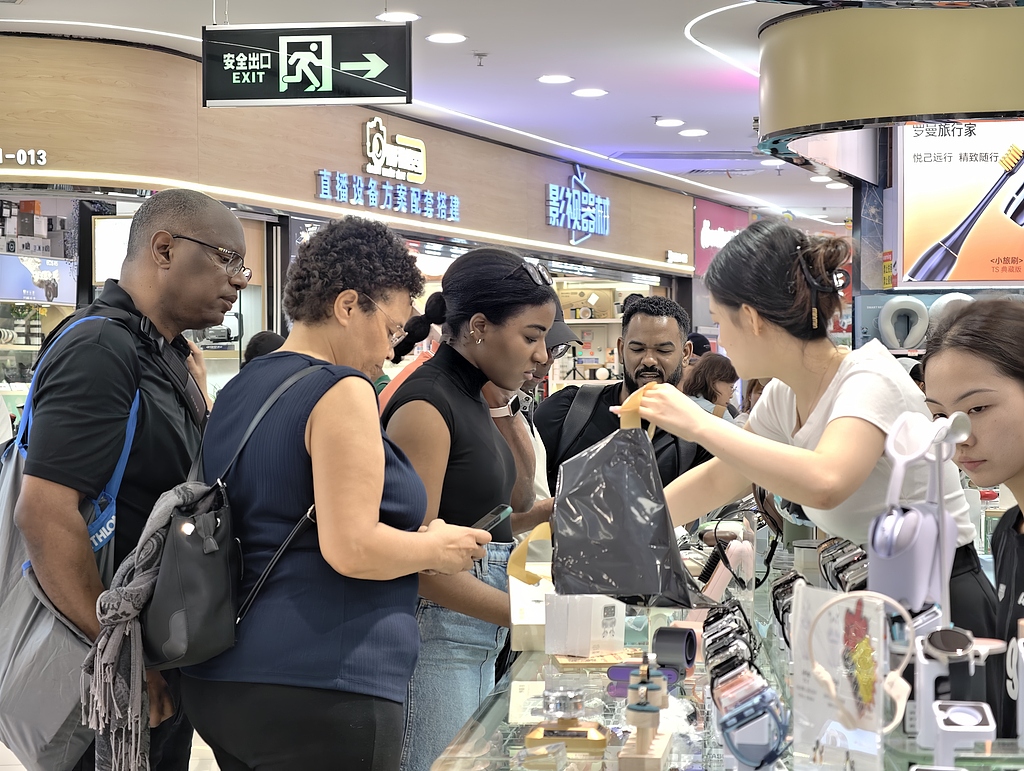
Foreign tourists browse and shop along Shenzhen Huaqiangbei Commercial Street on April 20, 2025. Photo: VCG
The bustling Shenzhen Huaqiangbei - the city's storied electronics bazaar in Shenzhen, South China's Guangdong Province has become a must-visit destination for international buyers and tourists hunting for "made-in-Guangdong" tech. According to a report published Wednesday by Shenzhen Fabu, the city's official WeChat account, the district now attracts thousands of overseas business visitors every day.
Official data showed that the markets record an average daily footfall of roughly 750,000, with foreign buyers exceeding 7,000 — double the year-ago figure — while merchant enquiries and transactions have risen markedly, according to the Shenzhen Fabu report.
Analysts said the surge underscores Shenzhen's momentum in attracting overseas visitors and boosting inbound consumption, serving as a live showcase of China's high-tech supply chain.
Walking into the area, shoppers find drones, AI toys and robots, smart-home appliances, AI glasses, smartwatches, smartphones and 3C accessories crammed into neon-lit booths. The 1.45-square kilometer "electronics town" condenses Guangdong's manufacturing upgrade into a single street.
Merchants and buyers said the area's appeal lies in the concentration of innovative products, rapid supply chains and convenient logistics.
"Our Guangdong-brand Bluetooth earbuds and AI glasses are especially popular with foreign buyers," said Pang, manager of the WJOY shop in Huaqiang Electronics World, noting that nearby factories make restocking fast and flexible — that's the key to Guangdong goods going global.
"Buyers from Southeast Asia and Hong Kong Special Administrative Region are regulars; many return year after year because Guangdong goods offer good value and reliable after-sales service," she added.
"Buyers from Southeast Asia, Australia and the Middle East love AI glasses and drones," said Chen, manager of Shenzhen Yuexinyu Technology, demonstrating their translation and navigation functions. "They see them as practical solutions, and the price advantage is obvious at comparable quality."
Aries, an Indian wholesaler who has sourced from Huaqiangbei for eight years, praised the stability and value of Guangdong-made products and the smooth logistics support that helps him ship to India, Canada and Dubai. "My customers keep reordering; I've never had a quality complaint," he said.
A first-time visitor from Canada, Michael, said he was impressed by the product range and convenience: "I didn't expect to be able to assemble a lighting and electronics package in one stop. These items are innovative and competitively priced."
Local authorities have bolstered the shopping experience with targeted services aimed at international visitors. City officials said a campaign aimed at pushing more Guangdong-made tech into global markets and further positioning Shenzhen as a top destination for tech-minded international shoppers, has helped turbocharge inbound consumption.
To keep the experience frictionless, the Huaqiangbei sub-district has launched the "Guangdong Goods Go Global" spring campaign, unifying promotions across 35 specialized markets. Multilingual signage, an orange-vest volunteer squad, 70 new tax-refund stores and exchange kiosks accepting 19 currencies create what officials call an "international-friendly, borderless block."
The city has introduced measures to facilitate services related to payments, shopping, and transportation, thereby creating an international consumer environment. Officials said Shenzhen will continue to expand the range of high‑tech products eligible for departure tax refunds and to help local enterprises showcase new products and brands on international stages.
For example, Shenzhen's 240‑hour visa‑free transit policy and "immediate refund" departure tax measures have encouraged more "China shopping-oriented travel." Shenzhen municipal data shows that domestic brands' share of departure-tax-refund sales rose by 30.45 percent year-on year in 2024, with homegrown phones and drones accounting for a growing portion of refunded purchases, the Shenzhen Special Zone Daily reported.
City officials see Huaqiangbei's strengths as rooted in the Pearl River Delta's integrated manufacturing ecosystem. The district links Shenzhen with nearby production centers in Dongguan, Foshan and Zhongshan, and is supported by more than 200 logistics nodes that can dispatch orders globally — in some cases, sellers say, from order to shipment within a day.
Annual transaction volume in the business district exceeds 480 billion yuan ($68.9 billion), with an increasing share coming from next-generation products such as smart terminals, drones and robots, according to local media reports.
According to a report by Shenzhen Fabu in July 2025, Shenzhen is committed to enriching its offering of technological products, aiming to include more high-tech items within the scope of departure tax refunds, thus enhancing the technological appeal of products available for tax rebates.
Global Times
RELATED ARTICLES