‘Chinese Trump impersonator’ Ryan Chen goes viral among US netizens during first US trip
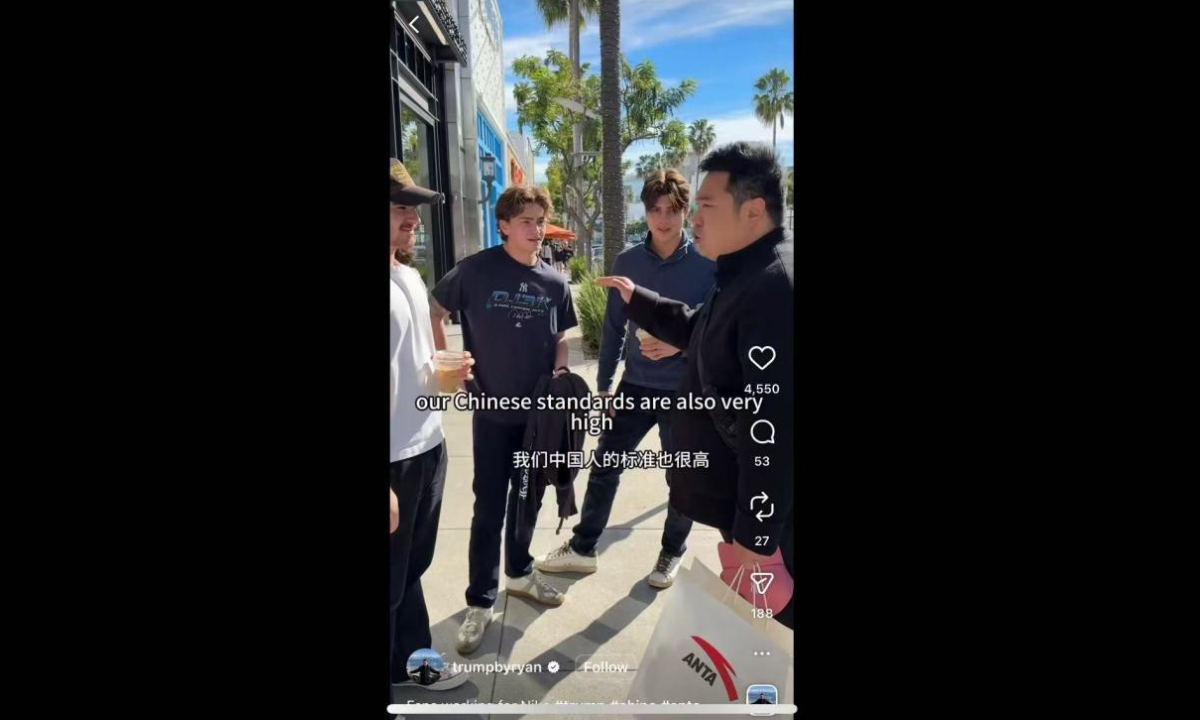
When Ryan Chen walked confidently along a Los Angeles street carrying an Anta shopping bag and struck up a conversation with a US fan who works at Nike, he delivered his lines with calm certainty, exaggerated cadence and unmistakable drawl of US President Donald Trump.
When Ryan Chen walked confidently along a Los Angeles street carrying an Anta shopping bag and struck up a conversation with a US fan who works at Nike, he delivered his lines with calm certainty, exaggerated cadence and unmistakable drawl of US President Donald Trump.
“We are competing with Nike, but it’s a fair competition, right… it’s all about fair competition, free markets, we love free markets, right… Chinese standards are also very high,” Chen said, staying fully in “Chinese Trump” character as his US fans listened.
The performance, which captured Trump’s mannerisms with striking precision, was not delivered by an American comedian, but by a middle-aged man from Chongqing in Southwest China.
Chen Rui, also known online as “Chinese Trump” or Ryan Chen, has become a recognizable English-language internet personality for the past year. His Trump impersonation, complete with signature hand gestures, rhetorical rhythm and exaggerated confidence, has earned him 2 million followers across Chinese and overseas platforms.
The exchange with US fans was just one example of Chen’s video content as a Chinese Trump impersonator during his first US trip in January. After his videos went viral on Instagram, comment sections were filled with welcoming and supportive responses from overseas viewers.
Many foreign netizens were initially drawn to the accuracy of Chen’s accent and physical imitation.
“You literally can transform President Trump’s vocabulary into everyday life situations worldwide, overcoming intercultural differences,” one user commented.
Another example unfolds in a restaurant, beginning with Chen asking his neighbor:“Hello, neighbor—what is that?” The answer comes back: guava. A familiar expression crosses his face—confused, but undeterred. Seconds later, the glass is in his hand. He dismisses the mint leaves as “useless,” saying such things should be “shut down,”all in Trump’s tone. Before the other diner can react, he drains the juice, adds a disclaimer, “I don’t know anything about it”then delivers a verdict: “It’s average.” Standards, he lectures, need to be higher, or “people will take advantage of you.”
The neighbor, visibly unsettled, apologizes. That only prompts another Chen’s question: why apologize, and where are you from? “Canada,” comes the answer. Chen nods, as if the puzzle is solved. “That’s your biggest problem,” he says. “You’re too nice.”
According to South Reviews, the skit’s impact goes beyond the accuracy of the Trump impersonation. Its sharpness lies in how a familiar power dynamic is transplanted into an everyday setting: curiosity as the opening move, ignorance as a shield, possession followed by judgment, and finally, responsibility pushed back onto the other side.
As one Canadian netizen put it, “He explained the current Canada–U.S. relationship in the simplest way possible,”per South Reviews.
Chen’s rise, however, began almost by accident.
It began in January 2025 when Chen was playing a game of truth or dare with friends. After losing a round, he was challenged to imitate Trump and post a video online. He did not expect that casual decision to change his life, according to CNN.
Before that, Chen had experimented with various types of content, English teaching, fitness check-ins, and travel introductions, but attracted little attention. Even carefully edited English-language videos introducing foreign tourist attractions often received fewer than 100 views.
That “punishment” video, however, quickly gained traction. Chen soon began producing Trump-style videos consistently.
A major turning point came in April 2025, when American streamer IShowSpeed visited Chongqing. Chen appeared in a live interaction with him, speaking in what viewers described as “Trump-style English,” leaving the streamer visibly surprised. The clip garnered millions of views, bringing Chen his first wave of widespread attention.
Chen used to work as a business director at a design institute, and what many viewers find particularly striking is that Chen has never studied or lived abroad, nor has he ever visited the US until recently. His English skills were developed largely through watching US TV series such as Friends and repeatedly studying Trump’s speeches, according to media reports.
Wang Lihong, a professor at Beijing Language and Culture University, told the Global Times that Chen’s appeal lies not only in his accent but also in his precise grasp of Trump’s gestures, expressions and rhetorical logic.
Over time, viewers noticed that Chen began using Trump’s exaggerated speaking style to introduce Chinese elements, from Chongqing noodles and hotpot to drone food delivery in Shenzhen and kung fu tea ceremonies in Chengdu.
Wang noted that Chen’s content focuses on small, tangible moments rather than grand narratives: One day he’s eating hotpot in Chongqing; another day he’s filming at Liziba, the viral monorail station that runs through a building.
“Everyday details, what people eat, how cities feel, how technology fits into life, create emotional connection,” Wang said. “The contrast between serious political delivery and ordinary daily scenes has become a defining feature of his videos."
International media have also taken notice. CNN praised his impersonation as “pitch-perfect,” while The New York Times ran a feature titled He’s Never Been to America. But in China, He’s Trump.
One online comment reads: “Voice, 100 percent; gestures, 1,000 percent; performance, 2,000 percent.” Some US viewers have even invited him to visit their cities.
In January 2026, Chen traveled to the US for the first time, visiting Los Angeles and Las Vegas. As of publication, his trip is ongoing, with recent videos showing him at San Francisco’s Golden Gate Bridge.
Maintaining his familiar style, Chen attended the Consumer Electronics Show 2026, interacted with students at the University of Southern California, chatted with fans at Asian restaurants, and handed out red envelopes to younger followers.
Unlike his China-based videos, Chen’s US content often features spontaneous interactions with fans and strangers on the street. Even when conversations touch on potentially sensitive topics, he responds calmly and humorously, often receiving friendly reactions in return.
At one hotel where Chen stayed, a Trump Store was located on-site. Chen filmed several videos there.
In one clip, he greeted a white middle-aged couple and immediately clarified that he was from China before switching into Trump-style speech.
“There used to be a lot of Made in China here,” he said, pausing and nodding in a familiar expression. “But we solved that problem, right?”
He then listed other manufacturing countries: Vietnam, Bangladesh, India, prompting the woman to burst into laughter.
Chen joked about industrial supply chain shifts without targeting anyone directly. The couple responded positively, and they asked to follow him online. Chen concluded with a smile: “For unity and friendship.”
A similar tone appeared in the earlier mentioned exchange with the Nike employee, who joked that Anta and Nike were “adversary”. Chen responded naturally: “It’s a fair competition,” before emphasizing high Chinese standards. The group listened attentively and shook hands afterward.
Comments under the video included “This man could solve global conflicts,” and “He connects people.”
“His interactions feel casual, credible and approachable,” Song Guoyou, deputy director of the Center for American Studies at Fudan University, told the Global Times. “A Chinese individual going abroad and showing Americans a sense of humor and diversity, that itself carries meaning.”
Chen himself remains modest about his intentions.
“I try to keep everything non-political,” Chen said. he just enjoys what he does because laughter bridges barriers, he said.
RELATED ARTICLES