ARTS / CULTURE & LEISURE
China's cultural IPs breathe spirit into hardcore tech innovation
From sea goddess to AI guardians
By Published: Jan 21, 2026 09:50 PM

Editor's Note:
In contemporary China, an increasing number of names draw inspiration from Chinese history and classical texts. From high-tech products to newborns, names offer a window into the nation's rich cultural heritage and ongoing development.
To unpack the allure behind these names, the Global Times launches the Chinese Calling Card trilogy. The second installment will delve into ancient wisdom-inspired names as bridges between ancient wisdom-inspired legacy and futuristic ambition.

Drawing from Mazu, the revered Chinese goddess of the sea who has protected fishermen and seafarers for centuries, the name carries deep roots in China's maritime folklore and coastal culture.
The choice was deliberate and multifaceted. MAZU serves as an acronym for Multi-hazard Alert with Zero-gap and Universal access. In an interesting coincidence, the legendary birthday of Mazu falls on the 23rd day of the third month of the traditional Chinese calendar, which echoes the date for World Meteorological Day, which falls on March 23.
As Hu Ya from the CMA's Publicity and Popularization Center emphasized, this was "not accidental." It reflects a deep recognition of the disaster-prevention wisdom embedded in Mazu culture and a creative integration of outstanding traditional Chinese culture with modern technology.
Luo Jing, a lecturer from Beijing Foreign Studies University, observed that over the past decade, many tech products were keen on using foreign-sounding names, which reflected a cultural mind-set of "catching up" during that specific developmental phase.
"But now, from the BeiDou Navigation Satellite System to MAZU, from the Kunlun chip to the Xuanwu system, these Chinese names are striding confidently to the center of the world stage," said Luo, adding that this trend signifies a shift toward greater cultural confidence and the innovative power of cultural IPs in shaping technological identity.
Cultural decoding
Huawei's product lineup, featuring names like Kirin, Kunpeng, and Hongmeng (HarmonyOS) derived from ancient texts such as Shanhaijing, or The Classic of Mountains and Seas, and the Daoist classic Zhuangzi, have become a cultural signature recognizable in the global tech community.
The Kirin chip, named after a benevolent beast from The Classic of Mountains and Seas, symbolizes auspiciousness, while the Kunpeng server chip, inspired by the immense mythical creatures from Zhuangzi, represents ambitions for breakthroughs in computing power.
Yao Jianbin, director of the Department of Chinese Language and Literature at the Faculty of Arts and Sciences of Beijing Normal University, attributes this phenomenon to the manifestation of Chinese companies' cultural consciousness.
"From a simple Sino-foreign comparison, we can see that foreign companies actually provide some relevant cases in this regard," Yao told the Global Times. "For instance, German cars use names from ancient Greek mythology, and Japanese companies use names like 'Odyssey.' This is actually a common strategy for enterprises worldwide to enhance the cultural connotations of their products."
In the naming practices of Chinese tech companies, Yao identifies a threefold logic: "First, it demonstrates a company's sense of cultural responsibility; second, it expresses the commitment to promote, protect, and propagate their own national culture; and third, it is a crucial move to add cultural depth and enhance the cultural character of their own products."
Names are chosen for their poetic resonance, symbolic depth, and ability to convey ambition such as transformation, harmony, or boundless potential. This approach contrasts sharply with Western tech naming conventions like the simplicity of Apple.
Ying Jinfei, director of the Zhejiang Art Museum, curated The New Classic of Mountains and Seas: Online Art Exhibition on Contemporary Art on Original Chinese Myths and Legends. He has a profound understanding of the modern transformation of mythological IPs.
"The core of global dialogue lies in finding common ground and points of connection," Ying told the Global Times on Tuesday. "Various myths and legends are also something all humanity can understand and accept. Names from these myths are carefully considered, not simply borrowed and used without thought."
Baidu's flagship AI model Wenxin Yiyan draws from Wenxin Diaolong, or The Literary Mind and the Carving of Dragons, an ancient literary critique emphasizing heartfelt expression, while Hunyuan, Tencent's large language model embedded in WeChat, is inspired by the Daoist concept of primordial chaos, akin to the universe's origin.
'Leading the way'
In China, the naming aligns with a broader cultural revival. The practice of transforming cultural symbols into modern identifiers - exemplified by Kunpeng soaring through the skies, BeiDou guiding the way, and Hongmeng (HarmonyOS) heralding a new beginning - signals a shift in the cultural mind-set accompanying Chinese technology's journey from "catching up" to "leading the way."
Yao emphasized that "Chinese companies consciously using classical names from traditional culture is one of the most significant signals of cultural revival. Cultural confidence means having the courage to present our own cultural calling cards, allowing the world to understand China."
He cites the Kunlun chip, named after the mysterious Kunlun Mountains in Chinese mythology, as a prime example: "The name 'Kunlun' naturally sparks curiosity about the mythological system behind it, which has inspired many contemporary fantasy novels. Naming it 'Kunlun' precisely reflects the courage to tell China's stories well."
More notably, these names often stimulate international users' curiosity and their willingness to explore the Chinese culture.
Ying added from the perspective that "myths and legends are cultural forms universally understandable and acceptable to all humanity. Names based on these possesses inherent advantages for international cultural exchanges and communication."
In contemporary China, an increasing number of names draw inspiration from Chinese history and classical texts. From high-tech products to newborns, names offer a window into the nation's rich cultural heritage and ongoing development.
To unpack the allure behind these names, the Global Times launches the Chinese Calling Card trilogy. The second installment will delve into ancient wisdom-inspired names as bridges between ancient wisdom-inspired legacy and futuristic ambition.
An AI-generated image of a chip Illustration: VCG
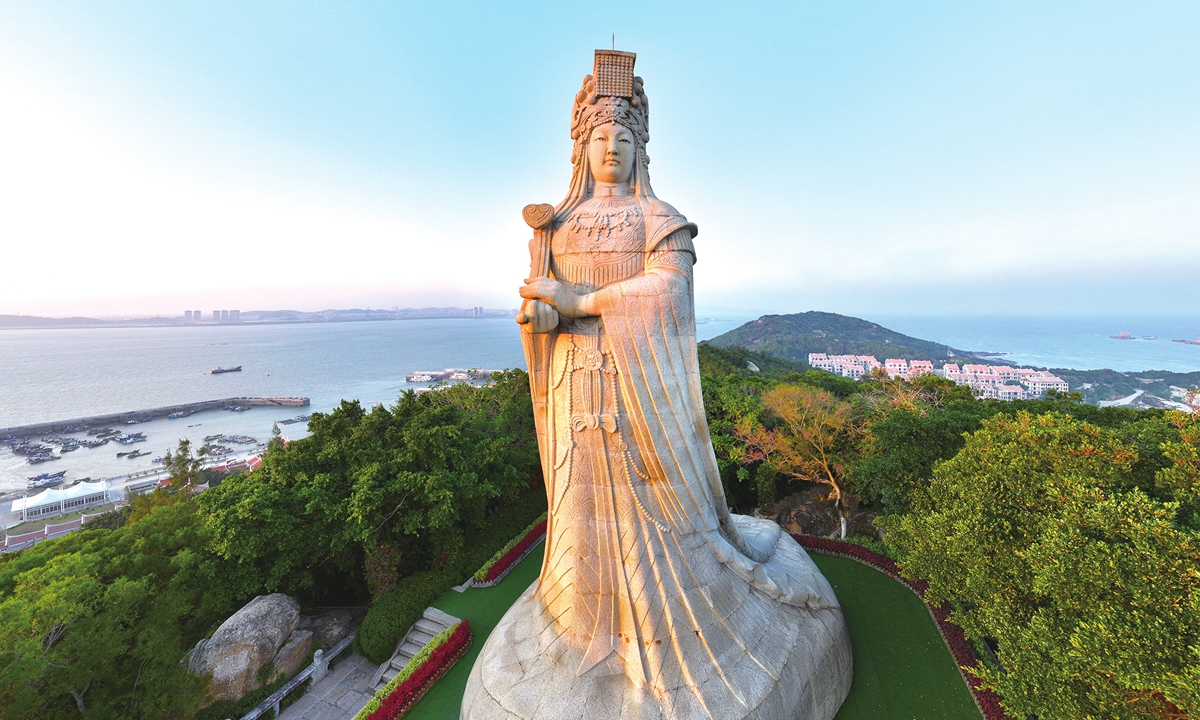
At the World Artificial Intelligence Conference (WAIC) held in Shanghai in July 2025, the China Meteorological Administration (CMA) unveiled its AI-powered public early warning system named MAZU.Drawing from Mazu, the revered Chinese goddess of the sea who has protected fishermen and seafarers for centuries, the name carries deep roots in China's maritime folklore and coastal culture.
The choice was deliberate and multifaceted. MAZU serves as an acronym for Multi-hazard Alert with Zero-gap and Universal access. In an interesting coincidence, the legendary birthday of Mazu falls on the 23rd day of the third month of the traditional Chinese calendar, which echoes the date for World Meteorological Day, which falls on March 23.
As Hu Ya from the CMA's Publicity and Popularization Center emphasized, this was "not accidental." It reflects a deep recognition of the disaster-prevention wisdom embedded in Mazu culture and a creative integration of outstanding traditional Chinese culture with modern technology.
Luo Jing, a lecturer from Beijing Foreign Studies University, observed that over the past decade, many tech products were keen on using foreign-sounding names, which reflected a cultural mind-set of "catching up" during that specific developmental phase.
"But now, from the BeiDou Navigation Satellite System to MAZU, from the Kunlun chip to the Xuanwu system, these Chinese names are striding confidently to the center of the world stage," said Luo, adding that this trend signifies a shift toward greater cultural confidence and the innovative power of cultural IPs in shaping technological identity.
The giant Mazu statue in Putian, East China's Fujian Province Photo: IC
Cultural decoding
Huawei's product lineup, featuring names like Kirin, Kunpeng, and Hongmeng (HarmonyOS) derived from ancient texts such as Shanhaijing, or The Classic of Mountains and Seas, and the Daoist classic Zhuangzi, have become a cultural signature recognizable in the global tech community.
The Kirin chip, named after a benevolent beast from The Classic of Mountains and Seas, symbolizes auspiciousness, while the Kunpeng server chip, inspired by the immense mythical creatures from Zhuangzi, represents ambitions for breakthroughs in computing power.
Yao Jianbin, director of the Department of Chinese Language and Literature at the Faculty of Arts and Sciences of Beijing Normal University, attributes this phenomenon to the manifestation of Chinese companies' cultural consciousness.
"From a simple Sino-foreign comparison, we can see that foreign companies actually provide some relevant cases in this regard," Yao told the Global Times. "For instance, German cars use names from ancient Greek mythology, and Japanese companies use names like 'Odyssey.' This is actually a common strategy for enterprises worldwide to enhance the cultural connotations of their products."
In the naming practices of Chinese tech companies, Yao identifies a threefold logic: "First, it demonstrates a company's sense of cultural responsibility; second, it expresses the commitment to promote, protect, and propagate their own national culture; and third, it is a crucial move to add cultural depth and enhance the cultural character of their own products."
Names are chosen for their poetic resonance, symbolic depth, and ability to convey ambition such as transformation, harmony, or boundless potential. This approach contrasts sharply with Western tech naming conventions like the simplicity of Apple.
Ying Jinfei, director of the Zhejiang Art Museum, curated The New Classic of Mountains and Seas: Online Art Exhibition on Contemporary Art on Original Chinese Myths and Legends. He has a profound understanding of the modern transformation of mythological IPs.
"The core of global dialogue lies in finding common ground and points of connection," Ying told the Global Times on Tuesday. "Various myths and legends are also something all humanity can understand and accept. Names from these myths are carefully considered, not simply borrowed and used without thought."
Baidu's flagship AI model Wenxin Yiyan draws from Wenxin Diaolong, or The Literary Mind and the Carving of Dragons, an ancient literary critique emphasizing heartfelt expression, while Hunyuan, Tencent's large language model embedded in WeChat, is inspired by the Daoist concept of primordial chaos, akin to the universe's origin.
'Leading the way'
In China, the naming aligns with a broader cultural revival. The practice of transforming cultural symbols into modern identifiers - exemplified by Kunpeng soaring through the skies, BeiDou guiding the way, and Hongmeng (HarmonyOS) heralding a new beginning - signals a shift in the cultural mind-set accompanying Chinese technology's journey from "catching up" to "leading the way."
Yao emphasized that "Chinese companies consciously using classical names from traditional culture is one of the most significant signals of cultural revival. Cultural confidence means having the courage to present our own cultural calling cards, allowing the world to understand China."
He cites the Kunlun chip, named after the mysterious Kunlun Mountains in Chinese mythology, as a prime example: "The name 'Kunlun' naturally sparks curiosity about the mythological system behind it, which has inspired many contemporary fantasy novels. Naming it 'Kunlun' precisely reflects the courage to tell China's stories well."
More notably, these names often stimulate international users' curiosity and their willingness to explore the Chinese culture.
Ying added from the perspective that "myths and legends are cultural forms universally understandable and acceptable to all humanity. Names based on these possesses inherent advantages for international cultural exchanges and communication."
RELATED ARTICLES