GT Voice: South Korean deal shows China’s EV sector opens new co-op opportunities
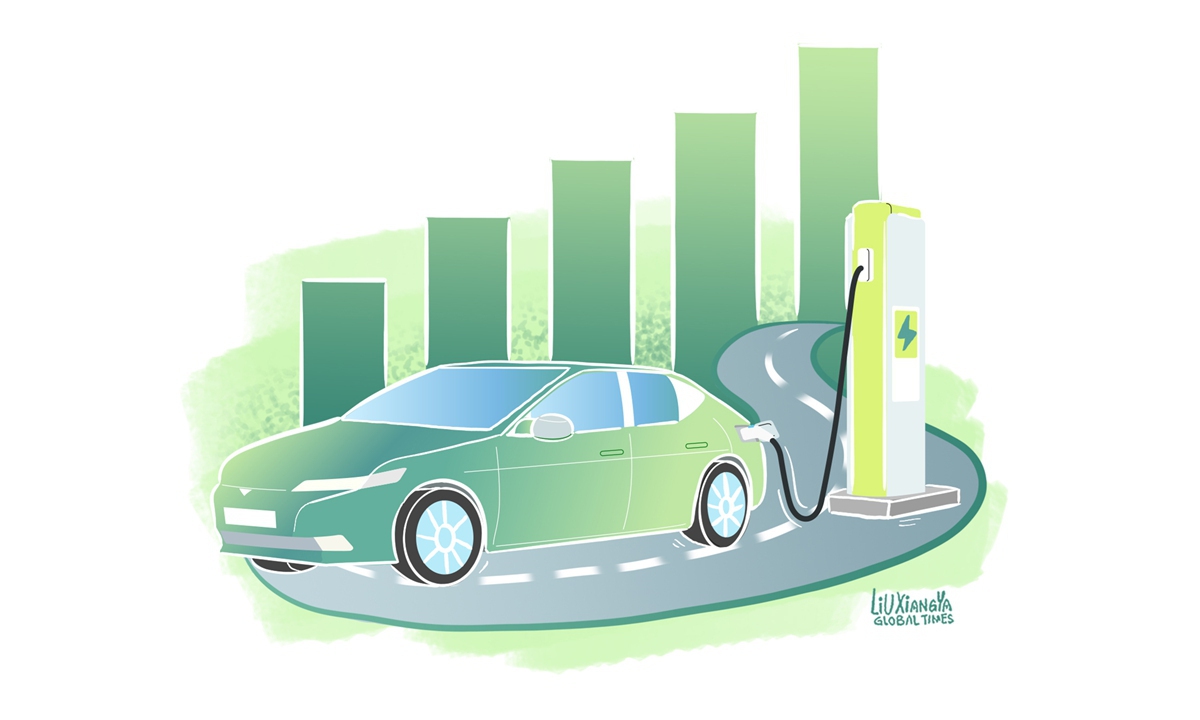
Illustration: Liu Xiangya/GT
South Korea-based Samsung Display Co said on Wednesday that it is supplying three types of organic light-emitting diode (OLED) panels for automotive displays to Chinese electric vehicle (EV) manufacturer Zeekr, according to the Yonhap News Agency.At first glance, this may seem like an ordinary cross-border component purchase. However, when placed in the broader context of the global auto industry's electrification shift, its significance runs much deeper. At a time when certain Western observers still cast doubt on China's EV development, this kind of partnership offers a timely reminder that instead of being confined to a zero-sum narrative of competition, a more constructive perspective is warranted - one that recognizes the vast and promising opportunities for collaboration being unlocked by the rise of China's EV sector.
The reported cooperation between Samsung Display and Zeekr is by no means an isolated case, but a microcosm of the open ecosystem of China's EV supply chain. Cooperation between Chinese EV makers and international suppliers such as Germany's Bosch and Continental, and Canada's Magna has become common. These partnerships highlight how the maturity and openness of China's EV supply chain are generating tangible commercial opportunities for international businesses. Instead of dwelling solely on competitive concerns, a more balanced view recognizes that the industrial ecosystem shaped by China's EV advancement is continually attracting worldwide partners, collaborating to drive both technological progress and market evolution.
The sheer scale and dynamism of China's market make it both a testing ground and an accelerator for collaboration between domestic EV manufacturers and international suppliers. As the world's largest new-energy vehicle (NEV) market for years, China is driving fast-evolving consumer demand for intelligent and premium features, creating an ideal environment to experiment with innovation in relevant technologies such as driver assistance, batteries and charging systems.
This deep technical synergy drives the development of more competitive products. China's EV ecosystem is a co‑innovation hub that can boost the global competitiveness of participating companies.
China has become a crucial link in the global layout of many international auto parts giants. In November, Magna strengthened its presence in China with a new facility in the Jiujiang Economic Development Zone, Wuhu in East China's Anhui Province to support the growing demand for electric drive systems, starting with Chery and positioned to serve additional automakers in the future, according to a release on its website.
Moreover, Bosch Mobility grew by 4 percent year-on-year to 116.6 billion yuan ($16.74 billion) in China in 2024, accounting for more than 80 percent of Bosch's sales revenue in the country. More than 65 percent of the new orders that Bosch Mobility won in China were in two areas of future importance: electrified power trains and software-defined cars, according to the company. These figures offer tangible proof of the importance of China's EV development to international suppliers.
There is no denying that after more than a decade of development, China has occupied a key position in the global NEV supply chain, which has brought efficient and large-scale industrial capabilities. However, this does not make it a closed ecosystem. As a product of high technological integration, the complexity of EVs determines that no single company or country can cover all core technical links. A truly mature industrial ecosystem stems not only from innovation, but also from the ability to efficiently integrate the world's best technological resources.
Therefore, the skepticism and wariness expressed by some Western public opinion makers essentially reflects the neglect or misunderstanding of the comprehensive competitiveness and openness of China's EV industrial chain. The rise of China's EV industry is not built upon technological isolation or market protection but is rooted in a full-chain capability forged by deeply integrating into the global divisions of labor and fierce market competition.
In this sense, for the global industry and policymakers, regarding the rise of China's EV sector as merely a challenge represents a limited perspective and a waste of opportunities.
As China's EV sector climbs to higher value chains and expands into broader global markets, the cross-border cooperation it inspires will undoubtedly deepen and broaden, moving beyond component supply toward joint research and development, shared standards, and co-created solutions for the next generation of mobility. Ultimately, the future of automotive transformation will be determined by partners who recognize openness, integration, and mutual gain as the true engines of sustainable progress.
RELATED ARTICLES