China’s agricultural modernization gains pace in 2025, backed up with modern technologies: official
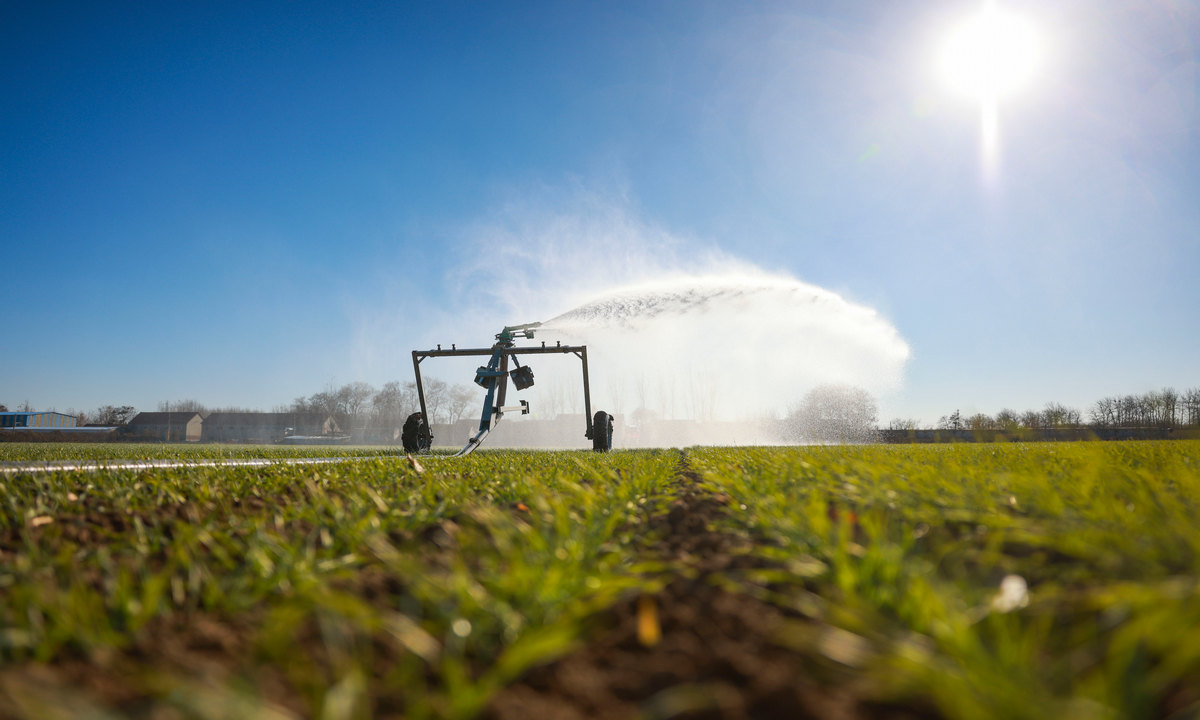
A sprinkler irrigates crops in Dongying, East China's Shandong Province on November 27, 2025. Photo: VCG
In 2025, China’s agricultural modernization gained pace with strengthened technological support, and the contribution rate of agricultural scientific and technological progress exceeding 64 percent, Zhang Xingwang, vice minister of China’s Ministry of Agriculture and Rural Affairs, told a press conference on Thursday.
Efforts to revitalize the seed industry have progressed steadily, with the proportion of area planted with domestically self-bred crop varieties exceeding 95 percent. The market share of domestic seed sources for livestock and poultry, aquatic products, and vegetables has reached 80 percent, 86 percent, and 91 percent, respectively, Zhang noted.
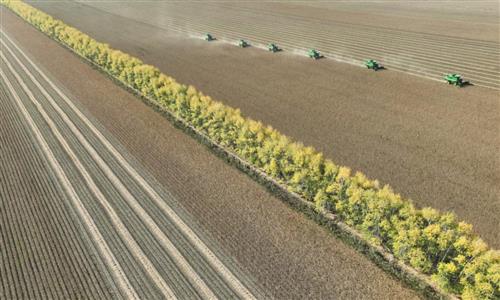
Research and development and application of agricultural machinery have advanced rapidly, pushing the comprehensive mechanization rate of crop cultivation, planting, and harvesting to 76.7 percent. The number of agricultural drones exceeds 300,000 and annual operating area exceeds 460 million mu (30.67 million hectares), Zhang added.
Zhou Yunlong, an official from the ministry’s science and tech department, said that last year, the ministry enhanced the overall effectiveness of the agricultural sci-tech innovation system, and reinforced agricultural enterprises with technological innovation.
Major breakthroughs have been achieved in basic research. According to Zhou, the country has unraveled the mystery of how a single somatic cell transforms into a complete plant, providing brand-new theoretical support for genetic improvement and efficient regeneration of crops. In addition, the world’s first heat-tolerant gene in rice has been cloned, offering a new solution for achieving stable and high-quality rice production under high-temperature conditions.
Frontier research also reaped major breakthroughs, including original breakthroughs realized in agricultural bio-manufacturing, Zhou said, adding that the layout of “AI + Agriculture” has been accelerated, with large models for smart agriculture continuously iterated and applied.
In addition, breakthroughs have been achieved in the R&D of new-energy agricultural machinery, which help effectively alleviate the problems of “no suitable machinery available” in some fields in hilly and mountainous areas. The R&D and application of agricultural robots have also accelerated, with key breakthroughs underway, Zhou said.
“Currently, modern technologies are being applied more widely in agriculture. We will continue to promote the application of artificial intelligence and other technologies in the agricultural sector, expanding the use of drones, the Internet of Things, robots, and other scenarios to make production more precise and efficient,” Zhang, the vice minister, said.
Global Times
RELATED ARTICLES