US House panel reportedly approves bill on AI chip exports; move only shows US anxiety about China’s tech rise: expert

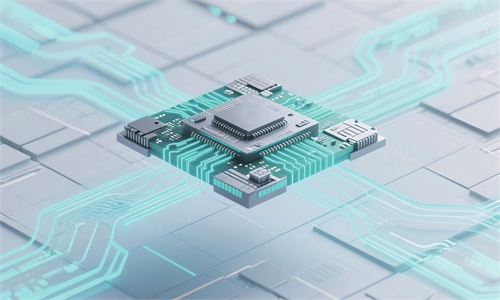
chip Photo:VCG
A US House committee focused on foreign affairs approved bipartisan legislation Wednesday that calls for arms-sale style congressional oversight of advanced artificial intelligence (AI) chip exports, Bloomberg reported. A Chinese experts said that the US move is another attempt to curb the development of China's AI industry, reflecting its increasingly anxious about China's progress in high-tech sectors.
According to Bloomberg, under the legislation, named ''AI OVERWATCH Act," the administration would be required to notify Congress of advanced AI chip sales before they're approved, giving lawmakers the power to review and block export licenses to China, Russia, Iran, and other so-called adversaries through a joint resolution. Beyond oversight, the text endorsed by the panel's Republicans and Democrats would outright ban sales of Nvidia's more advanced Blackwell chips to China for at least two years, codifying existing export controls into law.
"This move is yet another attempt to curb the development of China's chip industry, with its consistent 'small yard, high fence' policy," Zhou Mi, a senior researcher at the Chinese Academy of International Trade and Economic Cooperation, told the Global Times on Thursday, noting that it also reflected that some US politicians are becoming increasingly anxious about China's progress in AI and other high-tech fields.
According to Bloomberg, the panel approved the bill by a 42-2 margin. It now heads to the House for a floor vote.
Zhou said that this bill currently still requires consideration and approval by the full House of Representatives and the Senate, and ultimately submission to the US President for signature, which remains a significant uncertainty.
White House AI Czar David Sacks has publicly criticized the bill. Sacks and other Trump administration officials claimed that selling in China's market will encourage foreign companies to become reliant on American technology, boosting US leadership, Bloomberg reported.
"Chip exports to China have become a political football for the US administration, Congress, and both parties alike," said Ma Jihua, a veteran telecom industry analyst.
Xiang Ligang, director-general of the Beijing-based Information Consumption Alliance, told the Global Times that the fundamental attitude of this legislation remains one of "defense" and "blockade", with the aim of maintaining US technological superiority through such restrictive measures. "This approach reveals that some US politicians want to continue to pursue technological containment and blockade against China, while some seek to open up and profit from the Chinese market," Xiang noted.
Li Haidong, a professor at China Foreign Affairs University, told the Global Times on Thursday that the US seeks to both promote the development of its domestic semiconductor industry and prevent advanced related technologies from falling into the hands of countries which are not its "allies". "This represents an extremely challenging policy dilemma," Li said.
On the one hand, excessive regulation and export controls risk slowing the pace of US advancements in cutting-edge AI semiconductors. On the other hand, the rapid pace of technological iteration means that overly stringent controls could delay innovation cycles, reduce capital investment inflows, and ultimately erode the US share of the international market for these technologies, Li warned.
Ma noted that in the face of the US' erratic and frequently shifting policies in the chip sector, China's semiconductor industry will continue to firmly adhere to independent intellectual property rights, self-reliance and controllability, prioritizing domestic solutions, and sustained innovation — calmly and confidently responding to external policy shocks.
RELATED ARTICLES