Building block toys make big business
'Technology plus culture' is reshaping domestic consumption patterns
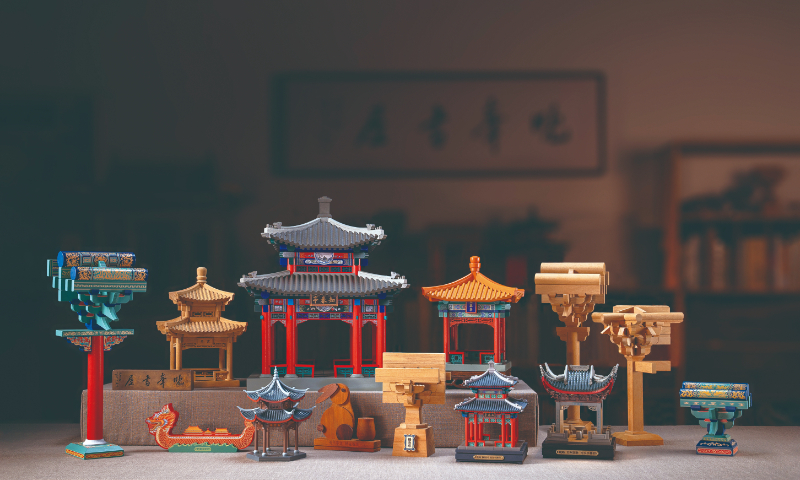
Miniature models of ancient Chinese building assembled from mortise-and-tenon toy building blocks, designed by Wanfeng Chinese Ancient Architecture Building Blocks. Photo: Courtesy of Liu Wenhui
When 23-year-old Wang Jihua spent 260 yuan ($37.3) on a mortise-and-tenon toy building block recreating Xi'an's Bell Tower (Northwest China's Shaanxi Province), he said that he was not just buying a toy.
"When it stands up on its own, you suddenly understand why ancient builders designed it this way," Wang told the Global Times. "It's not just about finishing a model, but about seeing how structure, force and beauty could come together."
Working in the technology sector, Wang said that he was drawn to domestic toy building blocks that combine engineering logic with Chinese culture. "The update speed is incredibly fast," he said.
Recently, domestic building block toys have emerged as an unexpected bridge between culture and consumption in China. Industry analysts told the Global Times that building block products based on traditional Chinese ancient building structures such as dougong, China's bracket system, also a hallmark mortise-and-tenon structure in Chinese ancient building, have grown into a market worth more than 100 million yuan.
Integrating with culture
Dating back to the Spring and Autumn period (770BC-476BC) and Warring States period (475BC-221BC), dougong has historically dispersed the immense weight of large roofs through layered wooden components. Today, it has found new expression in the hands of modern consumers as a highly sought-after building block display piece.
For Fang, a retired worker in his 60s, the appeal lies in rediscovering traditional culture through hands-on engagement.
The hand-crafted mortise-and-tenon building block toys he purchased struck him as a perfect balance between challenge and enjoyment, with traditional culture itself being the main reason behind his decision, Fang told the Global Times.
"They're easy to follow, but there's just enough difficulty to keep you fully engaged," Fang said. "I spent several hours assembling the model, and finishing it gave me a real sense of accomplishment."
What impressed him most was how cultural heritage was brought to life through designing. "When traditional culture can be touched, assembled and appreciated up close, it becomes truly alive again," Fang said.
Such consumer enthusiasm has translated into tangible market growth.
Liu Wenhui, founder of Wanfeng Chinese Ancient Architecture Building Blocks, a leading producer of Chinese architecture-themed building blocks, told the Global Times that his company's annual sales rose from about 100,000 yuan in 2017 to more than 10 million yuan in 2025.
At present, the company's product lineup includes more than 60 models. In terms of historical scope, it spans well-known extant architectural heritage sites from the Tang to the Qing dynasties; in terms of product types, it covers dougong structures, complete mortise-and-tenon architectural models, and ancient architecture-inspired home decor items.
As policies supporting intangible cultural heritage innovation and cultural tourism development have gained traction in recent years, more players have entered the niche. "When we started, there was basically only one company producing ancient architecture mortise-and-tenon building blocks," Liu said. "Now there are more than a dozen, and the category's overall market size has already exceeded several hundred million yuan."
At the heart of the business, Liu said, is the balance between tradition and innovation.
"The biggest challenge was never the technique itself," Liu said. "It was understanding how people in different dynasties perceived beauty, and how we translate that understanding for today's players."
That process, Liu added, has required countless rounds of testing, field research and redesign. The combination of cultural value and economic impact is built through repeated attempts, he said.
Other manufacturers are also exploring how traditional architecture can be translated into industrial production in a measured and sustainable way.
Li Jie, general manager of Guangdong Baoge Educational Material Sci-Tech Co, a China-based building block producer, told the Global Times that conventional building block components are incapable of accurately reproducing complex or circular architectural structures such as the Temple of Heaven. "To truly restore these buildings, we had to redesign the components from scratch," Li said.
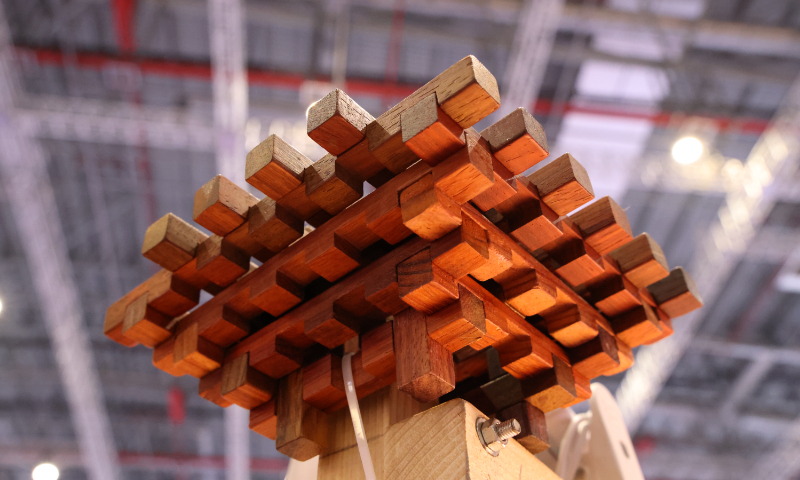
Building blocks assembled with mortise-and-tenon structure is showcased at the Yangtze River Delta International Cultural Industries Expo in Shanghai on November 21, 2025. Photo: VCG
Beyond traditional architectural culture, the rise of domestic building blocks is evident across a wide range of cultural fields. By actively exploring market demand and integrating new technologies into production, companies are carving out entirely new consumer segments.
Guangdong Sembo Cultural industrial Co (Sembo), a leading domestic manufacturer of modern, Chinese military-themed building blocks, told the Global Times that in 2025, the brand accelerated product innovation and carried out a comprehensive upgrade of its product lineup. New technologies - including Type-C rechargeable multicolor ambient lighting and afterburner-style visual effects - were introduced to selected models, seamlessly blending modern aesthetics with building block innovation.
Following its launch, the translucent-color version of the J-35 stealth fighter building block model generated sales of more than 1.5 million yuan as of Thursday, data from Sembo showed.
In August 2025, Sembo partnered with a cultural and creative industry company and the Communication University of China to produce a military parade-themed video, recreating iconic parade scenes through building blocks as a form of cross-sector creative expression. The video attracted more than 20 million views across online platforms.
As such products grow more sophisticated, they are laying the groundwork for a broader shift in public consumption.
Consumption upgrading
Currently, more than 1,400 ancient Chinese architecture-themed building block products are listed on JD.com, one of China's leading e-commerce platforms. Some affordable models, such as mortise-and-tenon sets recreating the Hall of Prayer for Good Harvests at the Temple of Heaven in Beijing, have recorded monthly sales of hundreds of sets per store, with prices around 200 yuan.
"Building blocks have long been a popular educational product with a stable user base. That foundation has made it possible for the category to upgrade from toys to cultural consumer goods integrating hard technology and traditional elements," Zhang Yi, CEO and chief analyst at consultancy iiMedia Research, told the Global Times on Thursday.
As incomes rise, especially among urban residents, market demand has increasingly shifted toward products offering cultural depth and emotional value, said Zhang.
"The multi-scenario attributes significantly expand the adult consumer base," Zhang said, adding that they generate new demand rather than merely replacing existing toy consumption.
Zhang said that as intelligent technologies continue to be embedded into products - through mechanical linkage, lighting systems and interactive design - their participation value and entertainment appeal are rising, supporting higher price points and a broader market.
From a macro perspective, he said, such innovation-driven consumption is increasingly important. "New forms of consumption are essential to driving market demand. This trend contributes not only to consumption growth, but also to employment, technological innovation and manufacturing upgrading," Zhang said.
"These products are rooted in China's architectural heritage and are difficult to replicate elsewhere," he said, noting that presenting traditional culture in forms consumers are willing to buy would create a virtuous cycle between inheritance and commercial sustainability.
For Liu, however, the meaning of this trend ultimately goes beyond market size or sales figures.
"When someone finishes assembling a toy set and still wants to look at it again and again, culture is no longer merely preserved - it is truly alive, and that's when it begins to generate lasting economic value," said Liu.
RELATED ARTICLES